Isaiah 41:14–20
The NET BibleOther versions
English
- NET The NET Bible
- DARBY 1890 Darby Bible
- ASV American Standard Version
- AV 1873 The Cambridge Paragraph Bible of the Authorized English Version
- CSB Christian Standard Bible
- D-R Douay-Rheims Bible
- ESV English Standard Version
- GW GOD’S WORD Translation
- GNB Good News Translation
- HCSB The Holman Christian Standard Bible
- KJV 1900 King James Version
- LSB Legacy Standard Bible
- LEB The Lexham English Bible
- MSG The Message: The Bible in Contemporary Language
- NASB95 New American Standard Bible (1995)
- NCV New Century Version
- NIrV New International Reader’s Version (1998)
- NIV New International Version (2011)
- NKJV The New King James Version
- NLT New Living Translation
- NRSVue New Revised Standard Version: Updated Edition
- RSV The Revised Standard Version
- RSVCE The Revised Standard Version, Catholic Edition
- TNIV Today’s New International Version
- YLT Young’s Literal Translation
Arabic
Czech
French
German
Hebrew
Hungarian
Italian
Korean
Latin
Portuguese
Russian
Simplified Chinese
Spanish
Traditional Chinese
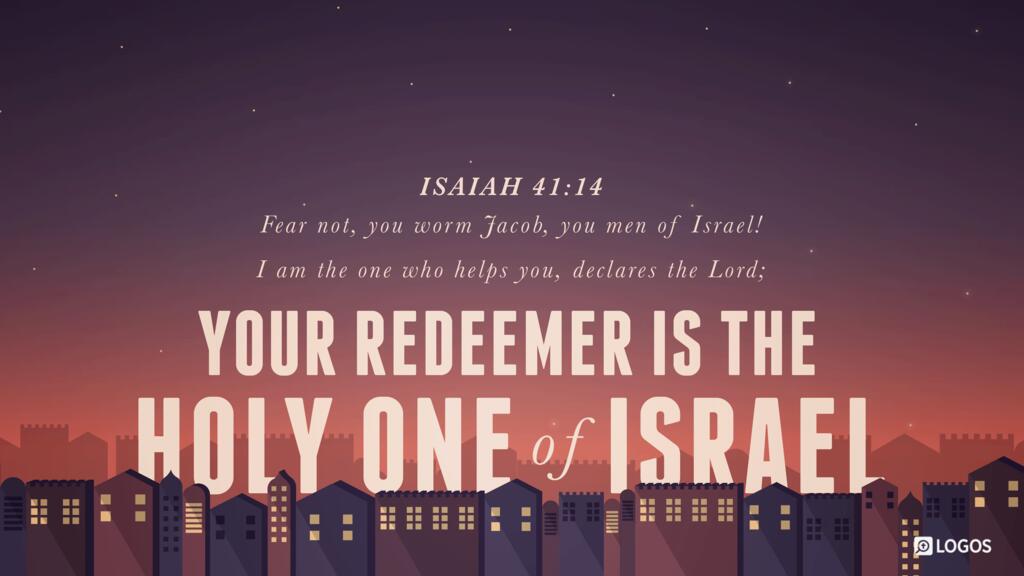
41:14Don’t be afraid, despised insignificant Jacob,27
men of28 Israel.
I am helping you,” says the Lord,
your protector,29 the Holy One of Israel.30
41:15“Look, I am making you like31 a sharp threshing sledge,
new and double-edged.32
You will thresh the mountains and crush them;
you will make the hills like straw.33
41:16You will winnow them and the wind will blow them away;
the wind will scatter them.
You will rejoice in the Lord;
you will boast in the Holy One of Israel.
41:17The oppressed and the poor look for water, but there is none;
their tongues are parched from thirst.
I, the Lord, will respond to their prayers;34
I, the God of Israel, will not abandon them.
41:18I will make streams flow down the slopes
and produce springs in the middle of the valleys.
I will turn the desert into a pool of water
and the arid land into springs.
41:19I will make cedars, acacias, myrtles, and olive trees grow in the wilderness;
I will make evergreens, firs, and cypresses grow together in the desert.
41:20I will do this so35 people36 will observe and recognize,
so they will pay attention and understand
that the Lord’s power37 has accomplished this,
and that the Holy One of Israel has brought it into being.”38
Footnotes
- 27 Heb “O worm Jacob” (, ). The worm metaphor suggests that Jacob is insignificant and despised.
- 28 On the basis of the parallelism (note “worm”) and an alleged Akkadian cognate, some read “louse” or “weevil.” Cf. “O maggot Israel”; “you insect Israel.”
- 29 Heb “your kinsman redeemer.” A גָּאַל (ga’al, “kinsman redeemer”) was a protector of the extended family’s interests.
- 30 See the note on the phrase “the Holy One of Israel” in .
- 31 Heb “into” (so ); “have made thee to be.”
- 32 Heb “owner of two-mouths,” i.e., double-edged.
- 33 The mountains and hills symbolize hostile nations that are obstacles to Israel’s restoration.
- 34 Heb “will answer them” (so , , , , , ).
- 35 The words “I will do this” are supplied in the translation for clarification. The Hebrew text has here simply, “in order that.”
- 36 Heb “they”; , “that all may see”; , “Everyone will see.”
- 37 Heb “hand” (so , , , ).
- 38 Or “created it” (, , , , ); “has made it happen.”
The NET Bible First Edition, Copyright 1996-2005 by Biblical Studies Press