Hebrews 12:18–29
The NET BibleOther versions
English
- NET The NET Bible
- DARBY 1890 Darby Bible
- ASV American Standard Version
- AV 1873 The Cambridge Paragraph Bible of the Authorized English Version
- CSB Christian Standard Bible
- D-R Douay-Rheims Bible
- ESV English Standard Version
- GW GOD’S WORD Translation
- GNB Good News Translation
- HCSB The Holman Christian Standard Bible
- KJV 1900 King James Version
- LSB Legacy Standard Bible
- LEB The Lexham English Bible
- MSG The Message: The Bible in Contemporary Language
- NASB95 New American Standard Bible (1995)
- NCV New Century Version
- NIrV New International Reader’s Version (1998)
- NIV New International Version (2011)
- NKJV The New King James Version
- NLT New Living Translation
- NRSVue New Revised Standard Version: Updated Edition
- RSV The Revised Standard Version
- RSVCE The Revised Standard Version, Catholic Edition
- TNIV Today’s New International Version
- YLT Young’s Literal Translation
Arabic
Czech
French
German
Greek
Hungarian
Italian
Korean
Latin
Portuguese
Russian
Simplified Chinese
Spanish
Traditional Chinese
12:18For you have not come to something that can be touched,25 to a burning fire and darkness and gloom and a whirlwind 12:19and the blast of a trumpet and a voice uttering words26 such that those who heard begged to hear no more.2712:20For they could not bear what was commanded: “If even an animal touches the mountain, it must be stoned.”2812:21In fact, the scene29 was so terrifying that Moses said, “I shudder with fear.”3012:22But you have come to Mount Zion, the city31 of the living God, the heavenly Jerusalem, and to myriads of angels, to the assembly 12:23and congregation of the firstborn, who are enrolled in heaven, and to God, the judge of all, and to the spirits of the righteous, who have been made perfect, 12:24and to Jesus, the mediator32 of a new covenant, and to the sprinkled blood that speaks of something better than Abel’s does.33
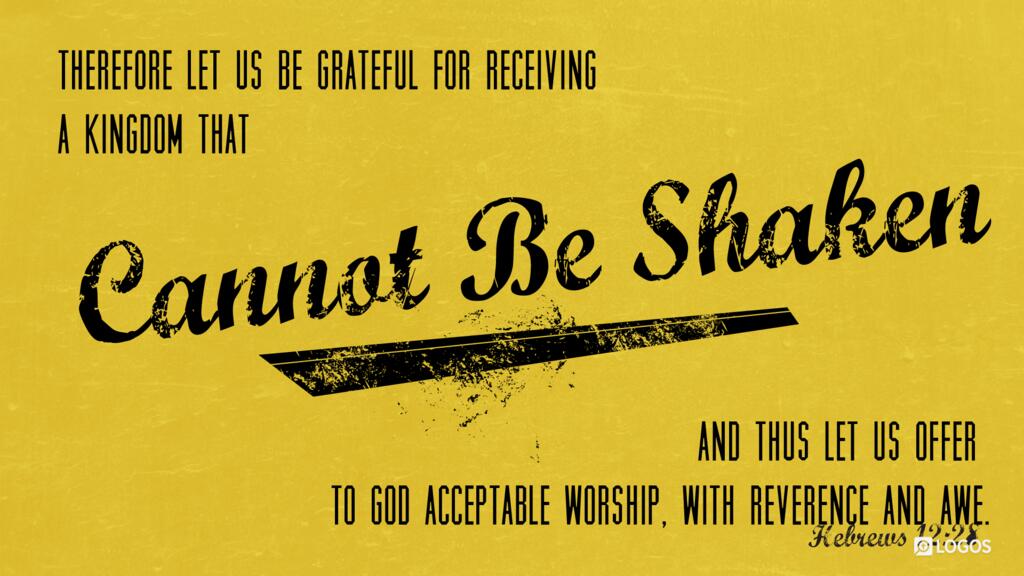
12:25Take care not to refuse the one who is speaking! For if they did not escape when they refused the one who warned them on earth, how much less shall we, if we reject the one who warns from heaven? 12:26Then his voice shook the earth, but now he has promised, “I will once more shake not only the earth but heaven too.”3412:27Now this phrase “once more” indicates the removal of what is shaken, that is, of created things, so that what is unshaken may remain. 12:28So since we are receiving an unshakable kingdom, let us give thanks, and through this let us offer worship pleasing to God in devotion and awe. 12:29For our God is indeed a devouring fire.35
Footnotes
- 25 This describes the nation of Israel approaching God on Mt. Sinai (Exod 19). There is a clear contrast with the reference to Mount Zion in v. 22, so this could be translated “a mountain that can be touched.” But the word “mountain” does not occur here and the more vague description seems to be deliberate.
- 26 Grk “a voice of words.”
- 27 Grk “a voice … from which those who heard begged that a word not be added to them.”
- 28 A quotation from Exod 19:12–13.
- 29 Grk “that which appeared.”
- 30 Grk “I am terrified and trembling.” A quotation from Deut 9:19.
- 31 Grk “and the city”; the conjunction is omitted in translation since it seems to be functioning epexegetically—that is, explaining further what is meant by “Mount Zion.”
- 32 The Greek word μεσίτης (mesitēs, “mediator”) in this context does not imply that Jesus was a mediator in the contemporary sense of the word, i.e., he worked for compromise between opposing parties. Here the term describes his function as the one who was used by God to enact a new covenant which established a new relationship between God and his people, but entirely on God’s terms.
- 33 Abel’s shed blood cried out to the Lord for justice and judgment, but Jesus’ blood speaks of redemption and forgiveness, something better than Abel’s does (Gen 4:10; Heb 9:11–14; 11:4).
- 34 A quotation from Hag 2:6.
- 35 A quotation from Deut 4:24; 9:3.
The NET Bible First Edition, Copyright 1996-2005 by Biblical Studies Press