Hebrews 1:2
The NET BibleOther versions
English
- NET The NET Bible
- DARBY 1890 Darby Bible
- ASV American Standard Version
- AV 1873 The Cambridge Paragraph Bible of the Authorized English Version
- CSB Christian Standard Bible
- D-R Douay-Rheims Bible
- ESV English Standard Version
- GW GOD’S WORD Translation
- GNB Good News Translation
- HCSB The Holman Christian Standard Bible
- KJV 1900 King James Version
- LSB Legacy Standard Bible
- LEB The Lexham English Bible
- MSG The Message: The Bible in Contemporary Language
- NASB95 New American Standard Bible (1995)
- NCV New Century Version
- NIrV New International Reader’s Version (1998)
- NIV New International Version (2011)
- NKJV The New King James Version
- NLT New Living Translation
- NRSVue New Revised Standard Version: Updated Edition
- RSV The Revised Standard Version
- RSVCE The Revised Standard Version, Catholic Edition
- TNIV Today’s New International Version
- YLT Young’s Literal Translation
Arabic
Czech
French
German
Greek
Hungarian
Italian
Korean
Latin
Portuguese
Russian
Simplified Chinese
Spanish
Traditional Chinese
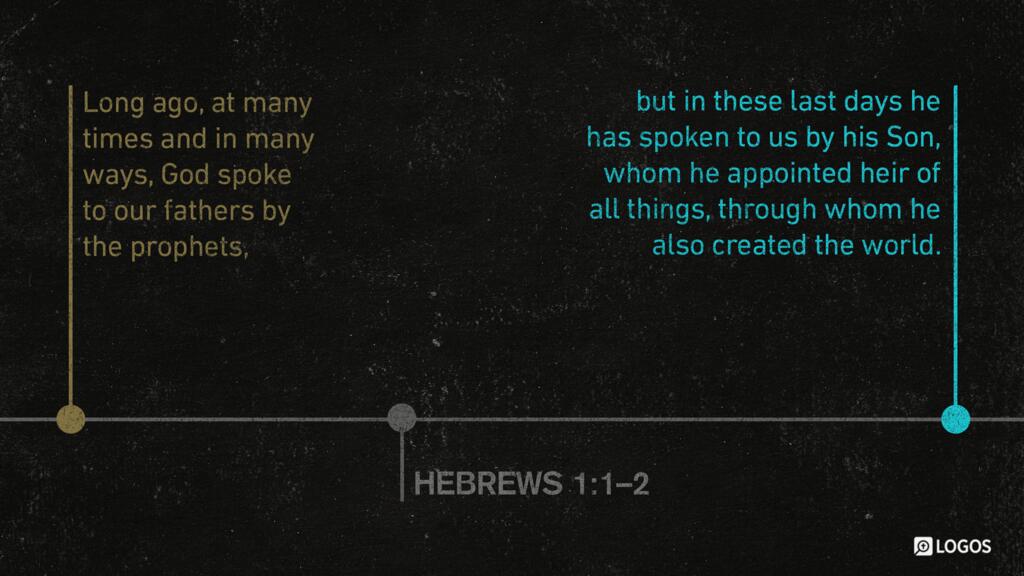
1:2in these last days he has spoken to us in a son,5 whom he appointed heir of all things, and through whom he created the world.6
Footnotes
- 5 The Greek puts an emphasis on the quality of God’s final revelation. As such, it is more than an indefinite notion (“a son”) though less than a definite one (“the son”), for this final revelation is not just through any son of God, nor is the emphasis specifically on the person himself. Rather, the focus here is on the nature of the vehicle of God’s revelation: He is no mere spokesman (or prophet) for God, nor is he merely a heavenly messenger (or angel); instead, this final revelation comes through one who is intimately acquainted with the heavenly Father in a way that only a family member could be. There is, however, no exact equivalent in English (“in son” is hardly good English style). The phrase in a son is the fulcrum of Heb 1:1–4. It concludes the contrast of God’s old and new revelation and introduces a series of seven descriptions of the Son. These descriptions show why he is the ultimate revelation of God.
- 6 Grk “the ages.” The temporal (ages) came to be used of the spatial (what exists in those time periods). See Heb 11:3 for the same usage.
The NET Bible First Edition, Copyright 1996-2005 by Biblical Studies Press
In other versions
ESVEnglish Standard Version
but in these last days he has spoken to us by his Son, whom he appointed the heir of all things, through whom also he created the world.
Copyright 2001 Crossway Bibles
NIVNew International Version (2011)
but in these last days he has spoken to us by his Son, whom he appointed heir of all things, and through whom also he made the universe.
Copyright 1973, 1978, 1984, 2011 Biblica, Inc.
CSBChristian Standard Bible
In these last days, he has spoken to us by his Son. God has appointed him heir of all things and made the universe through him.
Copyright 2017 Holman Bible Publishers
NLTNew Living Translation
And now in these final days, he has spoken to us through his Son. God promised everything to the Son as an inheritance, and through the Son he created the universe.
Holy Bible, New Living Translation, copyright © 1996, 2004, 2015 by Tyndale House Foundation. Used by permission of Tyndale House Publishers. All rights reserved.
LEBThe Lexham English Bible
in these last days he has spoken to us by a Son, whom he appointed heir of all things, through whom also he made the world,
Copyright 2012 Lexham Press
KJV 1900King James Version
Hath in these last days spoken unto us by his Son, whom he hath appointed heir of all things, by whom also he made the worlds;
Public Domain