Haggai 1:5–11
The NET BibleOther versions
English
- NET The NET Bible
- DARBY 1890 Darby Bible
- ASV American Standard Version
- AV 1873 The Cambridge Paragraph Bible of the Authorized English Version
- CSB Christian Standard Bible
- D-R Douay-Rheims Bible
- ESV English Standard Version
- GW GOD’S WORD Translation
- GNB Good News Translation
- HCSB The Holman Christian Standard Bible
- KJV 1900 King James Version
- LSB Legacy Standard Bible
- LEB The Lexham English Bible
- MSG The Message: The Bible in Contemporary Language
- NASB95 New American Standard Bible (1995)
- NCV New Century Version
- NIrV New International Reader’s Version (1998)
- NIV New International Version (2011)
- NKJV The New King James Version
- NLT New Living Translation
- NRSVue New Revised Standard Version: Updated Edition
- RSV The Revised Standard Version
- RSVCE The Revised Standard Version, Catholic Edition
- TNIV Today’s New International Version
- YLT Young’s Literal Translation
Arabic
Czech
French
German
Hebrew
Hungarian
Italian
Korean
Latin
Portuguese
Russian
Simplified Chinese
Spanish
Traditional Chinese
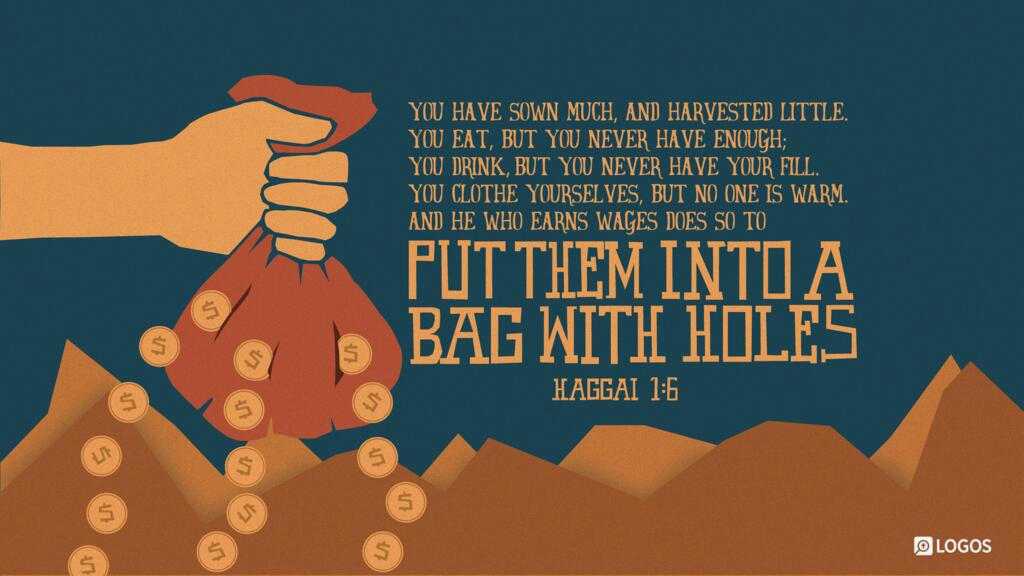
1:5Here then is what the Lord who rules over all says: ‘Think carefully about what you are doing.101:6You have planted much, but have harvested little. You eat, but are never filled. You drink, but are still thirsty. You put on clothes, but are not warm. Those who earn wages end up with holes in their money bags.’ ”11
The Instruction of the People
1:7“Moreover, the Lord who rules over all says: ‘Pay close attention to these things also.121:8Go up to the hill country and bring back timber to build13 the temple.14 Then I will be pleased and honored,’15 says the Lord. 1:9‘You expected a large harvest, but instead16 there was little, and when you brought it home it disappeared right away.17 Why?’ asks the Lord who rules over all. ‘Because my temple remains in ruins, thanks to each of you favoring his own house!181:10This is why the sky19 has held back its dew and the earth its produce.201:11Moreover, I have called for a drought that will affect the fields, the hill country, the grain, new wine, fresh olive oil, and everything that grows from the ground; it also will harm people, animals, and everything they produce.’ ”21
Footnotes
- 10 Heb “Set your heart upon your ways” (see 2:15, 18); traditionally “Consider your ways” (so , , , ).
- 11 Some translate “pockets” (so ) but the Hebrew word צְרוֹר (tséror) refers to a bag, pouch, or purse of money ( 865 צְרוֹר; צְרוֹר 1). Because coinage had been invented by the Persians and was thus in use in Haggai’s day, this likely is a money bag or purse rather than pouches or pockets in the clothing. Since in contemporary English “purse” (so , , ) could be understood as a handbag, the present translation uses “money bags.”
- 12 Heb “Set your heart upon your ways”; see v. 5.
- 13 Heb “and build the house” (so , ), with “house” referring specifically to the temple here.
- 14 The temple was built primarily of stone, so the timber here refers to interior paneling (see v. 4) and perhaps to scaffolding (see Ezra 5:8; 6:4).
- 15 The Hebrew verb אֶכָּבְדָ (’ekkavda) appears to be a defectively written cohortative (“that I may be glorified”). The cohortatives (note that the preceding אֶרְצֶה, ’ertseh, “I will be pleased,” may also be taken as cohortative) indicate purpose/result (cf. , “so that”; “so”) following the imperatives of v. 8a (“go up,” “bring back,” “build”).
- 16 Heb “look!” (הִנֵּה, hinneh). The term, an interjection, draws attention to the point being made.
- 17 Heb “I blew it away” (so , , ). The imagery here suggests that human achievements are so fragile and temporal that a mere breath from God can destroy them (see Ezek 22:20, 21; and Isa 40:7 with נָשַׁב, nashav).
- 18 Heb “and each of you runs to his own house”; “is busy with”; “is busy working on”; “work hard for.”
- 19 The Hebrew text has “over you” (so ), but this is redundant in contemporary English and has been left untranslated.
- 20 This linkage of human sin to natural disaster is reminiscent of the curse brought upon the earth by Adam’s disobedience (Gen 3:17–19; see Rom 8:20–22).
- 21 Heb “all the labor of hands” (similar , , ); cf. “all that is produced by hand.”
The NET Bible First Edition, Copyright 1996-2005 by Biblical Studies Press