Genesis 4:8–26
The NET BibleOther versions
English
- NET The NET Bible
- DARBY 1890 Darby Bible
- ASV American Standard Version
- AV 1873 The Cambridge Paragraph Bible of the Authorized English Version
- CSB Christian Standard Bible
- D-R Douay-Rheims Bible
- ESV English Standard Version
- GW GOD’S WORD Translation
- GNB Good News Translation
- HCSB The Holman Christian Standard Bible
- KJV 1900 King James Version
- LSB Legacy Standard Bible
- LEB The Lexham English Bible
- MSG The Message: The Bible in Contemporary Language
- NASB95 New American Standard Bible (1995)
- NCV New Century Version
- NIrV New International Reader’s Version (1998)
- NIV New International Version (2011)
- NKJV The New King James Version
- NLT New Living Translation
- NRSVue New Revised Standard Version: Updated Edition
- RSV The Revised Standard Version
- RSVCE The Revised Standard Version, Catholic Edition
- TNIV Today’s New International Version
- YLT Young’s Literal Translation
Arabic
Czech
French
German
Hebrew
Hungarian
Italian
Korean
Latin
Portuguese
Russian
Simplified Chinese
Spanish
Traditional Chinese
4:8Cain said to his brother Abel, “Let’s go out to the field.”21 While they were in the field, Cain attacked22 his brother23 Abel and killed him.
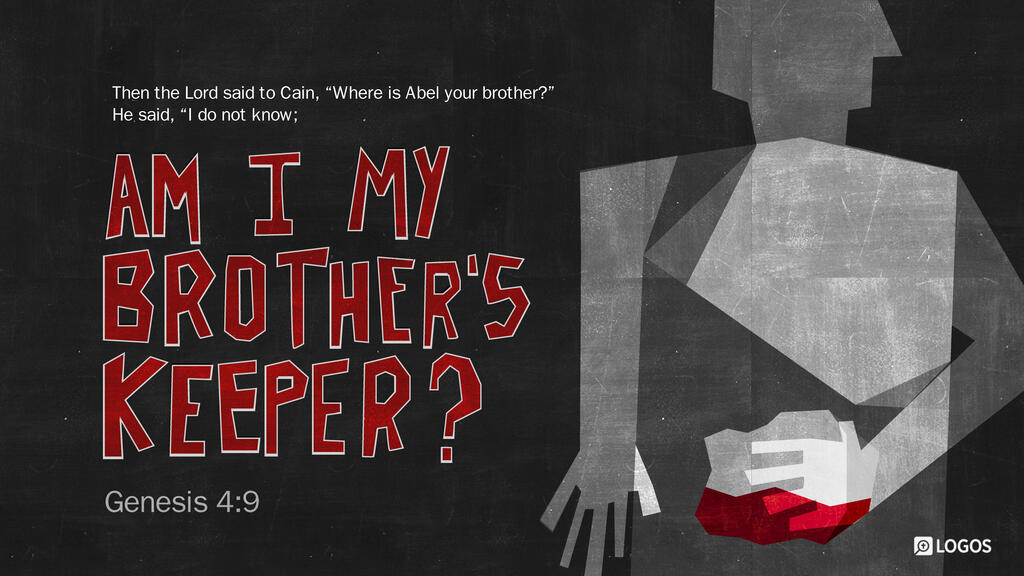
4:9Then the Lord said to Cain, “Where is your brother Abel?”24 And he replied, “I don’t know! Am I my brother’s guardian?”25 4:10But the Lord said, “What have you done?26 The voice27 of your brother’s blood is crying out to me from the ground! 4:11So now, you are banished28 from the ground, which has opened its mouth to receive your brother’s blood from your hand. 4:12When you try to cultivate29 the
ground it will no longer yield30 its best31 for you. You will be a homeless wanderer32 on the earth.” 4:13Then Cain said to the Lord, “My punishment33 is too great to endure!34 4:14Look! You are driving me off the land35 today, and I must hide from your presence.36 I will be a homeless wanderer on the earth; whoever finds me will kill me.” 4:15But the Lord said to him, “All right then,37 if anyone kills Cain, Cain will be avenged seven times as much.”38 Then the Lord put a special mark39 on Cain so that no one who found him would strike him down.40 4:16So Cain went out from the presence of the Lord and lived in the land of Nod,41 east of Eden.
The Beginning of Civilization
4:17Cain had marital relations42 with his wife, and she became pregnant43 and gave birth to Enoch. Cain was building a city, and he named the city after44 his son Enoch. 4:18To Enoch was born Irad, and Irad was the father45 of Mehujael. Mehujael was the father of Methushael, and Methushael was the father of Lamech.
4:19Lamech took two wives for himself; the name of the first was Adah, and the name of the second was Zillah. 4:20Adah gave birth to Jabal; he was the first46 of those who live in tents and keep47 livestock. 4:21The name of his brother was Jubal; he was the first of all who play the harp and the flute. 4:22Now Zillah also gave birth to Tubal-Cain, who heated metal and shaped48 all kinds of tools made of bronze and iron. The sister of Tubal-Cain was Naamah.
4:23Lamech said to his wives,
“Adah and Zillah! Listen to me!
You wives of Lamech, hear my words!
I have killed a man for wounding me,
a young man49 for hurting me.
4:24If Cain is to be avenged seven times as much,
then Lamech seventy-seven times!”50
4:25And Adam had marital relations51 with his wife again, and she gave birth to a son. She named him Seth, saying, “God has given52 me another child53 in place of Abel because Cain killed him.” 4:26And a son was also born to Seth, whom he named Enosh. At that time people54 began to worship55 the Lord.
Footnotes
- 21 The has simply “and Cain said to Abel his brother,” omitting Cain’s words to Abel. It is possible that the elliptical text is original. Perhaps the author uses the technique of aposiopesis, “a sudden silence” to create tension. In the midst of the story the narrator suddenly rushes ahead to what happened in the field. It is more likely that the ancient versions (Samaritan Pentateuch, , , and ), which include Cain’s words, “Let’s go out to the field,” preserve the original reading here. After writing אָחִיו (’akhiyv, “his brother”), a scribe’s eye may have jumped to the end of the form בַּשָּׂדֶה (basadeh, “to the field”) and accidentally omitted the quotation. This would be an error of virtual homoioteleuton. In older phases of the Hebrew script the sequence יו (yod-vav) on אָחִיו is graphically similar to the final ה (he) on בַּשָּׂדֶה.
- 22 Heb “arose against” (in a hostile sense).
- 23 The word “brother” appears six times in vv. 8–11, stressing the shocking nature of Cain’s fratricide (see 1 John 3:12).
- 24 Where is Abel your brother? Again the Lord confronts a guilty sinner with a rhetorical question (see Gen 3:9–13), asking for an explanation of what has happened.
- 25 Heb “The one guarding my brother [am] I?” Am I my brother’s guardian? Cain lies and then responds with a defiant rhetorical question of his own in which he repudiates any responsibility for his brother. But his question is ironic, for he is responsible for his brother’s fate, especially if he wanted to kill him. See P. A. Riemann, “Am I My Brother’s Keeper?” 24 (1970): 482–91.
- 26 What have you done? Again the Lord’s question is rhetorical (see Gen 3:13), condemning Cain for his sin.
- 27 The word “voice” is a personification; the evidence of Abel’s shed blood condemns Cain, just as a human eyewitness would testify in court. For helpful insights, see G. von Rad, Biblical Interpretations in Preaching; and L. Morris, “The Biblical Use of the Term ‘Blood,’ ” 6 (1955/56): 77–82.
- 28 Heb “cursed are you from the ground.” As in Gen 3:14, the word “cursed,” a passive participle from אָרָר (’arar), either means “punished” or “banished,” depending on how one interprets the following preposition. If the preposition is taken as indicating source, then the idea is “cursed (i.e., punished) are you from [i.e., “through the agency of”] the ground” (see v. 12a). If the preposition is taken as separative, then the idea is “cursed and banished from the ground.” In this case the ground rejects Cain’s efforts in such a way that he is banished from the ground and forced to become a fugitive out in the earth (see vv. 12b, 14).
- 29 Heb “work.”
- 30 Heb “it will not again (תֹסֵף, tosef) give (תֵּת, tet),” meaning the ground will no longer yield. In translation the infinitive becomes the main verb, and the imperfect verb form becomes adverbial.
- 31 Heb “its strength.”
- 32 Two similar sounding synonyms are used here: נָע וָנָד (na’ vanad, “a wanderer and a fugitive”). This juxtaposition of synonyms emphasizes the single idea. In translation one can serve as the main description, the other as a modifier. Other translation options include “a wandering fugitive” and a “ceaseless wanderer” (cf. ).
- 33 The primary meaning of the Hebrew word עָוֹן (’avon) is “sin, iniquity.” But by metonymy it can refer to the “guilt” of sin, or to “punishment” for sin. The third meaning applies here. Just before this the Lord announces the punishment for Cain’s actions, and right after this statement Cain complains of the severity of the punishment. Cain is not portrayed as repenting of his sin.
- 34 Heb “great is my punishment from bearing.” The preposition מִן (min, “from”) is used here in a comparative sense.
- 35 Heb “from upon the surface of the ground.”
- 36 I must hide from your presence. The motif of hiding from the Lord as a result of sin also appears in Gen 3:8–10.
- 37 The Hebrew term לָכֵן (lakhen, “therefore”) in this context carries the sense of “Okay,” or “in that case then I will do this.”
- 38 The symbolic number seven is used here to emphasize that the offender will receive severe punishment. For other rhetorical and hyperbolic uses of the expression “seven times over,” see Pss 12:6; 79:12; Prov 6:31; Isa 30:26.
- 39 Heb “sign”; “reminder.” The term “sign” is not used in the translation because it might imply to an English reader that God hung a sign on Cain. The text does not identify what the “sign” was. It must have been some outward, visual reminder of Cain’s special protected status.
- 40 God becomes Cain’s protector. Here is common grace—Cain and his community will live on under God’s care, but without salvation.
- 41 The name Nod means “wandering” in Hebrew (see vv. 12, 14).
- 42 Heb “knew,” a frequent euphemism for sexual relations.
- 43 Or “she conceived.”
- 44 Heb “according to the name of.”
- 45 Heb “and Irad fathered.”
- 46 Heb “father.” In this passage the word “father” means “founder,” referring to the first to establish such lifestyles and occupations.
- 47 The word “keep” is not in the Hebrew text, but is supplied in the translation. Other words that might be supplied instead are “tend,” “raise” (), or “have” ().
- 48 The traditional rendering here, “who forged” (or “a forger of”) is now more commonly associated with counterfeit or fraud (e.g., “forged copies” or “forged checks”) than with the forging of metal. The phrase “heated metal and shaped [it]” has been used in the translation instead.
- 49 The Hebrew term יֶלֶד (yeled) probably refers to a youthful warrior here, not a child.
- 50 Seventy-seven times. Lamech seems to reason this way: If Cain, a murderer, is to be avenged seven times (see v. 15), then how much more one who has been unjustly wronged! Lamech misses the point of God’s merciful treatment of Cain. God was not establishing a principle of justice when he warned he would avenge Cain’s murder. In fact he was trying to limit the shedding of blood, something Lamech wants to multiply instead. The use of “seventy-seven,” a multiple of seven, is hyperbolic, emphasizing the extreme severity of the vengeance envisioned by Lamech.
- 51 Heb “knew,” a frequent euphemism for sexual relations.
- 52 The name Seth probably means something like “placed”; “appointed”; “set”; “granted,” assuming it is actually related to the verb that is used in the sentiment. At any rate, the name שֵׁת (shet) and the verb שָׁת (shat, “to place, to appoint, to set, to grant”) form a wordplay (paronomasia).
- 53 Heb “offspring.”
- 54 The word “people” is not in the Hebrew text, but is supplied in the translation. The construction uses a passive verb without an expressed subject. “To call was begun” can be interpreted to mean that people began to call.
- 55 Heb “call in the name.” The expression refers to worshiping the Lord through prayer and sacrifice (see Gen 12:8; 13:4; 21:33; 26:25). See G. J. Wenham, Genesis (), 1:.
The NET Bible First Edition, Copyright 1996-2005 by Biblical Studies Press