Genesis 35:9–19
The NET BibleOther versions
English
- NET The NET Bible
- DARBY 1890 Darby Bible
- ASV American Standard Version
- AV 1873 The Cambridge Paragraph Bible of the Authorized English Version
- CSB Christian Standard Bible
- D-R Douay-Rheims Bible
- ESV English Standard Version
- GW GOD’S WORD Translation
- GNB Good News Translation
- HCSB The Holman Christian Standard Bible
- KJV 1900 King James Version
- LSB Legacy Standard Bible
- LEB The Lexham English Bible
- MSG The Message: The Bible in Contemporary Language
- NASB95 New American Standard Bible (1995)
- NCV New Century Version
- NIrV New International Reader’s Version (1998)
- NIV New International Version (2011)
- NKJV The New King James Version
- NLT New Living Translation
- NRSVue New Revised Standard Version: Updated Edition
- RSV The Revised Standard Version
- RSVCE The Revised Standard Version, Catholic Edition
- TNIV Today’s New International Version
- YLT Young’s Literal Translation
Arabic
Czech
French
German
Hebrew
Hungarian
Italian
Korean
Latin
Portuguese
Russian
Simplified Chinese
Spanish
Traditional Chinese
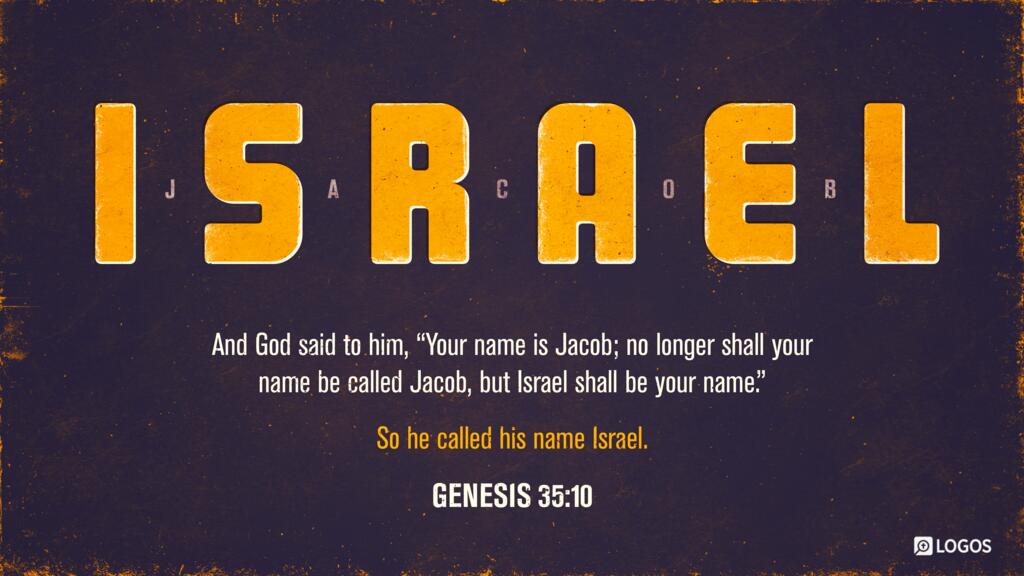
35:9God appeared to Jacob again after he returned from Paddan Aram and blessed him. 35:10God said to him, “Your name is Jacob, but your name will no longer be called Jacob; Israel will be your name.” So God named him Israel.2335:11Then God said to him, “I am the sovereign God.24 Be fruitful and multiply! A nation—even a company of nations—will descend from you; kings will be among your descendants!2535:12The land I gave26 to Abraham and Isaac I will give to you. To your descendants27 I will also give this land.” 35:13Then God went up from the place28 where he spoke with him. 35:14So Jacob set up a sacred stone pillar in the place where God spoke with him.29 He poured out a drink offering on it, and then he poured oil on it.3035:15Jacob named the place31 where God spoke with him Bethel.32
35:16They traveled on from Bethel, and when Ephrath was still some distance away,33 Rachel went into labor34—and her labor was hard. 35:17When her labor was at its hardest,35 the midwife said to her, “Don’t be afraid, for you are having another son.”3635:18With her dying breath,37 she named him Ben-Oni.38 But his father called him Benjamin instead.3935:19So Rachel died and was buried on the way to Ephrath (that is, Bethlehem).40
Footnotes
- 23 Heb “and he called his name Israel.” The referent of the pronoun “he” (God) has been specified in the translation for clarity. The name Israel means “God fights” (although some interpret the meaning as “he fights [with] God”). See Gen 32:28.
- 24 The name אֵל שַׁדַּי (’el shadday, “El Shaddai”) has often been translated “God Almighty,” primarily because Jerome translated it omnipotens (“all powerful”) in the Latin . There has been much debate over the meaning of the name. For discussion see W. F. Albright, “The Names Shaddai and Abram,” 54 (1935): 173–210; R. Gordis, “The Biblical Root sdy-sd,” 41 (1940): 34–43; and especially T. N. D. Mettinger, In Search of God, 69–72. Shaddai/El Shaddai is the sovereign king of the world who grants, blesses, and judges. In the Book of Genesis he blesses the patriarchs with fertility and promises numerous descendants. Outside Genesis he both blesses/protects and takes away life/happiness. The patriarchs knew God primarily as El Shaddai (Exod 6:3). While the origin and meaning of this name are uncertain its significance is clear. The name is used in contexts where God appears as the source of fertility and life. For a fuller discussion see the note on “sovereign God” in .
- 25 Heb “A nation and a company of nations will be from you and kings from your loins will come out.” A nation … will descend from you. The promise is rooted in the Abrahamic promise (see Gen 17). God confirms what Isaac told Jacob (see Gen 28:3–4). Here, though, for the first time Jacob is promised kings as descendants.
- 26 The Hebrew verb translated “gave” refers to the Abrahamic promise of the land. However, the actual possession of that land lay in the future. The decree of the Lord made it certain; but it has the sense “promised to give.”
- 27 Heb “and to your offspring after you.”
- 28 Heb “went up from upon him in the place.”
- 29 Heb “and Jacob set up a sacred pillar in the place where he spoke with him, a sacred pillar of stone” (see the notes on the term “sacred stone” in ). This passage stands parallel to Gen 28:18–19, where Jacob set up a sacred stone, poured oil on it, and called the place Bethel. Some commentators see these as two traditions referring to the same event, but it is more likely that Jacob reconsecrated the place in fulfillment of the vow he had made here earlier. In support of this is the fact that the present narrative alludes to and is built on the previous one.
- 30 The verb נָסַךְ (nasakh) means “to pour out, to make libations,” and the noun נֶסֶךְ (nesekh) is a “drink-offering,” usually of wine or of blood. The verb יָצַק (yatsaq) means “to pour out,” often of anointing oil, but of other elements as well.
- 31 Called the name of the place. In view of the previous naming of Bethel in Gen 28:19, here Jacob was confirming or affirming the name through an official ritual marking the fulfillment of the vow. This place now did become Bethel, the house of God.
- 32 The name Bethel means “house of God” in Hebrew. For location see ; ; ; ; .
- 33 Heb “and there was still a stretch of the land to go to Ephrath.”
- 34 Normally the verb would be translated “she gave birth,” but because that obviously had not happened yet, it is better to translate the verb as ingressive, “began to give birth” (cf. ) or “went into labor.”
- 35 The construction uses a Hiphil infinitive, which E. A. Speiser classifies as an elative Hiphil. The contrast is with the previous Piel: there “she had hard labor,” and here, “her labor was at its hardest.” Failure to see this, Speiser notes, has led to redundant translations and misunderstandings (Genesis [], ).
- 36 Another son. The episode recalls and fulfills the prayer of Rachel at the birth of Joseph (Gen 30:24): “may he add” another son.
- 37 Heb “in the going out of her life, for she was dying.” Rachel named the child with her dying breath.
- 38 The name Ben-Oni means “son of my suffering.” It is ironic that Rachel’s words to Jacob in Gen 30:1, “Give me children or I’ll die,” take a different turn here, for it was having the child that brought about her death.
- 39 The disjunctive clause is contrastive. His father called him Benjamin. There was a preference for giving children good or positive names in the ancient world, and “son of my suffering” would not do (see the incident in 1 Chr 4:9–10), because it would be a reminder of the death of Rachel (in this connection, see also D. Daube, “The Night of Death,” 61 [1968]: 629–32). So Jacob named him Benjamin, which means “son of the [or “my”] right hand.” The name Benjamin appears in the Mari texts. There have been attempts to connect this name to the resident tribe listed at Mari, “sons of the south” (since the term “right hand” can also mean “south” in Hebrew), but this assumes a different reading of the story. See J. Muilenburg, “The Birth of Benjamin,” 75 (1956): 194–201.
- 40 This explanatory note links the earlier name Ephrath with the later name Bethlehem. For location see ; ; ; .
The NET Bible First Edition, Copyright 1996-2005 by Biblical Studies Press