Genesis 32:28
The NET BibleOther versions
English
- NET The NET Bible
- DARBY 1890 Darby Bible
- ASV American Standard Version
- AV 1873 The Cambridge Paragraph Bible of the Authorized English Version
- CSB Christian Standard Bible
- D-R Douay-Rheims Bible
- ESV English Standard Version
- GW GOD’S WORD Translation
- GNB Good News Translation
- HCSB The Holman Christian Standard Bible
- KJV 1900 King James Version
- LSB Legacy Standard Bible
- LEB The Lexham English Bible
- MSG The Message: The Bible in Contemporary Language
- NASB95 New American Standard Bible (1995)
- NCV New Century Version
- NIrV New International Reader’s Version (1998)
- NIV New International Version (2011)
- NKJV The New King James Version
- NLT New Living Translation
- NRSVue New Revised Standard Version: Updated Edition
- RSV The Revised Standard Version
- RSVCE The Revised Standard Version, Catholic Edition
- TNIV Today’s New International Version
- YLT Young’s Literal Translation
Arabic
Czech
French
German
Hebrew
Hungarian
Italian
Korean
Latin
Portuguese
Russian
Simplified Chinese
Spanish
Traditional Chinese
32:28“No longer will your name be Jacob,” the man told him,66 “but Israel,67 because you have fought68 with God and with men and have prevailed.”
Footnotes
- 66 Heb “and he said.” The referent of the pronoun “he” (the man who wrestled with Jacob) has been specified for clarity, and the order of the introductory clause and the direct discourse has been rearranged in the translation for stylistic reasons.
- 67 The name Israel is a common construction, using a verb with a theophoric element (אֵל, ’el) that usually indicates the subject of the verb. Here it means “God fights.” This name will replace the name Jacob; it will be both a promise and a call for faith. In essence, the Lord was saying that Jacob would have victory and receive the promises because God would fight for him.
- 68 You have fought. The explanation of the name Israel includes a sound play. In Hebrew the verb translated “you have fought” (שָׂרִיתָ, sarita) sounds like the name “Israel” (יִשְׂרָאֵל, yisra’el), meaning “God fights” (although some interpret the meaning as “he fights [with] God”). The name would evoke the memory of the fight and what it meant. A. Dillmann says that ever after this the name would tell the Israelites that, when Jacob contended successfully with God, he won the battle with man (Genesis, 2:). To be successful with God meant that he had to be crippled in his own self-sufficiency (A. P. Ross, “Jacob at the Jabboq, Israel at Peniel,” 142 [1985]: ).
The NET Bible First Edition, Copyright 1996-2005 by Biblical Studies Press
In other versions
ESVEnglish Standard Version
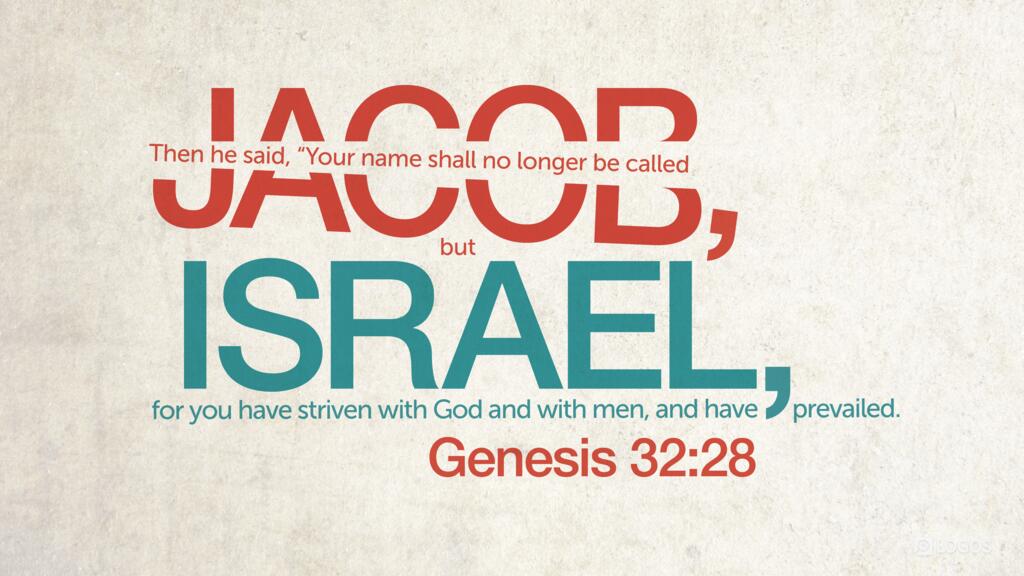
Then he said, “Your name shall no longer be called Jacob, but Israel, for you have striven with God and with men, and have prevailed.”
Copyright 2001 Crossway Bibles
NIVNew International Version (2011)
Then the man said, “Your name will no longer be Jacob, but Israel, because you have struggled with God and with humans and have overcome.”
Copyright 1973, 1978, 1984, 2011 Biblica, Inc.
CSBChristian Standard Bible
“Your name will no longer be Jacob,” he said. “It will be Israel because you have struggled with God and with men and have prevailed.”
Copyright 2017 Holman Bible Publishers
NLTNew Living Translation
“Your name will no longer be Jacob,” the man told him. “From now on you will be called Israel, because you have fought with God and with men and have won.”
Holy Bible, New Living Translation, copyright © 1996, 2004, 2015 by Tyndale House Foundation. Used by permission of Tyndale House Publishers. All rights reserved.
LEBThe Lexham English Bible
And he said, “Your name shall no longer be called Jacob, but Israel, for you have struggled with God and with men and have prevailed.”
Copyright 2012 Lexham Press
KJV 1900King James Version
And he said, Thy name shall be called no more Jacob, but Israel: for as a prince hast thou power with God and with men, and hast prevailed.
Public Domain