Genesis 3:6–8
The NET BibleOther versions
English
- NET The NET Bible
- DARBY 1890 Darby Bible
- ASV American Standard Version
- AV 1873 The Cambridge Paragraph Bible of the Authorized English Version
- CSB Christian Standard Bible
- D-R Douay-Rheims Bible
- ESV English Standard Version
- GW GOD’S WORD Translation
- GNB Good News Translation
- HCSB The Holman Christian Standard Bible
- KJV 1900 King James Version
- LSB Legacy Standard Bible
- LEB The Lexham English Bible
- MSG The Message: The Bible in Contemporary Language
- NASB95 New American Standard Bible (1995)
- NCV New Century Version
- NIrV New International Reader’s Version (1998)
- NIV New International Version (2011)
- NKJV The New King James Version
- NLT New Living Translation
- NRSVue New Revised Standard Version: Updated Edition
- RSV The Revised Standard Version
- RSVCE The Revised Standard Version, Catholic Edition
- TNIV Today’s New International Version
- YLT Young’s Literal Translation
Arabic
Czech
French
German
Hebrew
Hungarian
Italian
Korean
Latin
Portuguese
Russian
Simplified Chinese
Spanish
Traditional Chinese
3:6When15 the woman saw that the tree produced fruit that was good for food,16 was attractive17 to the eye, and was desirable for making one wise,18 she took some of its fruit and ate it.19 She also gave some of it to her husband who was with her, and he ate it.20 3:7Then the eyes of both of them opened, and they knew they were naked; so they sewed fig leaves together and made coverings for themselves.
The Judgment Oracles of God at the Fall
3:8Then the man and his wife heard the sound of the Lord God moving about21 in the orchard at the breezy time22 of the day, and they hid23 from the Lord God among the trees of the orchard.
Footnotes
- 15 Heb “And the woman saw.” The clause can be rendered as a temporal clause subordinate to the following verb in the sequence.
- 16 Heb “that the tree was good for food.” The words “produced fruit that was” are not in the Hebrew text, but are implied.
- 17 The Hebrew word תַּאֲוָה (ta’avah, translated “attractive” here) actually means “desirable.” This term and the later term נֶחְמָד (nekhmad, “desirable”) are synonyms. Attractive (Heb “desirable”) … desirable. These are different words in Hebrew. The verbal roots for both of these forms appear in Deut 5:21 in the prohibition against coveting. Strong desires usually lead to taking.
- 18 Heb “that good was the tree for food, and that desirable it was to the eyes, and desirable was the tree to make one wise.” On the connection between moral wisdom and the “knowledge of good and evil,” see the note on the word “evil” in . Desirable for making one wise. The quest for wisdom can follow the wrong course, as indeed it does here. No one can become like God by disobeying God. It is that simple. The Book of Proverbs stresses that obtaining wisdom begins with the fear of God that is evidenced through obedience to his word. Here, in seeking wisdom, Eve disobeys God and ends up afraid of God.
- 19 The pronoun “it” is not in the Hebrew text, but is supplied (here and also after “ate” at the end of this verse) for stylistic reasons. She took … and ate it. The critical word now discloses the disobedience: “[she] ate.” Since the Lord God had said, “You shall not eat,” the main point of the divine inquisition will be, “Did you eat,” meaning, “did you disobey the command?” The woman ate, being deceived by the serpent (1 Tim 2:14), but then the man ate, apparently willingly when the woman gave him the fruit (see Rom 5:12, 17–19).
- 20 This pericope (3:1–7) is a fine example of Hebrew narrative structure. After an introductory disjunctive clause that introduces a new character and sets the stage (3:1), the narrative tension develops through dialogue, culminating in the action of the story. Once the dialogue is over, the action is told in a rapid sequence of verbs—she took, she ate, she gave, and he ate.
- 21 The Hitpael participle of הָלָךְ (halakh, “to walk, to go”) here has an iterative sense, “moving” or “going about.” While a translation of “walking about” is possible, it assumes a theophany, the presence of the Lord God in a human form. This is more than the text asserts.
- 22 The expression is traditionally rendered “cool of the day,” because the Hebrew word רוּחַ (ruakh) can mean “wind.” U. Cassuto (Genesis: From Adam to Noah, ) concludes after lengthy discussion that the expression refers to afternoon when it became hot and the sun was beginning to decline. J. J. Niehaus (God at Sinai [], 155–57) offers a different interpretation of the phrase, relating יוֹם (yom, usually understood as “day”) to an Akkadian cognate umu (“storm”) and translates the phrase “in the wind of the storm.” If Niehaus is correct, then God is not pictured as taking an afternoon stroll through the orchard, but as coming in a powerful windstorm to confront the man and woman with their rebellion. In this case קוֹל יְהוָה (qol yéhvah, “sound of the Lord”) may refer to God’s thunderous roar, which typically accompanies his appearance in the storm to do battle or render judgment (e.g., see Ps 29).
- 23 The verb used here is the Hitpael, giving the reflexive idea (“they hid themselves”). In v. 10, when Adam answers the Lord, the Niphal form is used with the same sense: “I hid.”
The NET Bible First Edition, Copyright 1996-2005 by Biblical Studies Press
In other versions
ESVEnglish Standard Version
So when the woman saw that the tree was good for food, and that it was a delight to the eyes, and that the tree was to be desired to make one wise, she took of its fruit and ate, and she also gave some to her husband who was with her, and he ate. Then the eyes of both were opened, and they knew that they were naked. And they sewed fig leaves together and made themselves loincloths.
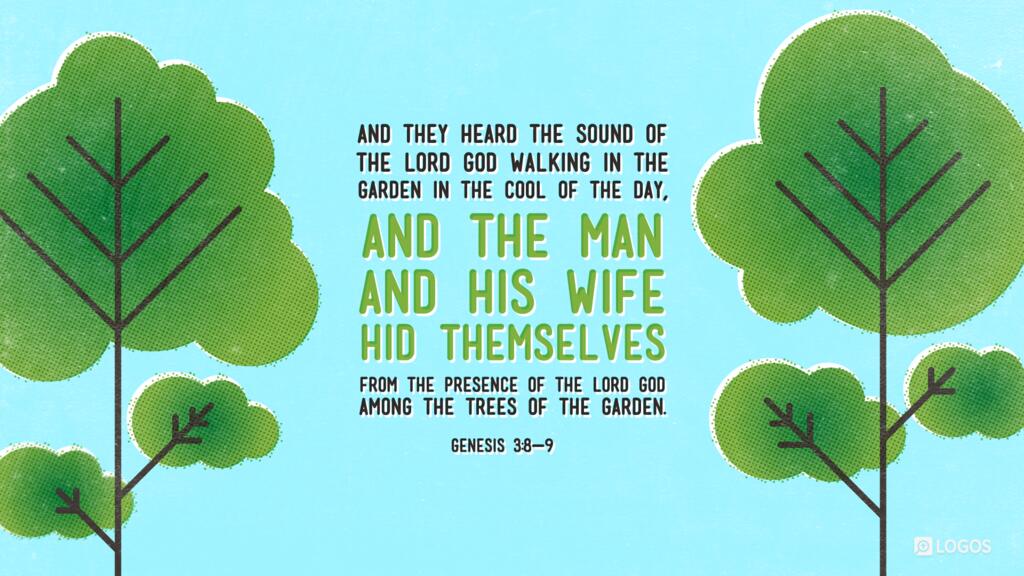
And they heard the sound of the Lord God walking in the garden in the cool of the day, and the man and his wife hid themselves from the presence of the Lord God among the trees of the garden.
Copyright 2001 Crossway Bibles
NIVNew International Version (2011)
When the woman saw that the fruit of the tree was good for food and pleasing to the eye, and also desirable for gaining wisdom, she took some and ate it. She also gave some to her husband, who was with her, and he ate it. Then the eyes of both of them were opened, and they realized they were naked; so they sewed fig leaves together and made coverings for themselves.
Then the man and his wife heard the sound of the Lord God as he was walking in the garden in the cool of the day, and they hid from the Lord God among the trees of the garden.
Copyright 1973, 1978, 1984, 2011 Biblica, Inc.
CSBChristian Standard Bible
The woman saw that the tree was good for food and delightful to look at, and that it was desirable for obtaining wisdom. So she took some of its fruit and ate it; she also gave some to her husband, who was with her, and he ate it. Then the eyes of both of them were opened, and they knew they were naked; so they sewed fig leaves together and made coverings for themselves.
Then the man and his wife heard the sound of the Lord God walking in the garden at the time of the evening breeze, and they hid from the Lord God among the trees of the garden.
Copyright 2017 Holman Bible Publishers
NLTNew Living Translation
The woman was convinced. She saw that the tree was beautiful and its fruit looked delicious, and she wanted the wisdom it would give her. So she took some of the fruit and ate it. Then she gave some to her husband, who was with her, and he ate it, too. At that moment their eyes were opened, and they suddenly felt shame at their nakedness. So they sewed fig leaves together to cover themselves.
When the cool evening breezes were blowing, the man and his wife heard the Lord God walking about in the garden. So they hid from the Lord God among the trees.
Holy Bible, New Living Translation, copyright © 1996, 2004, 2015 by Tyndale House Foundation. Used by permission of Tyndale House Publishers. All rights reserved.
LEBThe Lexham English Bible
When the woman saw that the tree was good for food and that it was a delight to the eyes, and the tree was desirable to make one wise, then she took from its fruit and she ate. And she gave it also to her husband with her, and he ate. Then the eyes of both of them were opened, and they knew that they were naked. And they sewed together fig leaves and they made for themselves coverings.
Then they heard the sound of Yahweh God walking in the garden at the windy time of day. And the man and his wife hid themselves from the presence of Yahweh God among the trees of the garden.
Copyright 2012 Lexham Press
KJV 1900King James Version
And when the woman saw that the tree was good for food, and that it was pleasant to the eyes, and a tree to be desired to make one wise, she took of the fruit thereof, and did eat, and gave also unto her husband with her; and he did eat. And the eyes of them both were opened, and they knew that they were naked; and they sewed fig leaves together, and made themselves aprons. And they heard the voice of the Lord God walking in the garden in the cool of the day: and Adam and his wife hid themselves from the presence of the Lord God amongst the trees of the garden.
Public Domain