Genesis 8:20–9:9
The NET BibleOther versions
English
- NET The NET Bible
- DARBY 1890 Darby Bible
- ASV American Standard Version
- AV 1873 The Cambridge Paragraph Bible of the Authorized English Version
- CSB Christian Standard Bible
- D-R Douay-Rheims Bible
- ESV English Standard Version
- GW GOD’S WORD Translation
- GNB Good News Translation
- HCSB The Holman Christian Standard Bible
- KJV 1900 King James Version
- LSB Legacy Standard Bible
- LEB The Lexham English Bible
- MSG The Message: The Bible in Contemporary Language
- NASB95 New American Standard Bible (1995)
- NCV New Century Version
- NIrV New International Reader’s Version (1998)
- NIV New International Version (2011)
- NKJV The New King James Version
- NLT New Living Translation
- NRSVue New Revised Standard Version: Updated Edition
- RSV The Revised Standard Version
- RSVCE The Revised Standard Version, Catholic Edition
- YLT Young’s Literal Translation
Arabic
Czech
French
German
Hebrew
Hungarian
Italian
Korean
Latin
Portuguese
Russian
Simplified Chinese
Spanish
Traditional Chinese
8:20Noah built an altar to the Lord. He then took some of every kind of clean animal and clean bird and offered burnt offerings on the altar.308:21And the Lord smelled the soothing aroma31 and said32 to himself,33 “I will never again curse34 the ground because of humankind, even though35 the inclination of their minds36 is evil from childhood on.37 I will never again destroy everything that lives, as I have just done.
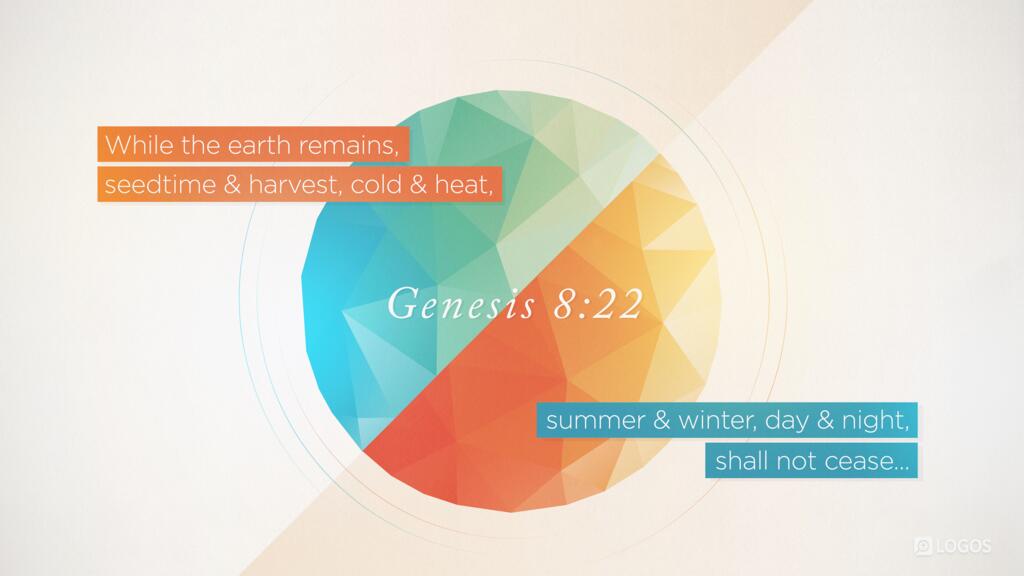
8:22“While the earth continues to exist,38
planting time39 and harvest,
cold and heat,
summer and winter,
and day and night will not cease.”
God’s Covenant with Humankind through Noah
9:1Then God blessed Noah and his sons and said to them, “Be fruitful and multiply and fill the earth. 9:2Every living creature of the earth and every bird of the sky will be terrified of you.1 Everything that creeps on the ground and all the fish of the sea are under your authority.29:3You may eat any moving thing that lives.3 As I gave you4 the green plants, I now give5 you everything.
9:4But6 you must not eat meat7 with its life (that is,8 its blood) in it.99:5For your lifeblood10 I will surely exact punishment,11 from12 every living creature I will exact punishment. From each person13 I will exact punishment for the life of the individual14 since the man was his relative.15
9:6“Whoever sheds human blood,16
by other humans17
must his blood be shed;
for in God’s image18
God19 has made humankind.”
9:7But as for you,20 be fruitful and multiply; increase abundantly on the earth and multiply on it.”
9:8God said to Noah and his sons,219:9“Look! I now confirm22 my covenant with you and your descendants after you23
Footnotes
- 30 Offered burnt offerings on the altar. F. D. Maurice includes a chapter on the sacrifice of Noah in The Doctrine of Sacrifice. The whole burnt offering, according to Leviticus 1, represented the worshiper’s complete surrender and dedication to the Lord. After the flood Noah could see that God was not only a God of wrath, but a God of redemption and restoration. The one who escaped the catastrophe could best express his gratitude and submission through sacrificial worship, acknowledging God as the sovereign of the universe.
- 31 The Lord “smelled” (וַיָּרַח, vayyarakh) a “soothing smell” (רֵיחַ הַנִּיהֹחַ, reakh hannihoakh). The object forms a cognate accusative with the verb. The language is anthropomorphic. The offering had a sweet aroma that pleased or soothed. The expression in Lev 1 signifies that God accepts the offering with pleasure, and in accepting the offering he accepts the worshiper.
- 32 Heb “and the Lord said.”
- 33 Heb “in his heart.”
- 34 Here the Hebrew word translated “curse” is קָלָל (qalal), used in the Piel verbal stem.
- 35 The Hebrew particle כִּי (ki) can be used in a concessive sense (see 473 כִּי), which makes good sense in this context. Its normal causal sense (“for”) does not fit the context here very well.
- 36 Heb “the inclination of the heart of humankind.”
- 37 Heb “from his youth.”
- 38 Heb “yet all the days of the earth.” The idea is “[while there are] yet all the days of the earth,” meaning, “as long as the earth exists.”
- 39 Heb “seed,” which stands here by metonymy for the time when seed is planted.
- 1 Heb “and fear of you and dread of you will be upon every living creature of the earth and upon every bird of the sky.” The suffixes on the nouns “fear” and “dread” are objective genitives. The animals will fear humans from this time forward.
- 2 Heb “into your hand are given.” The “hand” signifies power. To say the animals have been given into the hands of humans means humans have been given authority over them.
- 3 Heb “every moving thing that lives for you will be for food.”
- 4 The words “I gave you” are not in the Hebrew text, but are supplied in the translation for stylistic reasons.
- 5 The perfect verb form describes the action that accompanies the declaration.
- 6 Heb “only.”
- 7 Or “flesh.”
- 8 Heb “its life, its blood.” The second word is in apposition to the first, explaining what is meant by “its life.” Since the blood is equated with life, meat that had the blood in it was not to be eaten.
- 9 The words “in it” are supplied in the translation for stylistic reasons. You must not eat meat with its life … in it. Because of the carnage produced by the flood, people might conclude that life is cheap and therefore treat it lightly. But God will not permit them to kill or even to eat anything with the lifeblood still in it, serving as a reminder of the sanctity of life.
- 10 Again the text uses apposition to clarify what kind of blood is being discussed: “your blood, [that is] for your life.” See C. L. Dewar, “The Biblical Use of the Term ‘Blood,’ ” 4 (1953): 204–8.
- 11 The word “punishment” is not in the Hebrew text, but is supplied in the translation for clarification. The verb דָּרָשׁ (darash) means “to require, to seek, to ask for, to exact.” Here it means that God will exact punishment for the taking of a life. See R. Mawdsley, “Capital Punishment in Gen. 9:6,” 18 (1975): 20–25.
- 12 Heb “from the hand of,” which means “out of the hand of” or “out of the power of” and is nearly identical in sense to the preposition מִן (min) alone.
- 13 Heb “and from the hand of the man.” The article has a generic function, indicating the class, i.e., humankind.
- 14 Heb “of the man.”
- 15 Heb “from the hand of a man, his brother.” The point is that God will require the blood of someone who kills, since the person killed is a relative (“brother”) of the killer. The language reflects Noah’s situation (after the flood everyone would be part of Noah’s extended family), but also supports the concept of the brotherhood of humankind. According to the Genesis account the entire human race descended from Noah.
- 16 Heb “the blood of man.”
- 17 Heb “by man,” a generic term here for other human beings.
- 18 See the notes on the words “humankind” and “likeness” in , as well as J. Barr, “The Image of God in the Book of Genesis—A Study of Terminology,” 51 (1968/69): 11–26.
- 19 Heb “he”; the referent (God) has been specified in the translation for clarity.
- 20 The disjunctive clause (conjunction + pronominal subject + verb) here indicates a strong contrast to what has preceded. Against the backdrop of the warnings about taking life, God now instructs the people to produce life, using terms reminiscent of the mandate given to Adam (Gen 1:28).
- 21 Heb “to Noah and to his sons with him, saying.”
- 22 Heb “I, look, I confirm.” The particle הִנְנִי (hinni) used with the participle מֵקִים (meqim) gives the sense of immediacy or imminence, as if to say, “Look! I am now confirming.”
- 23 The three pronominal suffixes (translated “you,” “your,” and “you”) are masculine plural. As v. 8 indicates, Noah and his sons are addressed.
The NET Bible First Edition, Copyright 1996-2005 by Biblical Studies Press