Genesis 7:1–8:19
The NET BibleOther versions
English
- NET The NET Bible
- DARBY 1890 Darby Bible
- ASV American Standard Version
- AV 1873 The Cambridge Paragraph Bible of the Authorized English Version
- CSB Christian Standard Bible
- D-R Douay-Rheims Bible
- ESV English Standard Version
- GW GOD’S WORD Translation
- GNB Good News Translation
- HCSB The Holman Christian Standard Bible
- KJV 1900 King James Version
- LSB Legacy Standard Bible
- LEB The Lexham English Bible
- MSG The Message: The Bible in Contemporary Language
- NASB95 New American Standard Bible (1995)
- NCV New Century Version
- NIrV New International Reader’s Version (1998)
- NIV New International Version (2011)
- NKJV The New King James Version
- NLT New Living Translation
- NRSVue New Revised Standard Version: Updated Edition
- RSV The Revised Standard Version
- RSVCE The Revised Standard Version, Catholic Edition
- TNIV Today’s New International Version
- YLT Young’s Literal Translation
Arabic
Czech
French
German
Hebrew
Hungarian
Italian
Korean
Latin
Portuguese
Russian
Simplified Chinese
Spanish
Traditional Chinese
7:1The Lord said to Noah, “Come into the ark, you and all your household, for I consider you godly among this generation.17:2You must take with you seven2 of every kind of clean animal,3 the male and its mate,4 two of every kind of unclean animal, the male and its mate, 7:3and also seven5 of every kind of bird in the sky, male and female,6 to preserve their offspring7 on the face of the earth. 7:4For in seven days8 I will cause it to rain9 on the earth for forty days and forty nights, and I will wipe from the face of the ground every living thing that I have made.”
7:5And Noah did all10 that the Lord commanded him.
7:6Noah11 was 600 years old when the floodwaters engulfed12 the earth. 7:7Noah entered the ark along with his sons, his wife, and his sons’ wives because13 of the floodwaters. 7:8Pairs14 of clean animals, of unclean animals, of birds, and of everything that creeps along the ground, 7:9male and female, came into the ark to Noah,15 just as God had commanded him.167:10And after seven days the floodwaters engulfed the earth.17
7:11In the six hundredth year of Noah’s life, in the second month, on the seventeenth day of the month—on that day all the fountains of the great deep18 burst open and the floodgates of the heavens19 were opened. 7:12And the rain fell20 on the earth forty days and forty nights.
7:13On that very day Noah entered the ark, accompanied by his sons Shem, Ham, and Japheth, along with his wife and his sons’ three wives.217:14They entered,22 along with every living creature after its kind, every animal after its kind, every creeping thing that creeps on the earth after its kind, and every bird after its kind, everything with wings.237:15Pairs24 of all creatures25 that have the breath of life came into the ark to Noah. 7:16Those that entered were male and female,26 just as God commanded him. Then the Lord shut him in.
7:17The flood engulfed the earth for forty days. As the waters increased, they lifted the ark and raised it above the earth. 7:18The waters completely overwhelmed27 the earth, and the ark floated28 on the surface of the waters. 7:19The waters completely inundated29 the earth so that even30 all the high mountains under the entire sky were covered. 7:20The waters rose more than twenty feet31 above the mountains.327:21And all living things33 that moved on the earth died, including the birds, domestic animals, wild animals, all the creatures that swarm over the earth, and all humankind. 7:22Everything on dry land that had the breath of life34 in its nostrils died. 7:23So the Lord35 destroyed36 every living thing that was on the surface of the ground, including people, animals, creatures that creep along the ground, and birds of the sky.37 They were wiped off the earth. Only Noah and those who were with him in the ark survived.387:24The waters prevailed over39 the earth for 150 days.
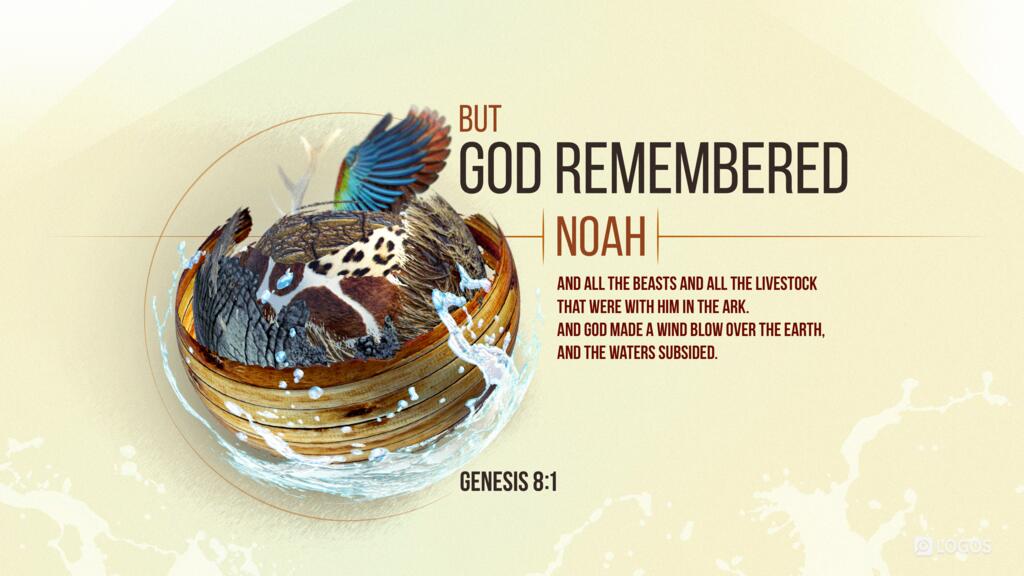
8:1But God remembered1 Noah and all the wild animals and domestic animals that were with him in the ark. God caused a wind to blow over2 the earth and the waters receded. 8:2The fountains of the deep and the floodgates of heaven were closed,3 and the rain stopped falling from the sky. 8:3The waters kept receding steadily4 from the earth, so that they5 had gone down6 by the end of the 150 days. 8:4On the seventeenth day of the seventh month, the ark came to rest on one of the mountains of Ararat.78:5The waters kept on receding8 until the tenth month. On the first day of the tenth month, the tops of the mountains became visible.9
8:6At the end of forty days,10 Noah opened the window he had made in the ark118:7and sent out a raven; it kept flying12 back and forth until the waters had dried up on the earth.
8:8Then Noah13 sent out a dove14 to see if the waters had receded15 from the surface of the ground. 8:9The dove could not find a resting place for its feet because water still covered16 the surface of the entire earth, and so it returned to Noah17 in the ark. He stretched out his hand, took the dove,18 and brought it back into the ark.198:10He waited seven more days and then sent out the dove again from the ark. 8:11When20 the dove returned to him in the evening, there was21 a freshly plucked olive leaf in its beak! Noah knew that the waters had receded from the earth. 8:12He waited another seven days and sent the dove out again,22 but it did not return to him this time.23
8:13In Noah’s six hundred and first year,24 in the first day of the first month, the waters had dried up from the earth, and Noah removed the covering from the ark and saw that25 the surface of the ground was dry. 8:14And by the twenty-seventh day of the second month the earth26 was dry.
8:15Then God spoke to Noah and said, 8:16“Come out of the ark, you, your wife, your sons, and your sons’ wives with you. 8:17Bring out with you all the living creatures that are with you. Bring out27 every living thing, including the birds, animals, and every creeping thing that creeps on the earth. Let them increase28 and be fruitful and multiply on the earth!”29
8:18Noah went out along with his sons, his wife, and his sons’ wives. 8:19Every living creature, every creeping thing, every bird, and everything that moves on the earth went out of the ark in their groups.
Footnotes
- 1 Heb “for you I see [as] godly before me in this generation.” The direct object (“you”) is placed first in the clause to give it prominence. The verb “to see” here signifies God’s evaluative discernment.
- 2 Or “seven pairs” (cf. ).
- 3 For a study of the Levitical terminology of “clean” and “unclean,” see L. E. Toombs, 1:643.
- 4 Heb “a male and his female” (also a second time at the end of this verse). The terms used here for male and female animals (אִישׁ, ’ish) and אִשָּׁה, ’ishah) normally refer to humans.
- 5 Or “seven pairs” (cf. ).
- 6 Here (and in v. 9) the Hebrew text uses the normal generic terms for “male and female” (זָכָר וּנְקֵבָה, zakhar unéqevah).
- 7 Heb “to keep alive offspring.”
- 8 Heb “for seven days yet,” meaning “after [or “in”] seven days.”
- 9 The Hiphil participle מַמְטִיר (mamtir, “cause to rain”) here expresses the certainty of the act in the imminent future.
- 10 Heb “according to all.”
- 11 Heb “Now Noah was.” The disjunctive clause (conjunction + subject + predicate nominative after implied “to be” verb) provides background information. The age of Noah receives prominence.
- 12 Heb “and the flood was water upon.” The disjunctive clause (conjunction + subject + verb) is circumstantial/temporal in relation to the preceding clause. The verb הָיָה (hayah) here carries the nuance “to come” ( 225 הָיָה). In this context the phrase “come upon” means “to engulf.”
- 13 The preposition מִן (min) is causal here, explaining why Noah and his family entered the ark.
- 14 Heb “two two” meaning “in twos.”
- 15 The Hebrew text of vv. 8–9a reads, “From the clean animal[s] and from the animal[s] which are not clean and from the bird[s] and everything that creeps on the ground, two two they came to Noah to the ark, male and female.”
- 16 Heb “Noah”; the pronoun has been used in the translation for stylistic reasons.
- 17 Heb “came upon.”
- 18 The Hebrew term תְּהוֹם (téhom, “deep”) refers to the watery deep, the salty ocean—especially the primeval ocean that surrounds and underlies the earth (see Gen 1:2). The watery deep. The same Hebrew term used to describe the watery deep in Gen 1:2 (תְּהוֹם, tihom) appears here. The text seems to picture here subterranean waters coming from under the earth and contributing to the rapid rise of water. The significance seems to be, among other things, that in this judgment God was returning the world to its earlier condition of being enveloped with water—a judgment involving the reversal of creation. On Gen 7:11 see G. F. Hasel, “The Fountains of the Great Deep,” Origins 1 (1974): 67–72; idem, “The Biblical View of the Extent of the Flood,” Origins 2 (1975): 77–95.
- 19 On the prescientific view of the sky reflected here, see L. I. J. Stadelmann, The Hebrew Conception of the World (), 46.
- 20 Heb “was.”
- 21 Heb “On that very day Noah entered, and Shem and Ham and Japheth, the sons of Noah, and the wife of Noah, and the three wives of his sons with him into the ark.”
- 22 The verb “entered” is not in the Hebrew text, but is supplied in the translation for stylistic reasons.
- 23 Heb “every bird, every wing.”
- 24 Heb “two two” meaning “in twos.”
- 25 Heb “flesh.”
- 26 Heb “Those that went in, male and female from all flesh they went in.”
- 27 Heb “and the waters were great and multiplied exceedingly.” The first verb in the sequence is וַיִּגְבְּרוּ (vayyigbéru, from גָּבַר, gavar), meaning “to become great, mighty.” The waters did not merely rise; they “prevailed” over the earth, overwhelming it.
- 28 Heb “went.”
- 29 Heb “and the waters were great exceedingly, exceedingly.” The repetition emphasizes the depth of the waters.
- 30 Heb “and.”
- 31 Heb “rose fifteen cubits.” Since a cubit is considered by most authorities to be about eighteen inches, this would make the depth 22.5 feet. This figure might give the modern reader a false impression of exactness, however, so in the translation the phrase “fifteen cubits” has been rendered “more than twenty feet.”
- 32 Heb “the waters prevailed fifteen cubits upward and they covered the mountains.” Obviously, a flood of twenty feet did not cover the mountains; the statement must mean the flood rose about twenty feet above the highest mountain.
- 33 Heb “flesh.”
- 34 Heb “everything which [has] the breath of the spirit of life in its nostrils from all which is in the dry land.”
- 35 Heb “and he”; the referent (the Lord) has been specified in the translation for clarity.
- 36 Heb “wiped away” (cf. “blotted out”).
- 37 Heb “from man to animal to creeping thing and to the bird of the sky.”
- 38 The Hebrew verb שָׁאָר (sha’ar) means “to be left over; to survive” in the Niphal verb stem. It is the word used in later biblical texts for the remnant that escapes judgment. See G. F. Hasel, “Semantic Values of Derivatives of the Hebrew Root š’r,” 11 (1973): 152–69.
- 39 The Hebrew verb translated “prevailed over” suggests that the waters were stronger than the earth. The earth and everything in it were no match for the return of the chaotic deep.
- 1 The Hebrew word translated “remembered” often carries the sense of acting in accordance with what is remembered, i.e., fulfilling covenant promises (see B. S. Childs, Memory and Tradition in Israel [], especially p. 34).
- 2 Heb “to pass over.”
- 3 Some (e.g., ) translate the preterite verb forms in this verse as past perfects (e.g., “had been closed”), for it seems likely that the sources of the water would have stopped before the waters receded.
- 4 The construction combines a Qal preterite from שׁוּב (shuv) with its infinitive absolute to indicate continuous action. The infinitive absolute from הָלָךְ (halakh) is included for emphasis: “the waters returned … going and returning.”
- 5 Heb “the waters.” The pronoun (“they”) has been employed in the translation for stylistic reasons.
- 6 The vav (ו) consecutive with the preterite here describes the consequence of the preceding action.
- 7 Heb “on the mountains of Ararat.” Obviously a boat (even one as large as the ark) cannot rest on multiple mountains. Perhaps (1) the preposition should be translated “among,” or (2) the plural “mountains” should be understood in the sense of “mountain range” (see E. A. Speiser, Genesis [], ). A more probable option (3) is that the plural indicates an indefinite singular, translated “one of the mountains” (see §124.o). Ararat is the Hebrew name for Urartu, the name of a mountainous region located north of Mesopotamia in modern day eastern Turkey. See E. M. Yamauchi, Foes from the Northern Frontier (), 29–32; G. J. Wenham, Genesis (), 1:; C. Westermann, Genesis, 1:.
- 8 Heb “the waters were going and lessening.” The perfect verb form הָיָה (hayah) is used as an auxiliary verb with the infinitive absolute חָסוֹר (khasor, “lessening”), while the infinitive absolute הָלוֹךְ (halokh) indicates continuous action.
- 9 Or “could be seen.”
- 10 The introductory verbal form וַיְהִי (vayéhi), traditionally rendered “and it came to pass,” serves as a temporal indicator and has not been translated here.
- 11 Heb “opened the window in the ark which he had made.” The perfect tense (“had made”) refers to action preceding the opening of the window, and is therefore rendered as a past perfect. Since in English “had made” could refer to either the ark or the window, the order of the phrases was reversed in the translation to clarify that the window is the referent.
- 12 Heb “and it went out, going out and returning.” The Hebrew verb יָצָא (yatsa’), translated here “flying,” is modified by two infinitives absolute indicating that the raven went back and forth.
- 13 Heb “he”; the referent (Noah) has been specified in the translation for clarity.
- 14 The Hebrew text adds “from him.” This has not been translated for stylistic reasons, because it is redundant in English.
- 15 The Hebrew verb קָלָל (qalal) normally means “to be light, to be slight”; it refers here to the waters receding.
- 16 The words “still covered” is supplied in the translation for stylistic reasons.
- 17 Heb “him”; the referent (Noah) has been specified in the translation for clarity.
- 18 Heb “it”; the referent (the dove) has been specified in the translation for clarity.
- 19 Heb “and he brought it to himself to the ark.”
- 20 The clause introduced by vav (ו) consecutive is translated as a temporal clause subordinated to the following clause.
- 21 The deictic particle הִנֵּה (hinneh) draws attention to the olive leaf. It invites readers to enter into the story, as it were, and look at the olive leaf with their own eyes.
- 22 The word “again” is not in the Hebrew text, but is supplied in the translation for stylistic reasons.
- 23 Heb “it did not again return to him still.” For a study of this section of the flood narrative, see W. O. E. Oesterley, “The Dove with the Olive Leaf (Gen VIII 8–11),” 18 (1906/07): 377–78.
- 24 Heb In the six hundred and first year.” Since this refers to the six hundred and first year of Noah’s life, the word “Noah’s” has been supplied in the translation for clarity.
- 25 Heb “and saw and look.” As in v. 11, the deictic particle הִנֵּה (hinneh) invites readers to enter into the story, as it were, and look at the dry ground with their own eyes.
- 26 In v. 13 the ground (הָאֲדָמָה, ha’adamah) is dry; now the earth (הָאָרֶץ, ha’arets) is dry.
- 27 The words “bring out” are not in the Hebrew text, but are supplied in the translation for stylistic reasons.
- 28 Following the Hiphil imperative, “bring out,” the three perfect verb forms with vav (ו) consecutive carry an imperatival nuance. For a discussion of the Hebrew construction here and the difficulty of translating it into English, see S. R. Driver, A Treatise on the Use of the Tenses in Hebrew, .
- 29 Heb “and let them swarm in the earth and be fruitful and multiply on the earth.”
The NET Bible First Edition, Copyright 1996-2005 by Biblical Studies Press