Genesis 4:17–5:32
The NET BibleOther versions
English
- NET The NET Bible
- DARBY 1890 Darby Bible
- ASV American Standard Version
- AV 1873 The Cambridge Paragraph Bible of the Authorized English Version
- CSB Christian Standard Bible
- D-R Douay-Rheims Bible
- ESV English Standard Version
- GW GOD’S WORD Translation
- GNB Good News Translation
- HCSB The Holman Christian Standard Bible
- KJV 1900 King James Version
- LSB Legacy Standard Bible
- LEB The Lexham English Bible
- MSG The Message: The Bible in Contemporary Language
- NASB95 New American Standard Bible (1995)
- NCV New Century Version
- NIrV New International Reader’s Version (1998)
- NIV New International Version (2011)
- NKJV The New King James Version
- NLT New Living Translation
- NRSVue New Revised Standard Version: Updated Edition
- RSV The Revised Standard Version
- RSVCE The Revised Standard Version, Catholic Edition
- YLT Young’s Literal Translation
Arabic
Czech
French
German
Hebrew
Hungarian
Italian
Korean
Latin
Portuguese
Russian
Simplified Chinese
Spanish
Traditional Chinese
The Beginning of Civilization
4:17Cain had marital relations42 with his wife, and she became pregnant43 and gave birth to Enoch. Cain was building a city, and he named the city after44 his son Enoch. 4:18To Enoch was born Irad, and Irad was the father45 of Mehujael. Mehujael was the father of Methushael, and Methushael was the father of Lamech.
4:19Lamech took two wives for himself; the name of the first was Adah, and the name of the second was Zillah. 4:20Adah gave birth to Jabal; he was the first46 of those who live in tents and keep47 livestock. 4:21The name of his brother was Jubal; he was the first of all who play the harp and the flute. 4:22Now Zillah also gave birth to Tubal-Cain, who heated metal and shaped48 all kinds of tools made of bronze and iron. The sister of Tubal-Cain was Naamah.
4:23Lamech said to his wives,
“Adah and Zillah! Listen to me!
You wives of Lamech, hear my words!
I have killed a man for wounding me,
a young man49 for hurting me.
4:24If Cain is to be avenged seven times as much,
then Lamech seventy-seven times!”50
4:25And Adam had marital relations51 with his wife again, and she gave birth to a son. She named him Seth, saying, “God has given52 me another child53 in place of Abel because Cain killed him.” 4:26And a son was also born to Seth, whom he named Enosh. At that time people54 began to worship55 the Lord.
From Adam to Noah
5:1This is the record1 of the family line2 of Adam.
When God created humankind,3 he made them4 in the likeness of God. 5:2He created them male and female; when they were created, he blessed them and named them “humankind.”5
5:3When6 Adam had lived 130 years he fathered a son in his own likeness, according to his image, and he named him Seth. 5:4The length of time Adam lived7 after he became the father of Seth was 800 years; during this time he had8 other9 sons and daughters. 5:5The entire lifetime10 of Adam was 930 years, and then he died.11
5:6When Seth had lived 105 years, he became the father12 of Enosh. 5:7Seth lived 807 years after he became the father of Enosh, and he had13 other14 sons and daughters. 5:8The entire lifetime of Seth was 912 years, and then he died.
5:9When Enosh had lived 90 years, he became the father of Kenan. 5:10Enosh lived 815 years after he became the father of Kenan, and he had other sons and daughters. 5:11The entire lifetime of Enosh was 905 years, and then he died.
5:12When Kenan had lived 70 years, he became the father of Mahalalel. 5:13Kenan lived 840 years after he became the father of Mahalalel, and he had other sons and daughters. 5:14The entire lifetime of Kenan was 910 years, and then he died.
5:15When Mahalalel had lived 65 years, he became the father of Jared. 5:16Mahalalel lived 830 years after he became the father of Jared, and he had other sons and daughters. 5:17The entire lifetime of Mahalalel was 895 years, and then he died.
5:18When Jared had lived 162 years, he became the father of Enoch. 5:19Jared lived 800 years after he became the father of Enoch, and he had other sons and daughters. 5:20The entire lifetime of Jared was 962 years, and then he died.
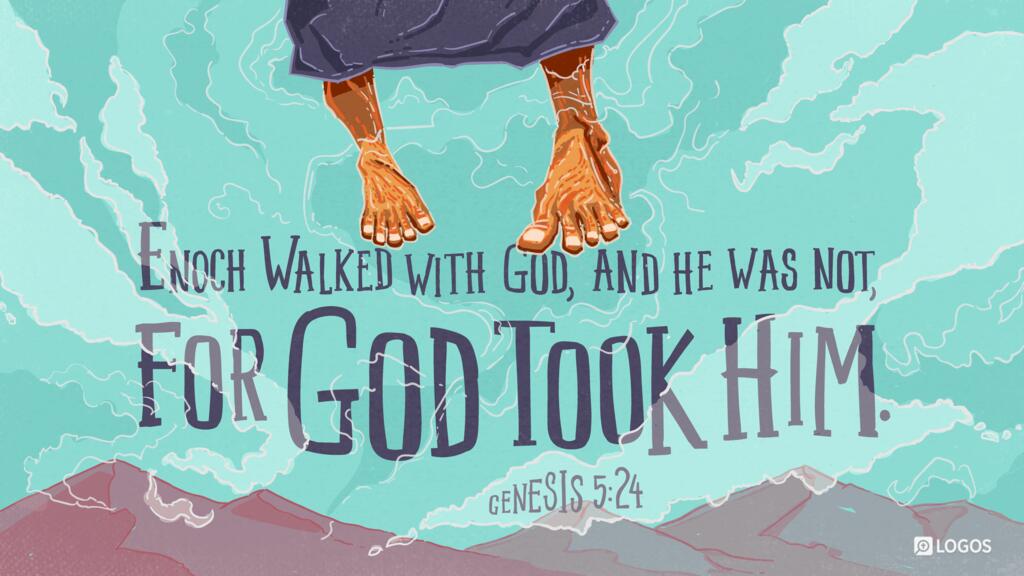
5:21When Enoch had lived 65 years, he became the father of Methuselah. 5:22After he became the father of Methuselah, Enoch walked with God15 for 300 years,16 and he had other17 sons and daughters. 5:23The entire lifetime of Enoch was 365 years. 5:24Enoch walked with God, and then he disappeared18 because God took19 him away.
5:25When Methuselah had lived 187 years, he became the father of Lamech. 5:26Methuselah lived 782 years after he became the father of Lamech, and he had other20 sons and daughters. 5:27The entire lifetime of Methuselah was 969 years, and then he died.
5:28When Lamech had lived 182 years, he had a son. 5:29He named him Noah,21 saying, “This one will bring us comfort22 from our labor and from the painful toil of our hands because of the ground that the Lord has cursed.” 5:30Lamech lived 595 years after he became the father of Noah, and he had other23 sons and daughters. 5:31The entire lifetime of Lamech was 777 years, and then he died.
5:32After Noah was 500 years old, he24 became the father of Shem, Ham, and Japheth.
Footnotes
- 42 Heb “knew,” a frequent euphemism for sexual relations.
- 43 Or “she conceived.”
- 44 Heb “according to the name of.”
- 45 Heb “and Irad fathered.”
- 46 Heb “father.” In this passage the word “father” means “founder,” referring to the first to establish such lifestyles and occupations.
- 47 The word “keep” is not in the Hebrew text, but is supplied in the translation. Other words that might be supplied instead are “tend,” “raise” (), or “have” ().
- 48 The traditional rendering here, “who forged” (or “a forger of”) is now more commonly associated with counterfeit or fraud (e.g., “forged copies” or “forged checks”) than with the forging of metal. The phrase “heated metal and shaped [it]” has been used in the translation instead.
- 49 The Hebrew term יֶלֶד (yeled) probably refers to a youthful warrior here, not a child.
- 50 Seventy-seven times. Lamech seems to reason this way: If Cain, a murderer, is to be avenged seven times (see v. 15), then how much more one who has been unjustly wronged! Lamech misses the point of God’s merciful treatment of Cain. God was not establishing a principle of justice when he warned he would avenge Cain’s murder. In fact he was trying to limit the shedding of blood, something Lamech wants to multiply instead. The use of “seventy-seven,” a multiple of seven, is hyperbolic, emphasizing the extreme severity of the vengeance envisioned by Lamech.
- 51 Heb “knew,” a frequent euphemism for sexual relations.
- 52 The name Seth probably means something like “placed”; “appointed”; “set”; “granted,” assuming it is actually related to the verb that is used in the sentiment. At any rate, the name שֵׁת (shet) and the verb שָׁת (shat, “to place, to appoint, to set, to grant”) form a wordplay (paronomasia).
- 53 Heb “offspring.”
- 54 The word “people” is not in the Hebrew text, but is supplied in the translation. The construction uses a passive verb without an expressed subject. “To call was begun” can be interpreted to mean that people began to call.
- 55 Heb “call in the name.” The expression refers to worshiping the Lord through prayer and sacrifice (see Gen 12:8; 13:4; 21:33; 26:25). See G. J. Wenham, Genesis (), 1:.
- 1 Heb “book” or “roll.” Cf. “written account”; “list.”
- 2 Heb “generations.” See the note on the phrase “this is the account of” in .
- 3 The Hebrew text has אָדָם (’adam).
- 4 Heb “him.” The Hebrew text uses the third masculine singular pronominal suffix on the accusative sign. The pronoun agrees grammatically with its antecedent אָדָם (’adam). However, the next verse makes it clear that אָדָם is collective here and refers to “humankind,” so it is preferable to translate the pronoun with the English plural.
- 5 The Hebrew word used here is אָדָם (’adam).
- 6 Heb “and Adam lived 130 years.” In the translation the verb is subordinated to the following verb, “and he fathered,” and rendered as a temporal clause.
- 7 Heb “The days of Adam.”
- 8 Heb “he fathered.”
- 9 The word “other” is not in the Hebrew text, but is supplied for stylistic reasons.
- 10 Heb “all the days of Adam which he lived”
- 11 The genealogy traces the line from Adam to Noah and forms a bridge between the earlier accounts and the flood story. Its constant theme of the reign of death in the human race is broken once with the account of Enoch, but the genealogy ends with hope for the future through Noah. See further G. F. Hasel, “The Genealogies of Gen. 5 and 11 and their Alleged Babylonian Background,” 16 (1978): 361–74; idem, “Genesis 5 and 11,” Origins 7 (1980): 23–37.
- 12 Heb “he fathered.”
- 13 Heb “he fathered.”
- 14 Here and in vv. 10, 13, 16, 19 the word “other” is not in the Hebrew text, but is supplied for stylistic reasons.
- 15 With the seventh panel there is a digression from the pattern. Instead of simply saying that Enoch lived, the text observes that he “walked with God.” The rare expression “walked with” (the Hitpael form of the verb הָלָךְ, halakh, “to walk” collocated with the preposition אֶת, ’et, “with”) is used in 1 Sam 25:15 to describe how David’s men maintained a cordial and cooperative relationship with Nabal’s men as they worked and lived side by side in the fields. In Gen 5:22 the phrase suggests that Enoch and God “got along.” This may imply that Enoch lived in close fellowship with God, leading a life of devotion and piety. An early Jewish tradition, preserved in 1:9 and alluded to in Jude 14, says that Enoch preached about the coming judgment. See F. S. Parnham, “Walking with God,” 46 (1974): 117–18.
- 16 Heb “and Enoch walked with God, after he became the father of Methuselah, [for] 300 years.”
- 17 The word “other” is not in the Hebrew text, but is supplied for stylistic reasons.
- 18 The Hebrew construction has the negative particle אֵין (’en, “there is not,” “there was not”) with a pronominal suffix, “he was not.” Instead of saying that Enoch died, the text says he no longer was present.
- 19 The text simply states that God took Enoch. Similar language is used of Elijah’s departure from this world (see 2 Kgs 2:10). The text implies that God overruled death for this man who walked with him.
- 20 The word “other” is not in the Hebrew text, but is supplied for stylistic reasons.
- 21 The name Noah appears to be related to the Hebrew word נוּחַ (nuakh, “to rest”). There are several wordplays on the name “Noah” in the story of the flood.
- 22 The Hebrew verb יְנַחֲמֵנוּ (yénakhamenu) is from the root נָחָם (nakham), which means “to comfort” in the Piel verbal stem. The letters ן (nun) and ח (heth) pick up the sounds in the name “Noah,” forming a paronomasia on the name. They are not from the same verbal root, and so the connection is only by sound. Lamech’s sentiment reflects the oppression of living under the curse on the ground, but also expresses the hope for relief in some way through the birth of Noah. His words proved to be ironic but prophetic. The relief would come with a new beginning after the flood. See E. G. Kraeling, “The Interpretations of the Name Noah in Genesis 5:29,” 48 (1929): 138–43.
- 23 The word “other” is not in the Hebrew text, but is supplied for stylistic reasons.
- 24 Heb “Noah.” The pronoun (“he”) has been employed in the translation for stylistic reasons.
The NET Bible First Edition, Copyright 1996-2005 by Biblical Studies Press