Exodus 3:2–4
The NET BibleOther versions
English
- NET The NET Bible
- DARBY 1890 Darby Bible
- ASV American Standard Version
- AV 1873 The Cambridge Paragraph Bible of the Authorized English Version
- CSB Christian Standard Bible
- D-R Douay-Rheims Bible
- ESV English Standard Version
- GW GOD’S WORD Translation
- GNB Good News Translation
- HCSB The Holman Christian Standard Bible
- KJV 1900 King James Version
- LSB Legacy Standard Bible
- LEB The Lexham English Bible
- MSG The Message: The Bible in Contemporary Language
- NASB95 New American Standard Bible (1995)
- NCV New Century Version
- NIrV New International Reader’s Version (1998)
- NIV New International Version (2011)
- NKJV The New King James Version
- NLT New Living Translation
- NRSVue New Revised Standard Version: Updated Edition
- RSV The Revised Standard Version
- RSVCE The Revised Standard Version, Catholic Edition
- TNIV Today’s New International Version
- YLT Young’s Literal Translation
Arabic
Czech
French
German
Hebrew
Hungarian
Italian
Korean
Latin
Portuguese
Russian
Simplified Chinese
Spanish
Traditional Chinese
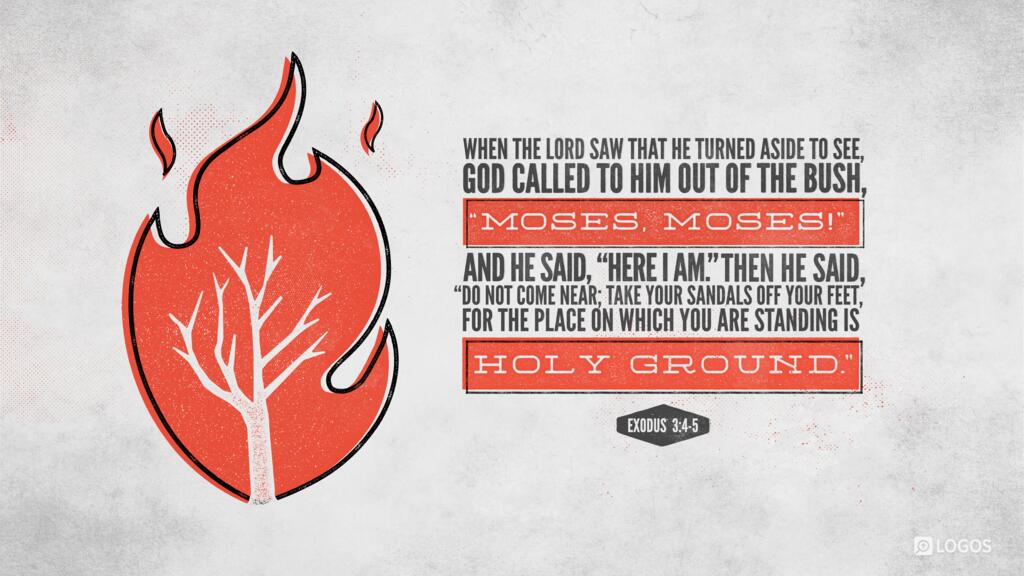
3:2The angel of the Lord4 appeared5 to him in6 a flame of fire from within a bush.7 He looked8—and9 the bush was ablaze with fire, but it was not being consumed!103:3So Moses thought,11 “I will turn aside to see12 this amazing13 sight. Why does the bush not burn up?”143:4When the Lord15 saw that16 he had turned aside to look, God called to him from within the bush and said, “Moses, Moses!”17 And Moses18 said, “Here I am.”
Footnotes
- 4 The designation “the angel of the Lord” (Heb “the angel of Yahweh”) occurred in Genesis already (16:7–13; 21:17; 22:11–18). There is some ambiguity in the expression, but it seems often to be interchangeable with God’s name itself, indicating that it refers to the Lord.
- 5 The verb וַיֵּרָא (vayyera’) is the Niphal preterite of the verb “to see.” For similar examples of רָאָה (ra’ah) in Niphal where the subject “appears,” that is, allows himself to be seen, or presents himself, see Gen 12:7; 35:9; 46:29; Exod 6:3; and 23:17. B. Jacob notes that God appears in this way only to individuals and never to masses of people; it is his glory that appears to the masses (Exodus, 49).
- 6 Gesenius rightly classifies this as a bet (ב) essentiae ( §119.i); it would then indicate that Yahweh appeared to Moses “as a flame.”
- 7 Fire frequently accompanies the revelation of Yahweh in Exodus as he delivers Israel, guides her, and purifies her. The description here is unique, calling attention to the manifestation as a flame of fire from within the bush. Philo was the first to interpret the bush as Israel, suffering under the persecution of Egypt but never consumed. The Bible leaves the interpretation open. However, in this revelation the fire is coming from within the bush, not from outside, and it represents the Lord who will deliver his people from persecution. See further E. Levine, “The Evolving Symbolism of the Burning Bush,” Dor le Dor 8 (1979): 185–93.
- 8 Heb “And he saw.”
- 9 The text again uses the deictic particle with vav, וְהִנֵּה (véhinneh), traditionally rendered “and behold.” The particle goes with the intense gaze, the outstretched arm, the raised eyebrow—excitement and intense interest: “look, over there.” It draws the reader into the immediate experience of the subject.
- 10 The construction uses the suffixed negative אֵינֶנּוּ (’enennu) to convey the subject of the passive verb: “It was not” consumed. This was the amazing thing, for nothing would burn faster in the desert than a thornbush on fire.
- 11 Heb “And Moses said.” The implication is that Moses said this to himself.
- 12 The construction uses the cohortative אָסֻרָה־נָּא (’asura-nna’) followed by an imperfect with vav (וְאֶרְאֶה, vé’er’eh) to express the purpose or result (logical sequence): “I will turn aside in order that I may see.”
- 13 Heb “great.” The word means something extraordinary here. In using this term Moses revealed his reaction to the strange sight and his anticipation that something special was about to happen. So he turned away from the flock to investigate.
- 14 The verb is an imperfect. Here it has the progressive nuance—the bush is not burning up.
- 15 The preterite with the vav (ו) is subordinated as a temporal clause to the main point of the verse, that God called to him. The language is anthropomorphic, as if God’s actions were based on his observing what Moses did.
- 16 The particle כִּי (ki, “that”) introduces the noun clause that functions as the direct object of the verb “saw” (R. J. Williams, Hebrew Syntax, 81, §490).
- 17 The repetition of the name in God’s call is emphatic, making the appeal direct and immediate (see also Gen 22:11; 46:2). The use of the personal name shows how specifically God directed the call and that he knew this person. The repetition may have stressed even more that it was indeed he whom the Lord wanted. It would have been an encouragement to Moses that this was in fact the Lord who was meeting him.
- 18 Heb “And he said”; the referent (Moses) has been specified in the translation for clarity.
The NET Bible First Edition, Copyright 1996-2005 by Biblical Studies Press
In other versions
ESVEnglish Standard Version
And the angel of the Lord appeared to him in a flame of fire out of the midst of a bush. He looked, and behold, the bush was burning, yet it was not consumed. And Moses said, “I will turn aside to see this great sight, why the bush is not burned.” When the Lord saw that he turned aside to see, God called to him out of the bush, “Moses, Moses!” And he said, “Here I am.”
Copyright 2001 Crossway Bibles
NIVNew International Version (2011)
There the angel of the Lord appeared to him in flames of fire from within a bush. Moses saw that though the bush was on fire it did not burn up. So Moses thought, “I will go over and see this strange sight—why the bush does not burn up.”
When the Lord saw that he had gone over to look, God called to him from within the bush, “Moses! Moses!”
And Moses said, “Here I am.”
Copyright 1973, 1978, 1984, 2011 Biblica, Inc.
CSBChristian Standard Bible
Then the angel of the Lord appeared to him in a flame of fire within a bush. As Moses looked, he saw that the bush was on fire but was not consumed. So Moses thought, “I must go over and look at this remarkable sight. Why isn’t the bush burning up?”
When the Lord saw that he had gone over to look, God called out to him from the bush, “Moses, Moses!”
“Here I am,” he answered.
Copyright 2017 Holman Bible Publishers
NLTNew Living Translation
There the angel of the Lord appeared to him in a blazing fire from the middle of a bush. Moses stared in amazement. Though the bush was engulfed in flames, it didn’t burn up. “This is amazing,” Moses said to himself. “Why isn’t that bush burning up? I must go see it.”
When the Lord saw Moses coming to take a closer look, God called to him from the middle of the bush, “Moses! Moses!”
“Here I am!” Moses replied.
Holy Bible, New Living Translation, copyright © 1996, 2004, 2015 by Tyndale House Foundation. Used by permission of Tyndale House Publishers. All rights reserved.
LEBThe Lexham English Bible
And the angel of Yahweh appeared to him in a flame of fire from the midst of a bush, and he looked, and there was the bush burning with fire, but the bush was not being consumed. And Moses said, “Let me turn aside and see this great sight. Why does the bush not burn up?” And Yahweh saw that he turned aside to see, and God called to him from the midst of the bush, and he said, “Moses, Moses.” And he said, “Here I am.”
Copyright 2012 Lexham Press
KJV 1900King James Version
And the angel of the Lord appeared unto him in a flame of fire out of the midst of a bush: and he looked, and, behold, the bush burned with fire, and the bush was not consumed. And Moses said, I will now turn aside, and see this great sight, why the bush is not burnt. And when the Lord saw that he turned aside to see, God called unto him out of the midst of the bush, and said, Moses, Moses. And he said, Here am I.
Public Domain