Genesis 16:7–13
The NET BibleOther versions
English
- NET The NET Bible
- DARBY 1890 Darby Bible
- ASV American Standard Version
- AV 1873 The Cambridge Paragraph Bible of the Authorized English Version
- CSB Christian Standard Bible
- D-R Douay-Rheims Bible
- ESV English Standard Version
- GW GOD’S WORD Translation
- GNB Good News Translation
- HCSB The Holman Christian Standard Bible
- KJV 1900 King James Version
- LSB Legacy Standard Bible
- LEB The Lexham English Bible
- MSG The Message: The Bible in Contemporary Language
- NASB95 New American Standard Bible (1995)
- NCV New Century Version
- NIrV New International Reader’s Version (1998)
- NIV New International Version (2011)
- NKJV The New King James Version
- NLT New Living Translation
- NRSVue New Revised Standard Version: Updated Edition
- RSV The Revised Standard Version
- RSVCE The Revised Standard Version, Catholic Edition
- TNIV Today’s New International Version
- YLT Young’s Literal Translation
Arabic
Czech
French
German
Hebrew
Hungarian
Italian
Korean
Latin
Portuguese
Russian
Simplified Chinese
Spanish
Traditional Chinese
16:7The Lord’s angel26 found Hagar near a spring of water in the desert—the spring that is along the road to Shur.2716:8He said, “Hagar, servant of Sarai, where have you come from, and where are you going?” She replied, “I’m running away from28 my mistress, Sarai.”
16:9Then the Lord’s angel said to her, “Return to your mistress and submit29 to her authority. 16:10I will greatly multiply your descendants,” the Lord’s angel added,30 “so that they will be too numerous to count.”3116:11Then the Lord’s angel said to her,
“You are now32 pregnant
and are about to give birth33 to a son.
You are to name him Ishmael,34
for the Lord has heard your painful groans.35
16:12He will be a wild donkey36 of a man.
He will be hostile to everyone,37
and everyone will be hostile to him.38
He will live away from39 his brothers.”
16:13So Hagar named the Lord who spoke to her, “You are the God who sees me,”40 for she said, “Here I have seen one who sees me!”41
Footnotes
- 26 Heb “the messenger of the Lord.” Some identify the angel of the Lord as the preincarnate Christ because in some texts the angel is identified with the Lord himself. However, it is more likely that the angel merely represents the Lord; he can speak for the Lord because he is sent with the Lord’s full authority. In some cases the angel is clearly distinct from the Lord (see Judg 6:11–23). It is not certain if the same angel is always in view. Though the proper name following the noun “angel” makes the construction definite, this may simply indicate that a definite angel sent from the Lord is referred to in any given context. It need not be the same angel on every occasion. Note the analogous expression “the servant of the Lord,” which refers to various individuals in the OT (see 714 עֶבֶד).
- 27 Heb “And the angel of the Lord found her near the spring of water in the desert, near the spring on the way to Shur.”
- 28 Heb “from the presence of.”
- 29 The imperative וְהִתְעַנִּי (véhit’anni) is the Hitpael of עָנָה (’anah, here translated “submit”), the same word used for Sarai’s harsh treatment of her. Hagar is instructed not only to submit to Sarai’s authority, but to whatever mistreatment that involves. God calls for Hagar to humble herself.
- 30 Heb “The Lord’s angel said, ‘I will greatly multiply your descendants.…” The order of the clauses has been rearranged in the translation for stylistic reasons.
- 31 Heb “cannot be numbered because of abundance.”
- 32 The particle הִנֵּה (hinneh) focuses on her immediate situation: “Here you are pregnant.”
- 33 The active participle refers here to something that is about to happen.
- 34 The name Ishmael consists of the imperfect or jussive form of the Hebrew verb with the theophoric element added as the subject. It means “God hears” or “may God hear.”
- 35 Heb “affliction,” which must refer here to Hagar’s painful groans of anguish. This clause gives the explanation of the name Ishmael, using a wordplay. Ishmael’s name will be a reminder that “God hears” Hagar’s painful cries.
- 36 A wild donkey of a man. The prophecy is not an insult. The wild donkey lived a solitary existence in the desert away from society. Ishmael would be free-roaming, strong, and like a bedouin; he would enjoy the freedom his mother sought.
- 37 Heb “His hand will be against everyone.” The “hand” by metonymy represents strength. His free-roaming life style would put him in conflict with those who follow social conventions. There would not be open warfare, only friction because of his antagonism to their way of life.
- 38 Heb “And the hand of everyone will be against him.”
- 39 Heb “opposite, across from.” Ishmael would live on the edge of society (cf. “to the east of”). Some take this as an idiom meaning “be at odds with” (cf. , ) or “live in hostility toward” (cf. ).
- 40 Heb “God of my seeing.” The pronominal suffix may be understood either as objective (“who sees me,” as in the translation) or subjective (“whom I see”).
- 41 Heb “after one who sees me.” For a discussion of Hagar’s exclamation, see T. Booij, “Hagar’s Words in Genesis 16:13b,” 30 (1980): 1–7.
The NET Bible First Edition, Copyright 1996-2005 by Biblical Studies Press
In other versions
ESVEnglish Standard Version
The angel of the Lord found her by a spring of water in the wilderness, the spring on the way to Shur. And he said, “Hagar, servant of Sarai, where have you come from and where are you going?” She said, “I am fleeing from my mistress Sarai.” The angel of the Lord said to her, “Return to your mistress and submit to her.” The angel of the Lord also said to her, “I will surely multiply your offspring so that they cannot be numbered for multitude.” And the angel of the Lord said to her,
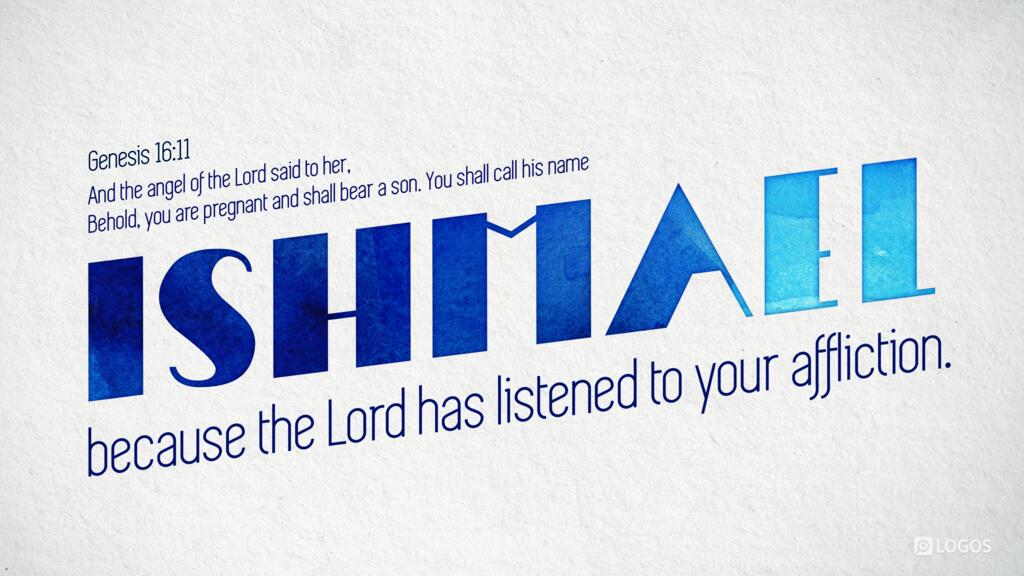
“Behold, you are pregnant
and shall bear a son.
You shall call his name Ishmael,
because the Lord has listened to your affliction.
He shall be a wild donkey of a man,
his hand against everyone
and everyone’s hand against him,
and he shall dwell over against all his kinsmen.”
So she called the name of the Lord who spoke to her, “You are a God of seeing,” for she said, “Truly here I have seen him who looks after me.”
Copyright 2001 Crossway Bibles
NIVNew International Version (2011)
The angel of the Lord found Hagar near a spring in the desert; it was the spring that is beside the road to Shur. And he said, “Hagar, slave of Sarai, where have you come from, and where are you going?”
“I’m running away from my mistress Sarai,” she answered.
Then the angel of the Lord told her, “Go back to your mistress and submit to her.” The angel added, “I will increase your descendants so much that they will be too numerous to count.”
The angel of the Lord also said to her:
“You are now pregnant
and you will give birth to a son.
You shall name him Ishmael,
for the Lord has heard of your misery.
He will be a wild donkey of a man;
his hand will be against everyone
and everyone’s hand against him,
and he will live in hostility
toward all his brothers.”
She gave this name to the Lord who spoke to her: “You are the God who sees me,” for she said, “I have now seen the One who sees me.”
Copyright 1973, 1978, 1984, 2011 Biblica, Inc.
CSBChristian Standard Bible
The angel of the Lord found her by a spring in the wilderness, the spring on the way to Shur. He said, “Hagar, slave of Sarai, where have you come from and where are you going?”
She replied, “I’m running away from my mistress Sarai.”
The angel of the Lord said to her, “Go back to your mistress and submit to her authority.” The angel of the Lord said to her, “I will greatly multiply your offspring, and they will be too many to count.”
The angel of the Lord said to her, “You have conceived and will have a son. You will name him Ishmael, for the Lord has heard your cry of affliction. This man will be like a wild donkey. His hand will be against everyone, and everyone’s hand will be against him; he will settle near all his relatives.”
So she named the Lord who spoke to her: “You are El-roi,” for she said, “In this place, have I actually seen the one who sees me?”
Copyright 2017 Holman Bible Publishers
NLTNew Living Translation
The angel of the Lord found Hagar beside a spring of water in the wilderness, along the road to Shur. The angel said to her, “Hagar, Sarai’s servant, where have you come from, and where are you going?”
“I’m running away from my mistress, Sarai,” she replied.
The angel of the Lord said to her, “Return to your mistress, and submit to her authority.” Then he added, “I will give you more descendants than you can count.”
And the angel also said, “You are now pregnant and will give birth to a son. You are to name him Ishmael (which means ‘God hears’), for the Lord has heard your cry of distress. This son of yours will be a wild man, as untamed as a wild donkey! He will raise his fist against everyone, and everyone will be against him. Yes, he will live in open hostility against all his relatives.”
Thereafter, Hagar used another name to refer to the Lord, who had spoken to her. She said, “You are the God who sees me.” She also said, “Have I truly seen the One who sees me?”
Holy Bible, New Living Translation, copyright © 1996, 2004, 2015 by Tyndale House Foundation. Used by permission of Tyndale House Publishers. All rights reserved.
LEBThe Lexham English Bible
And the angel of Yahweh found her at a spring of water in the wilderness, at the spring by the road of Shur. And he said to Hagar, the female slave of Sarai, “From where have you come, and where are you going?” And she said, “I am fleeing from the presence of Sarai my mistress.” Then the angel of Yahweh said to her, “Return to your mistress and submit yourself under her authority.” And the angel of Yahweh said to her, “I will greatly multiply your offspring, so that they cannot be counted for their abundance.” And the angel of Yahweh said to her:
“Behold, you are pregnant
and shall have a son.
And you shall call his name Ishmael,
for Yahweh has listened to your suffering.
And he shall be a wild donkey of a man,
his hand will be against everyone,
and the hand of everyone will be against him,
and he will live in hostility with all his brothers.”
So she called the name of Yahweh who spoke to her, “You are El-Roi,” for she said, “Here I have seen after he who sees me.”
Copyright 2012 Lexham Press
KJV 1900King James Version
And the angel of the Lord found her by a fountain of water in the wilderness, by the fountain in the way to Shur. And he said, Hagar, Sarai’s maid, whence camest thou? and whither wilt thou go? And she said, I flee from the face of my mistress Sarai. And the angel of the Lord said unto her, Return to thy mistress, and submit thyself under her hands. And the angel of the Lord said unto her, I will multiply thy seed exceedingly, that it shall not be numbered for multitude. And the angel of the Lord said unto her, Behold, thou art with child, and shalt bear a son, and shalt call his name Ishmael; because the Lord hath heard thy affliction. And he will be a wild man; his hand will be against every man, and every man’s hand against him; and he shall dwell in the presence of all his brethren. And she called the name of the Lord that spake unto her, Thou God seest me: for she said, Have I also here looked after him that seeth me?
Public Domain