Exodus 3:2–10
The NET BibleOther versions
English
- NET The NET Bible
- DARBY 1890 Darby Bible
- ASV American Standard Version
- AV 1873 The Cambridge Paragraph Bible of the Authorized English Version
- CSB Christian Standard Bible
- D-R Douay-Rheims Bible
- ESV English Standard Version
- GW GOD’S WORD Translation
- GNB Good News Translation
- HCSB The Holman Christian Standard Bible
- KJV 1900 King James Version
- LSB Legacy Standard Bible
- LEB The Lexham English Bible
- MSG The Message: The Bible in Contemporary Language
- NASB95 New American Standard Bible (1995)
- NCV New Century Version
- NIrV New International Reader’s Version (1998)
- NIV New International Version (2011)
- NKJV The New King James Version
- NLT New Living Translation
- NRSVue New Revised Standard Version: Updated Edition
- RSV The Revised Standard Version
- RSVCE The Revised Standard Version, Catholic Edition
- TNIV Today’s New International Version
- YLT Young’s Literal Translation
Arabic
Czech
French
German
Hebrew
Hungarian
Italian
Korean
Latin
Portuguese
Russian
Simplified Chinese
Spanish
Traditional Chinese
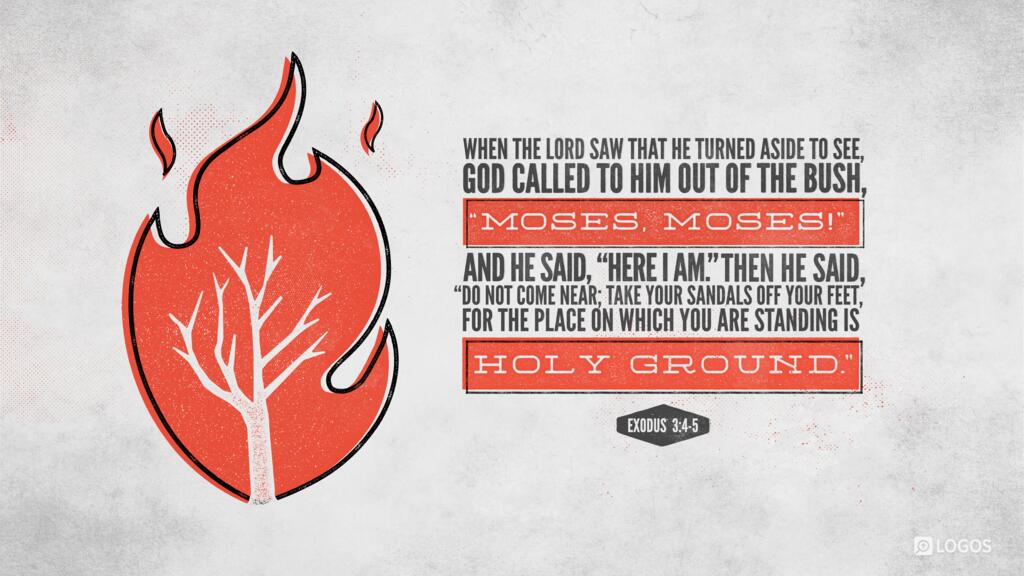
3:2The angel of the Lord4 appeared5 to him in6 a flame of fire from within a bush.7 He looked8—and9 the bush was ablaze with fire, but it was not being consumed!103:3So Moses thought,11 “I will turn aside to see12 this amazing13 sight. Why does the bush not burn up?”143:4When the Lord15 saw that16 he had turned aside to look, God called to him from within the bush and said, “Moses, Moses!”17 And Moses18 said, “Here I am.” 3:5God19 said, “Do not approach any closer!20 Take your sandals off your feet, for the place where you are standing is holy21 ground.”223:6He added, “I am the God of your father,23 the God of Abraham, the God of Isaac, and the God of Jacob.” Then Moses hid his face, because he was afraid to look24 at God.
3:7The Lord said, “I have surely seen25 the affliction of my people who are in Egypt. I have heard their cry because of their taskmasters, for I know their sorrows.263:8I have come down27 to deliver them28 from the hand of the Egyptians and to bring them up from that land to a land that is both good and spacious,29 to a land flowing with milk and honey,30 to the region of the Canaanites, Hittites, Amorites, Perizzites, Hivites, and Jebusites.313:9And now indeed32 the cry33 of the Israelites has come to me, and I have also seen how severely the Egyptians oppress them.343:10So now go, and I will send you35 to Pharaoh to bring my people, the Israelites, out of Egypt.”
Footnotes
- 4 The designation “the angel of the Lord” (Heb “the angel of Yahweh”) occurred in Genesis already (16:7–13; 21:17; 22:11–18). There is some ambiguity in the expression, but it seems often to be interchangeable with God’s name itself, indicating that it refers to the Lord.
- 5 The verb וַיֵּרָא (vayyera’) is the Niphal preterite of the verb “to see.” For similar examples of רָאָה (ra’ah) in Niphal where the subject “appears,” that is, allows himself to be seen, or presents himself, see Gen 12:7; 35:9; 46:29; Exod 6:3; and 23:17. B. Jacob notes that God appears in this way only to individuals and never to masses of people; it is his glory that appears to the masses (Exodus, 49).
- 6 Gesenius rightly classifies this as a bet (ב) essentiae ( §119.i); it would then indicate that Yahweh appeared to Moses “as a flame.”
- 7 Fire frequently accompanies the revelation of Yahweh in Exodus as he delivers Israel, guides her, and purifies her. The description here is unique, calling attention to the manifestation as a flame of fire from within the bush. Philo was the first to interpret the bush as Israel, suffering under the persecution of Egypt but never consumed. The Bible leaves the interpretation open. However, in this revelation the fire is coming from within the bush, not from outside, and it represents the Lord who will deliver his people from persecution. See further E. Levine, “The Evolving Symbolism of the Burning Bush,” Dor le Dor 8 (1979): 185–93.
- 8 Heb “And he saw.”
- 9 The text again uses the deictic particle with vav, וְהִנֵּה (véhinneh), traditionally rendered “and behold.” The particle goes with the intense gaze, the outstretched arm, the raised eyebrow—excitement and intense interest: “look, over there.” It draws the reader into the immediate experience of the subject.
- 10 The construction uses the suffixed negative אֵינֶנּוּ (’enennu) to convey the subject of the passive verb: “It was not” consumed. This was the amazing thing, for nothing would burn faster in the desert than a thornbush on fire.
- 11 Heb “And Moses said.” The implication is that Moses said this to himself.
- 12 The construction uses the cohortative אָסֻרָה־נָּא (’asura-nna’) followed by an imperfect with vav (וְאֶרְאֶה, vé’er’eh) to express the purpose or result (logical sequence): “I will turn aside in order that I may see.”
- 13 Heb “great.” The word means something extraordinary here. In using this term Moses revealed his reaction to the strange sight and his anticipation that something special was about to happen. So he turned away from the flock to investigate.
- 14 The verb is an imperfect. Here it has the progressive nuance—the bush is not burning up.
- 15 The preterite with the vav (ו) is subordinated as a temporal clause to the main point of the verse, that God called to him. The language is anthropomorphic, as if God’s actions were based on his observing what Moses did.
- 16 The particle כִּי (ki, “that”) introduces the noun clause that functions as the direct object of the verb “saw” (R. J. Williams, Hebrew Syntax, 81, §490).
- 17 The repetition of the name in God’s call is emphatic, making the appeal direct and immediate (see also Gen 22:11; 46:2). The use of the personal name shows how specifically God directed the call and that he knew this person. The repetition may have stressed even more that it was indeed he whom the Lord wanted. It would have been an encouragement to Moses that this was in fact the Lord who was meeting him.
- 18 Heb “And he said”; the referent (Moses) has been specified in the translation for clarity.
- 19 Heb “And he”; the referent (God) has been specified in the translation for clarity.
- 20 Even though the Lord was drawing near to Moses, Moses could not casually approach him. There still was a barrier between God and human, and God had to remind Moses of this with instructions. The removal of sandals was, and still is in the East, a sign of humility and reverence in the presence of the Holy One. It was a way of excluding the dust and dirt of the world. But it also took away personal comfort and convenience and brought the person more closely in contact with the earth.
- 21 The word קֹדֶשׁ (qodesh, “holy”) indicates “set apart, distinct, unique.” What made a mountain or other place holy was the fact that God chose that place to reveal himself or to reside among his people. Because God was in this place, the ground was different—it was holy.
- 22 The causal clause includes within it a typical relative clause, which is made up of the relative pronoun, then the independent personal pronoun with the participle, and then the preposition with the resumptive pronoun. It would literally be “which you are standing on it,” but the relative pronoun and the resumptive pronoun are combined and rendered, “on which you are standing.”
- 23 This self-revelation by Yahweh prepares for the revelation of the holy name. While no verb is used here, the pronoun and the predicate nominative are a construction used throughout scripture to convey the “I am” disclosures—“I [am] the God of.…” But the significant point here is the naming of the patriarchs, for this God is the covenant God, who will fulfill his promises.
- 24 The clause uses the Hiphil infinitive construct with a preposition after the perfect tense: יָרֵא מֵהַבִּיט (yare’ mehabbit, “he was afraid from gazing”) meaning “he was afraid to gaze.” The preposition min (מִן) is used before infinitives after verbs like the one to complete the verb (see 583 7b).
- 25 The use of the infinitive absolute with the perfect tense intensifies the statement: I have surely seen—there is no doubt that I have seen and will do something about it.
- 26 Two new words are introduced now to the report of suffering: “affliction” and “pain/suffering.” These add to the dimension of the oppression of God’s people.
- 27 God’s coming down is a frequent anthropomorphism in Genesis and Exodus. It expresses his direct involvement, often in the exercise of judgment.
- 28 The Hiphil infinitive with the suffix is לְהַצִּילוֹ (léhatsilo, “to deliver them”). It expresses the purpose of God’s coming down. The verb itself is used for delivering or rescuing in the general sense, and snatching out of danger for the specific.
- 29 Heb “to a land good and large”; “to a good and broad land.” In the translation the words “that is both” are supplied because in contemporary English “good and” combined with any additional descriptive term can be understood as elative (“good and large” = “very large”; “good and spacious” = “very spacious”; “good and ready” = “very ready”). The point made in the Hebrew text is that the land to which they are going is both good (in terms of quality) and large (in terms of size).
- 30 This vibrant description of the promised land is a familiar one. Gesenius classifies “milk and honey” as epexegetical genitives because they provide more precise description following a verbal adjective in the construct state ( §128.x). The land is modified by “flowing,” and “flowing” is explained by the genitives “milk and honey.” These two products will be in abundance in the land, and they therefore exemplify what a desirable land it is. The language is hyperbolic, as if the land were streaming with these products.
- 31 Each people group is joined to the preceding by the vav conjunction, “and.” Each also has the definite article, as in other similar lists (3:17; 13:5; 34:11). To repeat the conjunction and article in the translation seems to put more weight on the list in English than is necessary to its function in identifying what land God was giving the Israelites.
- 32 The particle הִנֵּה (hinneh) focuses attention on what is being said as grounds for what follows.
- 33 The word is a technical term for the outcry one might make to a judge. God had seen the oppression and so knew that the complaints were accurate, and so he initiated the proceedings against the oppressors (B. Jacob, Exodus, 59).
- 34 Heb “seen the oppression with which the Egyptians oppress them.” The word for the oppression is now לַחַץ (lakhats), which has the idea of pressure with the oppression—squeezing, pressuring—which led to its later use in the Semitic languages for torture. The repetition in the Hebrew text of the root in the participle form after this noun serves to stress the idea. This emphasis has been represented in the translation by the expression “seen how severely the Egyptians oppress them.”
- 35 The verse has a sequence of volitives. The first form is the imperative לְכָה (lékha, “go”). Then comes the cohortative/imperfect form with the vav (ו), “and I will send you” or more likely “that I may send you” (וְאֶשְׁלָחֲךָ, vé’eshlakhakha), which is followed by the imperative with the vav, “and bring out” or “that you may bring out” (וְהוֹצֵא, véhotse’). The series of actions begins with Moses going. When he goes, it will be the Lord who sends him, and if the Lord sends him, it will be with the purpose of leading Israel out of Egypt. These instructions for Moses are based on the preceding revelation made to him. The deliverance of Israel was to be God’s work—hence, “I will send you.” When God commissioned people, often using the verb “to send,” it indicated that they went with his backing, his power, and his authority. Moses could not have brought Israel out without this. To name this incident a commissioning, then, means that the authority came from God to do the work (compare John 3:2).
The NET Bible First Edition, Copyright 1996-2005 by Biblical Studies Press