Exodus 3:14
The NET BibleOther versions
English
- NET The NET Bible
- DARBY 1890 Darby Bible
- ASV American Standard Version
- AV 1873 The Cambridge Paragraph Bible of the Authorized English Version
- CSB Christian Standard Bible
- D-R Douay-Rheims Bible
- ESV English Standard Version
- GW GOD’S WORD Translation
- GNB Good News Translation
- HCSB The Holman Christian Standard Bible
- KJV 1900 King James Version
- LSB Legacy Standard Bible
- LEB The Lexham English Bible
- MSG The Message: The Bible in Contemporary Language
- NASB95 New American Standard Bible (1995)
- NCV New Century Version
- NIrV New International Reader’s Version (1998)
- NIV New International Version (2011)
- NKJV The New King James Version
- NLT New Living Translation
- NRSVue New Revised Standard Version: Updated Edition
- RSV The Revised Standard Version
- RSVCE The Revised Standard Version, Catholic Edition
- TNIV Today’s New International Version
- YLT Young’s Literal Translation
Arabic
Czech
French
German
Hebrew
Hungarian
Italian
Korean
Latin
Portuguese
Russian
Simplified Chinese
Spanish
Traditional Chinese
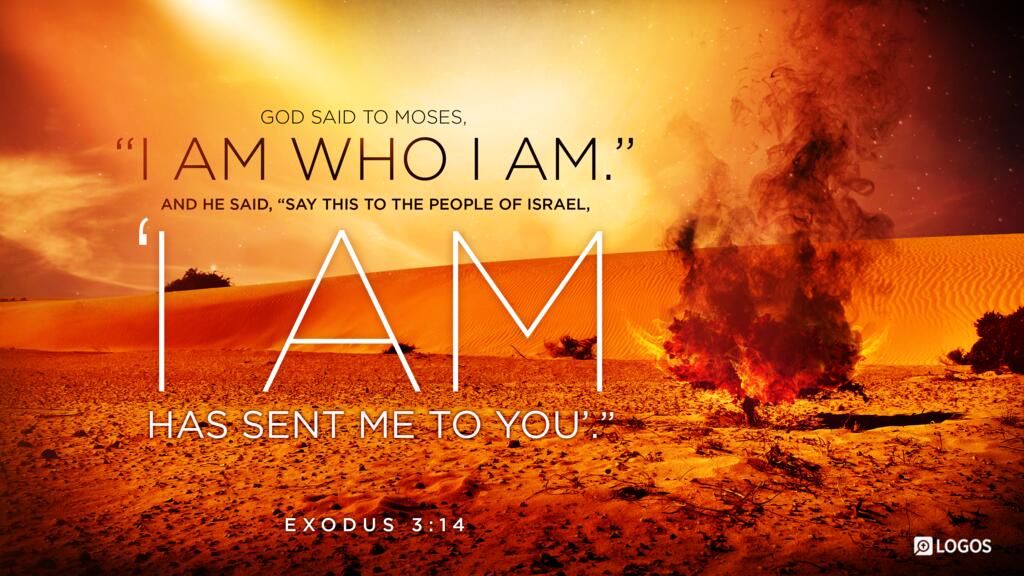
3:14God said to Moses, “I am that I am.”47 And he said, “You must say this48 to the Israelites, ‘I am has sent me to you.’ ”
Footnotes
- 47 The verb form used here is אֶהְיֶה (’ehyeh), the Qal imperfect, first person common singular, of the verb הָיָה (haya, “to be”). It forms an excellent paronomasia with the name. So when God used the verb to express his name, he used this form saying, “I am.” When his people refer to him as Yahweh, which is the third person masculine singular form of the same verb, they say “he is.” Some commentators argue for a future tense translation, “I will be who I will be,” because the verb has an active quality about it, and the Israelites lived in the light of the promises for the future. They argue that “I am” would be of little help to the Israelites in bondage. But a translation of “I will be” does not effectively do much more except restrict it to the future. The idea of the verb would certainly indicate that God is not bound by time, and while he is present (“I am”) he will always be present, even in the future, and so “I am” would embrace that as well (see also Ruth 2:13; Ps 50:21; Hos 1:9). The Greek translation of the OT used a participle to capture the idea, and several times in the Gospels Jesus used the powerful “I am” with this significance (e.g., John 8:58). The point is that Yahweh is sovereignly independent of all creation and that his presence guarantees the fulfillment of the covenant (cf. Isa 41:4; 42:6, 8; 43:10–11; 44:6; 45:5–7). Others argue for a causative Hiphil translation of “I will cause to be,” but nowhere in the Bible does this verb appear in Hiphil or Piel. A good summary of the views can be found in G. H. Parke-Taylor, Yahweh, the Divine Name in the Bible. See among the many articles: B. Beitzel, “Exodus 3:14 and the Divine Name: A Case of Biblical Paronomasia,” 1 (1980): ; C. D. Isbell, “The Divine Name ehyeh as a Symbol of Presence in Israelite Tradition,” 2 (1978): 101–18; J. G. Janzen, “What’s in a Name? Yahweh in Exodus 3 and the Wider Biblical Context,” 33 (1979): 227–39; J. R. Lundbom, “God’s Use of the Idem per Idem to Terminate Debate,” 71 (1978): 193–201; A. R. Millard, “Yw and Yhw Names,” 30 (1980): 208–12; and R. Youngblood, “A New Occurrence of the Divine Name ‘I AM,’ ” 15 (1972): .
- 48 Or “Thus you shall say” (also in the following verse). The word “must” in the translation conveys the instructional and imperatival force of the statement.
The NET Bible First Edition, Copyright 1996-2005 by Biblical Studies Press
In other versions
ESVEnglish Standard Version
God said to Moses, “I am who I am.” And he said, “Say this to the people of Israel: ‘I am has sent me to you.’ ”
Copyright 2001 Crossway Bibles
NIVNew International Version (2011)
God said to Moses, “I am who I am. This is what you are to say to the Israelites: ‘I am has sent me to you.’ ”
Copyright 1973, 1978, 1984, 2011 Biblica, Inc.
CSBChristian Standard Bible
God replied to Moses, “I AM WHO I AM. This is what you are to say to the Israelites: I AM has sent me to you.”
Copyright 2017 Holman Bible Publishers
NLTNew Living Translation
God replied to Moses, “I Am Who I Am. Say this to the people of Israel: I Am has sent me to you.”
Holy Bible, New Living Translation, copyright © 1996, 2004, 2015 by Tyndale House Foundation. Used by permission of Tyndale House Publishers. All rights reserved.
LEBThe Lexham English Bible
And God said to Moses, “I am that I am.” And he said, “So you must say to the Israelites, ‘I am sent me to you.’ ”
Copyright 2012 Lexham Press
KJV 1900King James Version
And God said unto Moses, I AM THAT I AM: and he said, Thus shalt thou say unto the children of Israel, I AM hath sent me unto you.
Public Domain