Exodus 28:15–30
The NET BibleOther versions
English
- NET The NET Bible
- DARBY 1890 Darby Bible
- ASV American Standard Version
- AV 1873 The Cambridge Paragraph Bible of the Authorized English Version
- CSB Christian Standard Bible
- D-R Douay-Rheims Bible
- ESV English Standard Version
- GW GOD’S WORD Translation
- GNB Good News Translation
- HCSB The Holman Christian Standard Bible
- KJV 1900 King James Version
- LSB Legacy Standard Bible
- LEB The Lexham English Bible
- MSG The Message: The Bible in Contemporary Language
- NASB95 New American Standard Bible (1995)
- NCV New Century Version
- NIrV New International Reader’s Version (1998)
- NIV New International Version (2011)
- NKJV The New King James Version
- NLT New Living Translation
- NRSVue New Revised Standard Version: Updated Edition
- RSV The Revised Standard Version
- RSVCE The Revised Standard Version, Catholic Edition
- TNIV Today’s New International Version
- YLT Young’s Literal Translation
Arabic
Czech
French
German
Hebrew
Hungarian
Italian
Korean
Latin
Portuguese
Russian
Simplified Chinese
Spanish
Traditional Chinese
28:15“You are to make a breastpiece for use in making decisions,26 the work of an artistic designer; you are to make it in the same fashion as the ephod; you are to make it of gold, blue, purple, scarlet, and fine twisted linen. 28:16It is to be square27 when28 doubled, nine inches29 long and nine inches wide. 28:17You are to set in it a setting for stones, four rows of stones, a row with a ruby, a topaz, and a beryl—the first row; 28:18and the second row, a turquoise, a sapphire, and an emerald; 28:19and the third row, a jacinth, an agate, and an amethyst; 28:20and the fourth row, a chrysolite, an onyx, and a jasper.30 They are to be enclosed in gold in their filigree settings. 28:21The stones are to be for the names of the sons of Israel, twelve, according to the number of31 their names. Each name according to the twelve tribes is to be like32 the engravings of a seal.
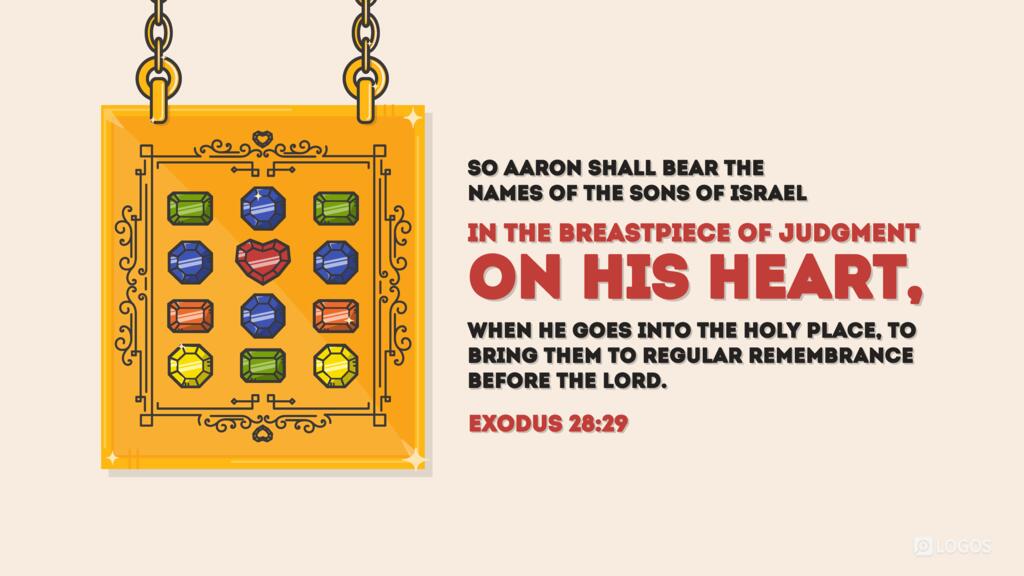
28:22“You are to make for the breastpiece braided chains like cords of pure gold, 28:23and you are to make for the breastpiece two gold rings and attach33 the two rings to the upper34 two ends of the breastpiece. 28:24You are to attach the two gold chains to the two rings at the ends of the breastpiece; 28:25the other35 two ends of the two chains you will attach to the two settings and then attach them36 to the shoulder pieces of the ephod at the front of it. 28:26You are to make two rings of gold and put them on the other37 two ends of the breastpiece, on its edge that is on the inner side of the ephod. 28:27You are to make two more38 gold rings and attach them to the bottom of the two shoulder pieces on the front of the ephod, close to the juncture above the waistband of the ephod. 28:28They are to tie the breastpiece by its rings to the rings of the ephod by blue cord, so that it may be above the waistband of the ephod, and so that the breastpiece will not be loose from the ephod. 28:29Aaron will bear the names of the sons of Israel in the breastpiece of decision over his heart39 when he goes into the holy place, for a memorial before the Lord continually.
28:30“You are to put the Urim and the Thummim40 into the breastpiece of decision; and they are to be over Aaron’s heart when he goes in before the Lord. Aaron is to bear the decisions41 of the Israelites over his heart before the Lord continually.
Footnotes
- 26 Heb “a breastpiece of decision” (חֹשֶׁן מִשְׁפָּט, khoshen mishpat; so ). The first word, rendered “breastpiece,” is of uncertain etymology. This item was made of material similar to the ephod. It had four rows of three gems on it, bearing the names of the tribes. In it were the urim and thummim. J. P. Hyatt refers to a similar object found in the Egyptian reliefs, including even the twisted gold chains used to hang it from the priest (Exodus [], 282).
- 27 Heb “four.”
- 28 “when” is added for clarification (U. Cassuto, Exodus, ).
- 29 The word זֶרֶת (zeret) is half a cubit; it is often translated “span.”
- 30 U. Cassuto (Exodus, ) points out that these are the same precious stones mentioned in Ezek 28:13 that were to be found in Eden, the garden of God. So the priest, when making atonement, was to wear the precious gems that were there and symbolized the garden of Eden when man was free from sin.
- 31 For clarity the words “the number of” have been supplied.
- 32 The phrase translated “the engravings of a seal” is an adverbial accusative of manner here.
- 33 Heb “give, put.”
- 34 Here “upper” has been supplied.
- 35 Here “the other” has been supplied.
- 36 Here “them” has been supplied.
- 37 Here “other” has been supplied.
- 38 Here “more” has been supplied.
- 39 So Aaron will have the names of the tribes on his shoulders (v. 12) which bear the weight and symbol of office (see Isa 9:6; 22:22), and over his heart (implying that they have a constant place in his thoughts [Deut 6:6]). Thus he was to enter the presence of God as the nation’s representative, ever mindful of the nation’s interests, and ever bringing the remembrance of it before God (S. R. Driver, Exodus, ).
- 40 The Urim and the Thummim were two objects intended for determining the divine will. There is no clear evidence of their size or shape or the material of which they were made, but they seem to have been familiar items to Moses and the people. The best example of their use comes from 1 Sam 14:36–42. Some have suggested from the etymologies that they were light and dark objects respectively, perhaps stones or sticks or some other object. They seem to have fallen out of use after the Davidic period when the prophetic oracles became popular. It may be that the title “breastpiece of judgment” indicates that these objects were used for making “decisions” (J. P. Hyatt, Exodus [], 283–84). U. Cassuto has the most thorough treatment of the subject (Exodus, ); he lists several very clear rules for their uses gathered from their instances in the Bible, including that they were a form of sacred lot, that priests or leaders of the people only could use them, and that they were used for discovering the divine will in areas that were beyond human knowledge.
- 41 Or “judgment” (, , , ). The term is מִשְׁפָּט (mishpat), the same word that describes the breastpiece that held the two objects. Here it is translated “decisions” since the Urim and Thummim contained in the breastpiece represented the means by which the Lord made decisions for the Israelites. The high priest bore the responsibility of discerning the divine will on matters of national importance.
The NET Bible First Edition, Copyright 1996-2005 by Biblical Studies Press