Deuteronomy 6:6–9
The NET BibleOther versions
English
- NET The NET Bible
- DARBY 1890 Darby Bible
- ASV American Standard Version
- AV 1873 The Cambridge Paragraph Bible of the Authorized English Version
- CSB Christian Standard Bible
- D-R Douay-Rheims Bible
- ESV English Standard Version
- GW GOD’S WORD Translation
- GNB Good News Translation
- HCSB The Holman Christian Standard Bible
- KJV 1900 King James Version
- LSB Legacy Standard Bible
- LEB The Lexham English Bible
- MSG The Message: The Bible in Contemporary Language
- NASB95 New American Standard Bible (1995)
- NCV New Century Version
- NIrV New International Reader’s Version (1998)
- NIV New International Version (2011)
- NKJV The New King James Version
- NLT New Living Translation
- NRSVue New Revised Standard Version: Updated Edition
- RSV The Revised Standard Version
- RSVCE The Revised Standard Version, Catholic Edition
- TNIV Today’s New International Version
- YLT Young’s Literal Translation
Arabic
Czech
French
German
Hebrew
Hungarian
Italian
Korean
Latin
Portuguese
Russian
Simplified Chinese
Spanish
Traditional Chinese
Exhortation to Teach the Covenant Principles
6:6These words I am commanding you today must be kept in mind, 6:7and you must teach12 them to your children and speak of them as you sit in your house, as you walk along the road,13 as you lie down, and as you get up. 6:8You should tie them as a reminder on your forearm14 and fasten them as symbols15 on your forehead. 6:9Inscribe them on the doorframes of your houses and gates.16
Footnotes
- 12 Heb “repeat” (so ). If from the root I שָׁנַן (shanan), the verb means essentially to “engrave,” that is, “to teach incisively” (Piel); note “Drill them into your children.” Cf. 1041–42
- 13 Or “as you are away on a journey” (cf. , , ); “at home and abroad.”
- 14 Tie them as a sign on your forearm. Later Jewish tradition referred to the little leather containers tied to the forearms and foreheads as tefillin. They were to contain the following passages from the Torah: Exod 13:1–10, 11–16; Deut 6:5–9; 11:13–21. The purpose was to serve as a “sign” of covenant relationship and obedience.
- 15 Fasten them as symbols on your forehead. These were also known later as tefillin (see previous note) or phylacteries (from the Greek term). These box-like containers, like those on the forearms, held the same scraps of the Torah. It was the hypocritical practice of wearing these without heartfelt sincerity that caused Jesus to speak scathingly about them (cf. Matt 23:5).
- 16 The Hebrew term מְזוּזֹת (mézuzot) refers both to the door frames and to small cases attached on them containing scripture texts (always Deut 6:4–9 and 11:13–21; and sometimes the decalogue; Exod 13:1–10, 11–16; and Num 10:35–36). See J. H. Tigay, Deuteronomy (), .
The NET Bible First Edition, Copyright 1996-2005 by Biblical Studies Press
In other versions
ESVEnglish Standard Version
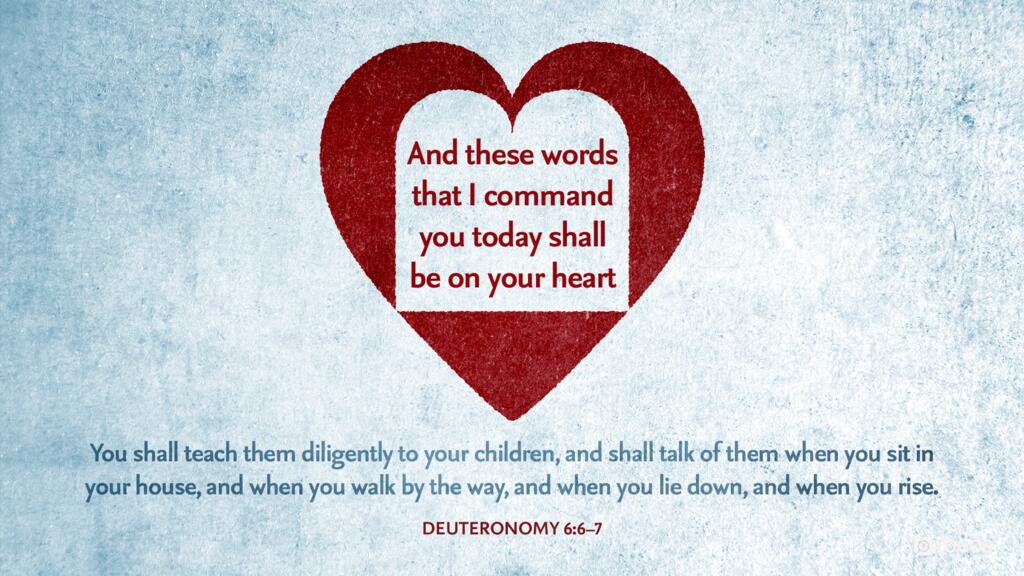
And these words that I command you today shall be on your heart. You shall teach them diligently to your children, and shall talk of them when you sit in your house, and when you walk by the way, and when you lie down, and when you rise. You shall bind them as a sign on your hand, and they shall be as frontlets between your eyes. You shall write them on the doorposts of your house and on your gates.
Copyright 2001 Crossway Bibles
NIVNew International Version (2011)
These commandments that I give you today are to be on your hearts. Impress them on your children. Talk about them when you sit at home and when you walk along the road, when you lie down and when you get up. Tie them as symbols on your hands and bind them on your foreheads. Write them on the doorframes of your houses and on your gates.
Copyright 1973, 1978, 1984, 2011 Biblica, Inc.
CSBChristian Standard Bible
These words that I am giving you today are to be in your heart. Repeat them to your children. Talk about them when you sit in your house and when you walk along the road, when you lie down and when you get up. Bind them as a sign on your hand and let them be a symbol on your forehead. Write them on the doorposts of your house and on your city gates.
Copyright 2017 Holman Bible Publishers
NLTNew Living Translation
And you must commit yourselves wholeheartedly to these commands that I am giving you today. Repeat them again and again to your children. Talk about them when you are at home and when you are on the road, when you are going to bed and when you are getting up. Tie them to your hands and wear them on your forehead as reminders. Write them on the doorposts of your house and on your gates.
Holy Bible, New Living Translation, copyright © 1996, 2004, 2015 by Tyndale House Foundation. Used by permission of Tyndale House Publishers. All rights reserved.
LEBThe Lexham English Bible
And these words that I am commanding you today shall be on your heart. And you shall recite them to your children, and you shall talk about them at the time of your living in your house and at the time of your going on the road and at the time of your lying down and at the time of your rising up. And you shall bind them as a sign on your hand, and they shall be as an emblem between your eyes. And you shall write them on the doorframe of your house and on your gates.
Copyright 2012 Lexham Press
KJV 1900King James Version
And these words, which I command thee this day, shall be in thine heart: And thou shalt teach them diligently unto thy children, and shalt talk of them when thou sittest in thine house, and when thou walkest by the way, and when thou liest down, and when thou risest up. And thou shalt bind them for a sign upon thine hand, and they shall be as frontlets between thine eyes. And thou shalt write them upon the posts of thy house, and on thy gates.
Public Domain