Deuteronomy 4:25–31
The NET BibleOther versions
English
- NET The NET Bible
- DARBY 1890 Darby Bible
- ASV American Standard Version
- AV 1873 The Cambridge Paragraph Bible of the Authorized English Version
- CSB Christian Standard Bible
- D-R Douay-Rheims Bible
- ESV English Standard Version
- GW GOD’S WORD Translation
- GNB Good News Translation
- HCSB The Holman Christian Standard Bible
- KJV 1900 King James Version
- LSB Legacy Standard Bible
- LEB The Lexham English Bible
- MSG The Message: The Bible in Contemporary Language
- NASB95 New American Standard Bible (1995)
- NCV New Century Version
- NIrV New International Reader’s Version (1998)
- NIV New International Version (2011)
- NKJV The New King James Version
- NLT New Living Translation
- NRSVue New Revised Standard Version: Updated Edition
- RSV The Revised Standard Version
- RSVCE The Revised Standard Version, Catholic Edition
- TNIV Today’s New International Version
- YLT Young’s Literal Translation
Arabic
Czech
French
German
Hebrew
Hungarian
Italian
Korean
Latin
Portuguese
Russian
Simplified Chinese
Spanish
Traditional Chinese
Threat and Blessing following Covenant Disobedience
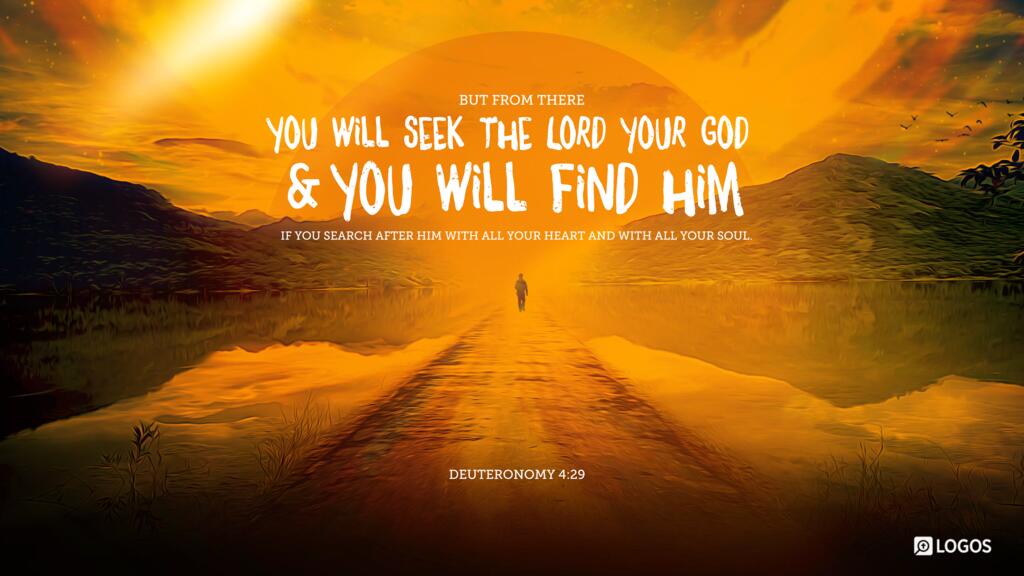
4:25After you have produced children and grandchildren and have been in the land a long time,42 if you become corrupt and make an image of any kind43 and do other evil things before the Lord your God that enrage him,444:26I invoke heaven and earth as witnesses against you45 today that you will surely and swiftly be removed46 from the very land you are about to cross the Jordan to possess. You will not last long there because you will surely be47 annihilated. 4:27Then the Lord will scatter you among the peoples and there will be very few of you48 among the nations where the Lord will drive you. 4:28There you will worship gods made by human hands—wood and stone that can neither see, hear, eat, nor smell. 4:29But if you seek the Lord your God from there, you will find him, if, indeed, you seek him with all your heart and soul.494:30In your distress when all these things happen to you in the latter days,50 if you return to the Lord your God and obey him514:31(for he52 is a merciful God), he will not let you down53 or destroy you, for he cannot54 forget the covenant with your ancestors that he confirmed by oath to them.
Footnotes
- 42 Heb “have grown old in the land,” i.e., been there for a long time.
- 43 Heb “a form of anything.” Cf. , , , “an idol.”
- 44 The infinitive construct is understood here as indicating the result, not the intention, of their actions.
- 45 I invoke heaven and earth as witnesses against you. This stock formula introduces what is known form-critically as a רִיב (riv) or controversy pattern. It is commonly used in the ancient Near Eastern world in legal contexts and in the OT as a forensic or judicial device to draw attention to Israel’s violation of the Lord’s covenant with them (see Deut 30:19; Isa 1:2; 3:13; Jer 2:9). Since court proceedings required the testimony of witnesses, the Lord here summons heaven and earth (that is, all creation) to testify to his faithfulness, Israel’s disobedience, and the threat of judgment.
- 46 Or “be destroyed”; “utterly perish”; “will quickly disappear”; “you won’t have long to live.”
- 47 Or “be completely” (so , ). It is not certain here if the infinitive absolute indicates the certainty of the following action (cf. ) or its degree.
- 48 Heb “you will be left men (i.e., few) of number.”
- 49 Or “mind and being.” See Deut 6:5.
- 50 The phrase is not used here in a technical sense for the eschaton, but rather refers to a future time when Israel will be punished for its sin and experience exile. See Deut 31:29.
- 51 Heb “hear his voice.” The expression is an idiom meaning “obey,” occurring in Deut 8:20; 9:23; 13:18; 21:18, 20; 26:14, 17; 27:10; 28:1–2, 15, 45, 62; 30:2, 8, 10, 20.
- 52 Heb “the Lord your God.” See note on “he” in .
- 53 Heb “he will not drop you,” i.e., “will not abandon you” (cf. , , , ).
- 54 Or “will not.” The translation understands the imperfect verbal form to have an added nuance of capability here.
The NET Bible First Edition, Copyright 1996-2005 by Biblical Studies Press