Daniel 7:9–14
The NET BibleOther versions
English
- NET The NET Bible
- DARBY 1890 Darby Bible
- ASV American Standard Version
- AV 1873 The Cambridge Paragraph Bible of the Authorized English Version
- CSB Christian Standard Bible
- D-R Douay-Rheims Bible
- ESV English Standard Version
- GW GOD’S WORD Translation
- GNB Good News Translation
- HCSB The Holman Christian Standard Bible
- KJV 1900 King James Version
- LSB Legacy Standard Bible
- LEB The Lexham English Bible
- MSG The Message: The Bible in Contemporary Language
- NASB95 New American Standard Bible (1995)
- NCV New Century Version
- NIrV New International Reader’s Version (1998)
- NIV New International Version (2011)
- NKJV The New King James Version
- NLT New Living Translation
- NRSVue New Revised Standard Version: Updated Edition
- RSV The Revised Standard Version
- RSVCE The Revised Standard Version, Catholic Edition
- TNIV Today’s New International Version
- YLT Young’s Literal Translation
Arabic
Czech
French
German
Hebrew
Hungarian
Italian
Korean
Latin
Portuguese
Russian
Simplified Chinese
Spanish
Traditional Chinese
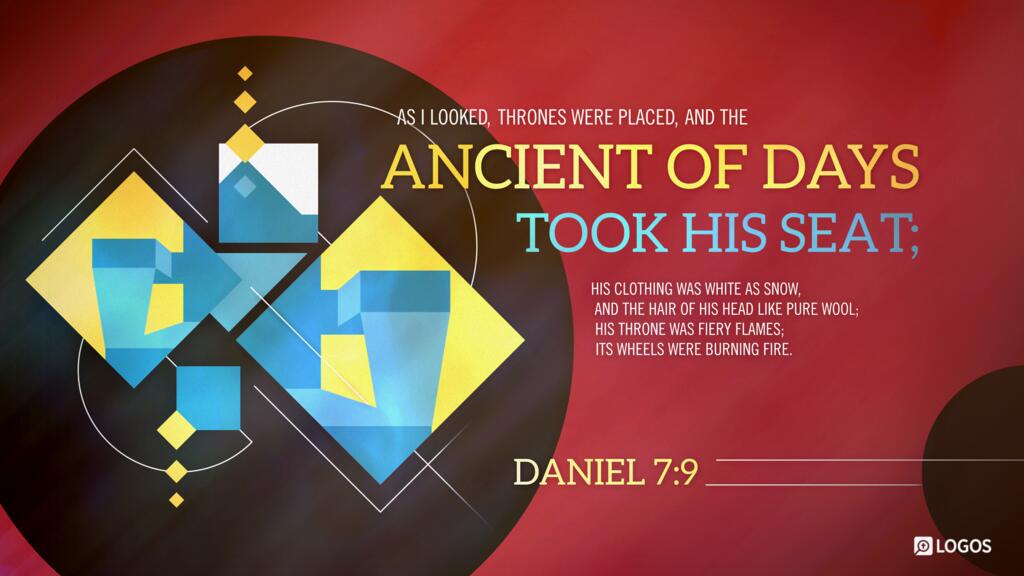
7:9“While I was watching,
thrones were set up,
and the Ancient of Days24 took his seat.
His attire was white like snow;
the hair of his head was like lamb’s25 wool.
His throne was ablaze with fire
and its wheels were all aflame.26
7:10A river of fire was streaming forth
and proceeding from his presence.
Many thousands were ministering to him;
Many tens of thousands stood ready to serve him.27
The court convened28
and the books were opened.
7:11“Then I kept on watching because of the arrogant words of the horn that was speaking. I was watching29 until the beast was killed and its body destroyed and thrown into30 the flaming fire. 7:12As for the rest of the beasts, their ruling authority had already been removed, though they were permitted to go on living31 for a time and a season. 7:13I was watching in the night visions,
“And with32 the clouds of the sky33
one like a son of man34 was approaching.
He went up to the Ancient of Days
and was escorted35 before him.
7:14To him was given ruling authority, honor, and sovereignty.
All peoples, nations, and language groups were serving36 him.
His authority is eternal and will not pass away.37
His kingdom will not be destroyed.38
Footnotes
- 24 Or “the Ancient One” (, , ), although the traditional expression has been retained in the present translation because it is familiar to many readers. Cf. “One who had been living for ever”; “the Eternal God.”
- 25 Traditionally the Aramaic word נְקֵא (néqe’) has been rendered “pure,” but here it more likely means “of a lamb.” Cf. the neqya’ (“a sheep, ewe”). On this word see further, M. Sokoloff, “’amar neqe’, ‘Lamb’s Wool’ (Dan 7:9),” 95 (1976): 277–79.
- 26 Aram “a flaming fire.”
- 27 Aram “were standing before him.”
- 28 Aram “judgment sat.”
- 29 The and Theodotion lack the words “I was watching” here. It is possible that these words in the are a dittography from the first part of the verse.
- 30 Aram “and given over to” (so ).
- 31 Aram “a prolonging of life was granted to them.”
- 32 The has ἐπί (epi, “upon”) here (cf. Matt 24:30; 26:64). Theodotion has μετά (meta, “with”) here (cf. Mark 14:62; Rev 1:7).
- 33 Or “the heavens.” The Hebrew term שָׁמַיִם (shamayim) may be translated “heavens” or “sky” depending on the context.
- 34 This text is probably the main OT background for Jesus’ use of the term “son of man.” In both Jewish and Christian circles the reference in the book of Daniel has traditionally been understood to refer to an individual, usually in a messianic sense. Many modern scholars, however, understand the reference to have a corporate identity. In this view, the “son of man” is to be equated with the “holy ones” (vv. 18, 21, 22, 25) or the “people of the holy ones” (v. 27) and understood as a reference to the Jewish people. Others understand Daniel’s reference to be to the angel Michael.
- 35 Aram “they brought him near.”
- 36 Some take “serving” here in the sense of “worshiping.”
- 37 Aram “is an eternal authority which will not pass away.”
- 38 Aram “is one which will not be destroyed.”
The NET Bible First Edition, Copyright 1996-2005 by Biblical Studies Press