2 Samuel 21:7–14
The NET BibleOther versions
English
- NET The NET Bible
- DARBY 1890 Darby Bible
- ASV American Standard Version
- AV 1873 The Cambridge Paragraph Bible of the Authorized English Version
- CSB Christian Standard Bible
- D-R Douay-Rheims Bible
- ESV English Standard Version
- GW GOD’S WORD Translation
- GNB Good News Translation
- HCSB The Holman Christian Standard Bible
- KJV 1900 King James Version
- LSB Legacy Standard Bible
- LEB The Lexham English Bible
- MSG The Message: The Bible in Contemporary Language
- NASB95 New American Standard Bible (1995)
- NCV New Century Version
- NIrV New International Reader’s Version (1998)
- NIV New International Version (2011)
- NKJV The New King James Version
- NLT New Living Translation
- NRSVue New Revised Standard Version: Updated Edition
- RSV The Revised Standard Version
- RSVCE The Revised Standard Version, Catholic Edition
- TNIV Today’s New International Version
- YLT Young’s Literal Translation
Arabic
Czech
French
German
Hebrew
Hungarian
Italian
Korean
Latin
Portuguese
Russian
Simplified Chinese
Spanish
Traditional Chinese
21:7The king had mercy on Mephibosheth son of Jonathan, the son of Saul, in light of the Lord’s oath that had been taken between David and Jonathan son of Saul. 21:8So the king took Armoni and Mephibosheth, the two sons of Aiah’s daughter Rizpah whom she had born to Saul, and the five sons of Saul’s daughter Merab10 whom she had born to Adriel the son of Barzillai the Meholathite. 21:9He turned them over to the Gibeonites, and they executed them on a hill before the Lord. The seven of them11 died12 together; they were put to death during harvest time—during the first days of the beginning13 of the barley harvest.
21:10Rizpah the daughter of Aiah took sackcloth and spread it out for herself on a rock. From the beginning of the harvest until the rain fell on them,14 she did not allow the birds of the air to feed15 on them by day, nor the wild animals16 by night. 21:11When David was told what Rizpah daughter of Aiah, Saul’s concubine, had done, 21:12he17 went and took the bones of Saul and of his son Jonathan18 from the leaders19 of Jabesh Gilead. (They had secretly taken20 them from the plaza at Beth Shan. It was there that Philistines21 publicly exposed their corpses22 after23 they24 had killed Saul at Gilboa.) 21:13David25 brought the bones of Saul and of Jonathan his son from there; they also gathered up the bones of those who had been executed.
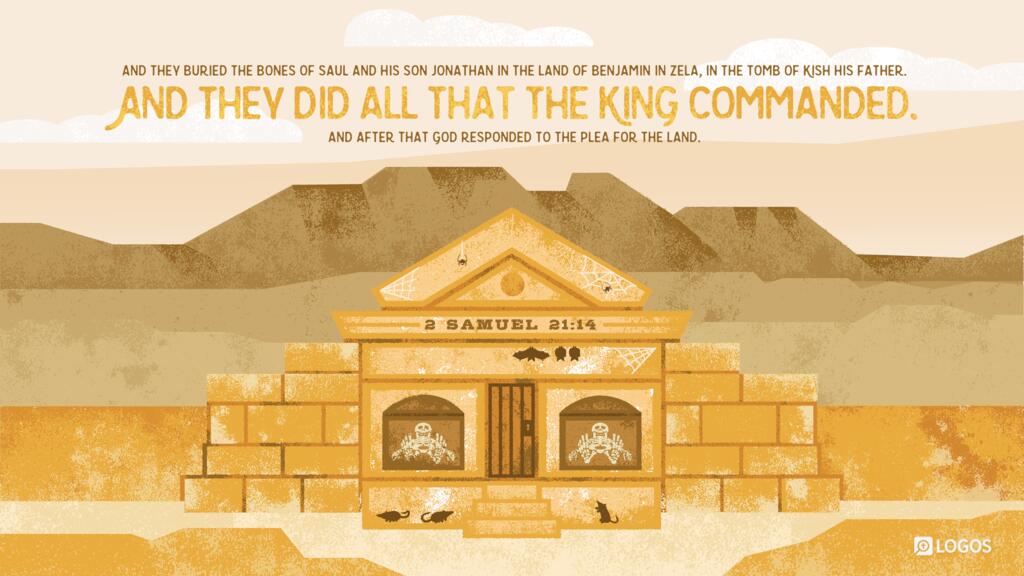
21:14They buried the bones of Saul and his son Jonathan in the land of Benjamin at Zela in the grave of his father Kish. After they had done everything26 that the king had commanded, God responded to their prayers27 for the land.
Footnotes
- 10 The reads “Michal” here, but two Hebrew manuscripts read “Merab,” along with some manuscripts. Cf. 1 Sam 18:19.
- 11 The translation follows the Qere and several medieval Hebrew in reading שְׁבַעְתָּם (shéva’tam, “the seven of them”) rather than שִׁבַעְתִּים (shiva’tim, “seventy”).
- 12 Heb “fell.”
- 13 The translation follows the Qere and many medieval Hebrew in reading בִּתְחִלַּת (bithkhillat, “in the beginning”) rather than תְחִלַּת (tékhillat, “beginning of”).
- 14 Heb “until water was poured on them from the sky.”
- 15 Heb “rest.”
- 16 Heb “the beasts of the field.”
- 17 Heb “David.” For stylistic reasons the name has been replaced by the pronoun (“he”) in the translation.
- 18 Heb “the bones of Saul and the bones of Jonathan his son.” See also v. 13.
- 19 Heb “lords.”
- 20 Heb “stolen.”
- 21 Against the , this word is better read without the definite article. The reading is probably here the result of wrong word division, with the letter ה (he) belonging with the preceding word שָׁם (sham) as the he directive (i.e., שָׁמָּה, samah, “to there”).
- 22 Heb “had hung them.”
- 23 Heb “in the day.”
- 24 Heb “Philistines.”
- 25 Heb “he”; the referent (David) has been specified in the translation for clarity.
- 26 Many medieval Hebrew have here כְּכֹל (kékhol, “according to all”).
- 27 Heb “was entreated.” The verb is an example of the so-called niphal tolerativum, with the sense that God allowed himself to be supplicated through prayer (cf. §51.c).
The NET Bible First Edition, Copyright 1996-2005 by Biblical Studies Press