2 Samuel 21:7–14
GOD’S WORD TranslationOther versions
English
- GW GOD’S WORD Translation
- DARBY 1890 Darby Bible
- ASV American Standard Version
- AV 1873 The Cambridge Paragraph Bible of the Authorized English Version
- CSB Christian Standard Bible
- D-R Douay-Rheims Bible
- ESV English Standard Version
- GNB Good News Translation
- HCSB The Holman Christian Standard Bible
- KJV 1900 King James Version
- LSB Legacy Standard Bible
- LEB The Lexham English Bible
- MSG The Message: The Bible in Contemporary Language
- NET The NET Bible
- NASB95 New American Standard Bible (1995)
- NCV New Century Version
- NIrV New International Reader’s Version (1998)
- NIV New International Version (2011)
- NKJV The New King James Version
- NLT New Living Translation
- NRSVue New Revised Standard Version: Updated Edition
- RSV The Revised Standard Version
- RSVCE The Revised Standard Version, Catholic Edition
- TNIV Today’s New International Version
- YLT Young’s Literal Translation
Arabic
Czech
French
German
Hebrew
Hungarian
Italian
Korean
Latin
Portuguese
Russian
Simplified Chinese
Spanish
Traditional Chinese
7But the king spared Mephibosheth, Jonathan’s son and Saul’s grandson, because of the oath in the Lord’s name between David and Jonathan, son of Saul. 8The king took Armoni and Mephibosheth, the two sons whom Rizpah (Aiah’s daughter) gave birth to for Saul, and five sons whom Meraba(Saul’s daughter) gave birth to for Adriel, son of Barzillai from Meholah. 9The king handed them over to the Gibeonites, who executed them on the mountain in the Lord’s presence. All seven died together. They were killed at the beginning of the harvest, when people started harvesting barley.
10Rizpah (Aiah’s daughter) took sackcloth and stretched it out on the rock for herself from the beginning of the harvest until the sky rained on the dead bodies. She wouldn’t let any birds land on them during the day or any wild animals come near them during the night.
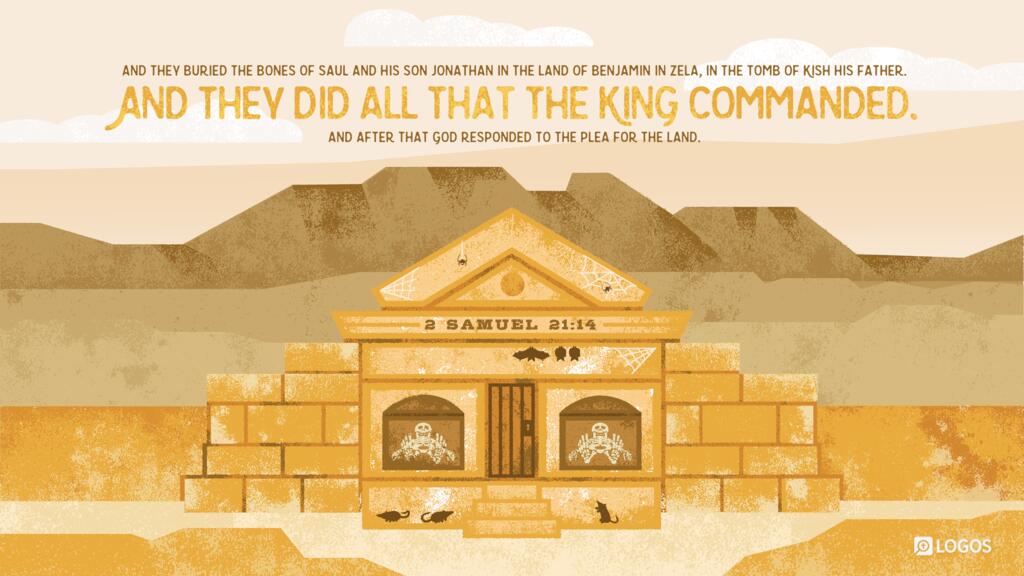
11When David was told what Saul’s concubinebRizpah (Aiah’s daughter) had done, 12David went and took the bones of Saul and of his son Jonathan from the citizens of Jabesh Gilead. They had stolen them from the public square of Beth Shean, where the Philistines had hung them the day they killed Saul at Gilboa. 13When David brought up the bones of Saul and Jonathan, his men gathered the bones of those who had been executed. 14Then they buried the bones of Saul and his son Jonathan in the land of Benjamin, in Zela, in the tomb of Saul’s father Kish. They did everything the king ordered. After that, God answered the prayers for the land.
Footnotes
- a21:8 1 Samuel 18:19, two Hebrew manuscripts, some Greek manuscripts, Syriac, Targum; other Hebrew and Greek manuscripts “Mical.”
- b21:11 A concubine is considered a wife except she has fewer rights under the law.
Copyright 1995 God’s Word to the Nations Bible Society