2 Peter 1:3
The NET BibleOther versions
English
- NET The NET Bible
- DARBY 1890 Darby Bible
- ASV American Standard Version
- AV 1873 The Cambridge Paragraph Bible of the Authorized English Version
- CSB Christian Standard Bible
- D-R Douay-Rheims Bible
- ESV English Standard Version
- GW GOD’S WORD Translation
- GNB Good News Translation
- HCSB The Holman Christian Standard Bible
- KJV 1900 King James Version
- LSB Legacy Standard Bible
- LEB The Lexham English Bible
- MSG The Message: The Bible in Contemporary Language
- NASB95 New American Standard Bible (1995)
- NCV New Century Version
- NIrV New International Reader’s Version (1998)
- NIV New International Version (2011)
- NKJV The New King James Version
- NLT New Living Translation
- NRSVue New Revised Standard Version: Updated Edition
- RSV The Revised Standard Version
- RSVCE The Revised Standard Version, Catholic Edition
- TNIV Today’s New International Version
- YLT Young’s Literal Translation
Arabic
Czech
French
German
Greek
Hungarian
Italian
Korean
Latin
Portuguese
Russian
Simplified Chinese
Spanish
Traditional Chinese
Believers’ Salvation and the Work of God
1:3I can pray this because his divine power12 has bestowed on us everything necessary13 for life and godliness through the rich knowledge14 of the one who called15 us by16 his own glory and excellence.
Footnotes
- 12 The verse in Greek starts out with ὡς (hōs) followed by a genitive absolute construction, dependent on the main verb in v. 2. Together, they form a subordinate causal clause. A more literal rendering would be “because his divine power …” The idea is that the basis or authority for the author’s prayer in v. 2 (that grace and peace would abound to the readers) was that God’s power was manifested in their midst. The author’s sentence structure is cumbersome even in Greek; hence, the translation has broken this up into two sentences.
- 13 The word “necessary” is not in the Greek, but is implied by the preposition πρός (pros).
- 14 See the note on “rich knowledge” in v. .
- 15 Called. The term καλέω (kaleō), used here in its participial form, in soteriological contexts when God is the subject, always carries the nuance of effectual calling. That is, the one who is called is not just invited to be saved—he is also and always saved (cf. Rom 8:30). Calling takes place at the moment of conversion, while election takes place in eternity past (cf. Eph 1:4).
- 16 The datives ἰδίᾳ δόξῃ καὶ ἀρετῇ (idia doxē kai aretē) could be taken either instrumentally (“by [means of] his own glory and excellence”) or advantage (“for [the benefit of] his own glory and excellence”). Both the connection with divine power and the textual variant found in several early and important witnesses (διὰ δόξης καὶ ἀρετῆς in 𝔓72 B 0209vid) argues for an instrumental meaning. The instrumental notion is also affirmed by the meaning of ἀρετῇ (“excellence”) in contexts that speak of God’s attributes ( ἀρετή 2 in fact defines it as “manifestation of divine power” in this verse).
The NET Bible First Edition, Copyright 1996-2005 by Biblical Studies Press
In other versions
ESVEnglish Standard Version
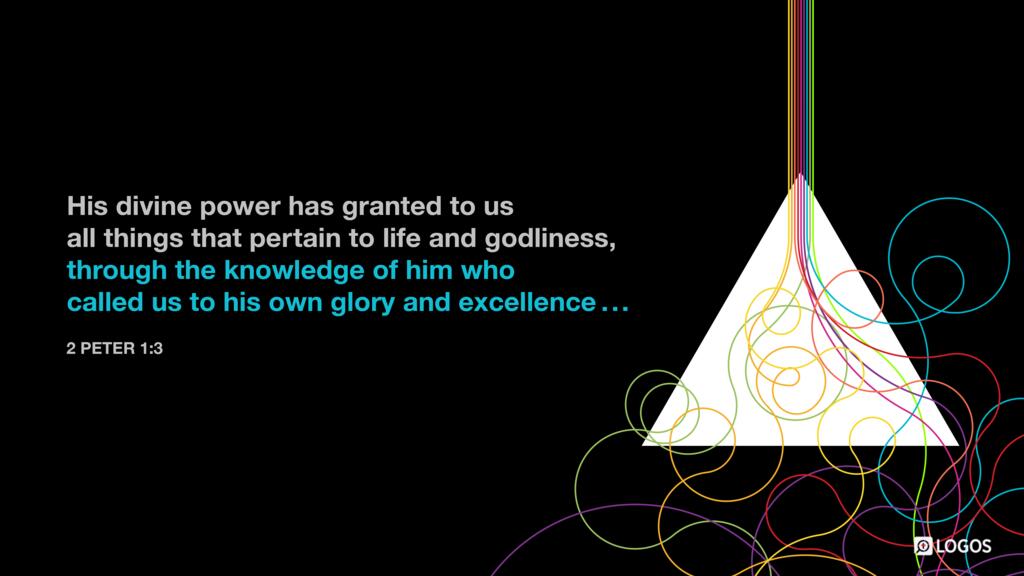
His divine power has granted to us all things that pertain to life and godliness, through the knowledge of him who called us to his own glory and excellence,
Copyright 2001 Crossway Bibles
NIVNew International Version (2011)
His divine power has given us everything we need for a godly life through our knowledge of him who called us by his own glory and goodness.
Copyright 1973, 1978, 1984, 2011 Biblica, Inc.
CSBChristian Standard Bible
His divine power has given us everything required for life and godliness through the knowledge of him who called us by his own glory and goodness.
Copyright 2017 Holman Bible Publishers
NLTNew Living Translation
By his divine power, God has given us everything we need for living a godly life. We have received all of this by coming to know him, the one who called us to himself by means of his marvelous glory and excellence.
Holy Bible, New Living Translation, copyright © 1996, 2004, 2015 by Tyndale House Foundation. Used by permission of Tyndale House Publishers. All rights reserved.
LEBThe Lexham English Bible
because his divine power has bestowed on us all things that are necessary for life and godliness, through the knowledge of the one who called us by his own glory and excellence of character,
Copyright 2012 Lexham Press
KJV 1900King James Version
According as his divine power hath given unto us all things that pertain unto life and godliness, through the knowledge of him that hath called us to glory and virtue:
Public Domain