1 Kings 3:9–28
The NET BibleOther versions
English
- NET The NET Bible
- DARBY 1890 Darby Bible
- ASV American Standard Version
- AV 1873 The Cambridge Paragraph Bible of the Authorized English Version
- CSB Christian Standard Bible
- D-R Douay-Rheims Bible
- ESV English Standard Version
- GW GOD’S WORD Translation
- GNB Good News Translation
- HCSB The Holman Christian Standard Bible
- KJV 1900 King James Version
- LSB Legacy Standard Bible
- LEB The Lexham English Bible
- MSG The Message: The Bible in Contemporary Language
- NASB95 New American Standard Bible (1995)
- NCV New Century Version
- NIrV New International Reader’s Version (1998)
- NIV New International Version (2011)
- NKJV The New King James Version
- NLT New Living Translation
- NRSVue New Revised Standard Version: Updated Edition
- RSV The Revised Standard Version
- RSVCE The Revised Standard Version, Catholic Edition
- YLT Young’s Literal Translation
Arabic
Czech
French
German
Hebrew
Hungarian
Italian
Korean
Latin
Portuguese
Russian
Simplified Chinese
Spanish
Traditional Chinese
3:9So give your servant a discerning mind18 so he can make judicial decisions for19 your people and distinguish right from wrong.20 Otherwise21 no one is able22 to make judicial decisions for23 this great nation of yours.”243:10The Lord25 was pleased that Solomon made this request.263:11God said to him, “Because you asked for the ability to make wise judicial decisions, and not for long life, or riches, or vengeance on your enemies,273:12I28 grant your request,29 and give30 you a wise and discerning mind31 superior to that of anyone who has preceded or will succeed you.323:13Furthermore, I am giving33 you what you did not request—riches and honor so that you will be the greatest king of your generation.343:14If you follow my instructions35 by obeying36 my rules and regulations, just as your father David did,37 then I will grant you long life.”383:15Solomon then woke up and realized it was a dream.39 He went to Jerusalem, stood before the ark of the Lord’s covenant, offered up burnt sacrifices, presented peace offerings,40 and held a feast for all his servants.
Solomon Demonstrates His Wisdom
3:16Then two prostitutes came to the king and stood before him. 3:17One of the women said, “My master, this woman and I live in the same house. I had a baby while she was with me in the house. 3:18Then three days after I had my baby, this woman also had a baby. We were alone; there was no one else in the house except the two of us.413:19This woman’s child suffocated42 during the night when she rolled43 on top of him. 3:20She got up in the middle of the night and took my son from my side, while your servant was sleeping. She put him in her arms, and put her dead son in my arms. 3:21I got up in the morning to nurse my son, and there he was,44 dead! But when I examined him carefully in the morning, I realized it was not my baby.”453:22The other woman said, “No! My son is alive; your son is dead!” But the first woman replied, “No, your son is dead; my son is alive.” Each presented her case before the king.46
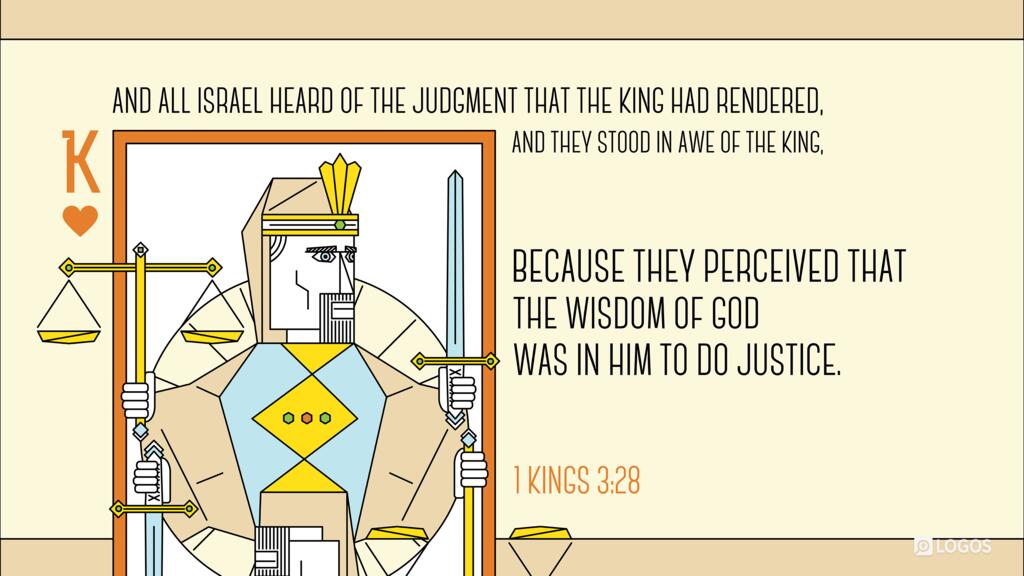
3:23The king said, “One says, ‘My son is alive; your son is dead,’ while the other says, ‘No, your son is dead; my son is alive.’ ” 3:24The king ordered, “Get me a sword!” So they placed a sword before the king. 3:25The king then said, “Cut the living child in two, and give half to one and half to the other!” 3:26The real mother47 spoke up to the king, for her motherly instincts were aroused.48 She said, “My master, give her the living child! Whatever you do, don’t kill him!”49 But the other woman said, “Neither one of us will have him! Let them cut him in two!” 3:27The king responded, “Give the first woman the living child; don’t kill him. She is the mother.” 3:28When all Israel heard about the judicial decision which the king had rendered, they respected50 the king, for they realized51 that he possessed supernatural wisdom52 to make judicial decisions.
Footnotes
- 18 Heb “a hearing heart.” (The Hebrew term translated “heart” often refers to the mental faculties.)
- 19 Heb “to judge.”
- 20 Heb “to understand between good and evil.”
- 21 Heb “for”; the word “otherwise” is used to reflect the logical sense of the statement.
- 22 Heb “who is able?” The rhetorical question anticipates the answer, “no one.”
- 23 Heb “to judge.”
- 24 Heb “your numerous people.”
- 25 The Hebrew term translated “Lord” here and in v. 15 is אֲדֹנָי (’adonay).
- 26 Heb “And the thing was good in the eyes of the Lord, for Solomon asked for this thing.”
- 27 Heb “because you asked for this thing, and did not ask for yourself many days and did not ask for yourself riches and did not ask for the life of your enemies, but you asked for yourself understanding to hear judgment.”
- 28 This statement is introduced in the Hebrew text by the particle הִנֵּה (hinneh, “look”) which draws attention to and emphasizes what follows.
- 29 Heb “I am doing according to your words.” The perfect tense is sometimes used of actions occurring at the same time a statement is made.
- 30 This statement is introduced by the particle הִנֵּה (hinneh, “look”) which draws attention to and emphasizes what follows. The translation assumes that the perfect tense here indicates that the action occurs as the statement is made (i.e., “right now I give you”).
- 31 Heb “heart.” (The Hebrew term translated “heart” often refers to the mental faculties.)
- 32 Heb “so that there has not been one like you prior to you, and after you one will not arise like you.”
- 33 The translation assumes that the perfect tense here indicates that the action occurs as the statement is made.
- 34 Heb “so that there is not one among the kings like you all your days.” The lacks the words “all your days.”
- 35 Heb “walk in my ways.”
- 36 Or “keeping.”
- 37 Heb “walked.”
- 38 Heb “I will lengthen your days.”
- 39 Heb “and look, a dream.”
- 40 Or “tokens of peace”; , “fellowship offerings.”
- 41 There was no one else in the house except the two of us. In other words, there were no other witnesses to the births who could identify which child belonged to which mother.
- 42 Heb “died.”
- 43 Heb “lay, slept.”
- 44 Heb “look.”
- 45 Heb “look, it was not my son to whom I had given birth.”
- 46 Heb “they spoke before the king.” Another option is to translate, “they argued before the king.”
- 47 Heb “the woman whose son was alive.”
- 48 Heb “for her compassions grew warm for her son.”
- 49 The infinitive absolute before the negated jussive emphasizes the main verb.
- 50 Heb “feared,” perhaps in the sense, “stood in awe of.”
- 51 Heb “saw.”
- 52 Heb “the wisdom of God within him.”
The NET Bible First Edition, Copyright 1996-2005 by Biblical Studies Press