1 John 1:7–9
The NET BibleOther versions
English
- NET The NET Bible
- DARBY 1890 Darby Bible
- ASV American Standard Version
- AV 1873 The Cambridge Paragraph Bible of the Authorized English Version
- CSB Christian Standard Bible
- D-R Douay-Rheims Bible
- ESV English Standard Version
- GW GOD’S WORD Translation
- GNB Good News Translation
- HCSB The Holman Christian Standard Bible
- KJV 1900 King James Version
- LSB Legacy Standard Bible
- LEB The Lexham English Bible
- MSG The Message: The Bible in Contemporary Language
- NASB95 New American Standard Bible (1995)
- NCV New Century Version
- NIrV New International Reader’s Version (1998)
- NIV New International Version (2011)
- NKJV The New King James Version
- NLT New Living Translation
- NRSVue New Revised Standard Version: Updated Edition
- RSV The Revised Standard Version
- RSVCE The Revised Standard Version, Catholic Edition
- TNIV Today’s New International Version
- YLT Young’s Literal Translation
Arabic
Czech
French
German
Greek
Hungarian
Italian
Korean
Latin
Portuguese
Russian
Simplified Chinese
Spanish
Traditional Chinese
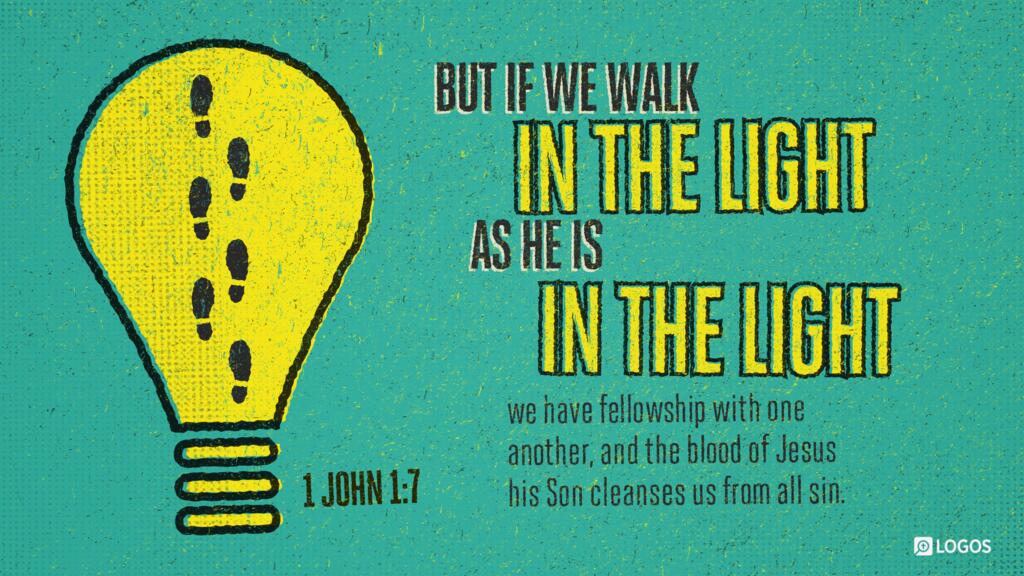
1:7But if we walk in the light as he himself is in the light, we have fellowship with one another and the blood of Jesus his Son cleanses19 us from all sin.201:8If we say we do not bear the guilt of sin,21 we are deceiving ourselves and the truth is not in us. 1:9But if we confess our sins, he is faithful and righteous,22 forgiving23 us our sins and cleansing24 us from all unrighteousness.
Footnotes
- 19 Or “purifies.”
- 20 ἁμαρτία 1 defines this term as “a departure fr. either human or divine standards of uprightness” (see 1 John 5:17 where ἁμαρτία [hamartia] and ἀδικία [adikia] are related). This word occurs 17 times in 1 John, of which 11 are singular and 6 are plural. From all sin. Sometimes a distinction between singular “sin” and plural “sins” has been suggested: Some would see the singular all sin of 1:7 as a reference to sinfulness before conversion and the plural sins of 1:9 as a reference to sins committed after one became a Christian. This amounts to making 1:7 refer to initial justification and 1:9 to sanctification. But the phrase all sin in 1:7 is so comprehensive that it can hardly be limited to preconversion sins, and the emphasis on “walking” in 1:7 strongly suggests that the Christian life is in view (not one’s life before conversion). In 1 John 1:8 sin appears as a condition or characteristic quality, which in 1:10 is regarded as universal. Apart from forgiveness in Christ it results in alienation from God (2:15) and spiritual death (3:14). But according to 1 John 1:7, cleansing from sin is possible by the blood (representing the sacrificial death) of Jesus.
- 21 Grk “say we do not have sin.” The use of ἔχω + ἁμαρτία (echō + hamartia) is an expression limited to John and 1 John in the NT. On the analogy with other constructions where ἔχω governs an abstract noun (e.g., 1 John 1:3, 6, 7; 2:28; 3:3, 15, 21; 4:16, 17; 5:12–13), it indicates that a state is involved, which in the case of ἁμαρτία would refer to a state of sin. The four times the expression ἔχω + ἁμαρτία occurs in the Gospel of John (9:41; 15:22, 24; 19:11) all refer to situations where a wrong action has been committed or a wrong attitude has already existed, resulting in a state of sin, and then something else happens which further emphasizes the evil of that action or attitude. Here in 1 John 1:8 the sense is the same. The author is addressing people who have sinned (resulting in a state of sin), warning them that they cannot claim to be free from the guilt of that sin. The context of 1 John does not imply libertinism (where sins are flaunted as a way of demonstrating one’s “liberty”) on the part of the opponents, since the author makes no explicit charges of immoral behavior against his opponents. The worst the author explicitly says is that they have failed to love the brethren (1 John 3:17). It seems more likely that the opponents were saying that things a believer did after conversion were not significant enough to be “sins” that could challenge one’s intimate relationship with God (a relationship the author denies that the opponents have to begin with).
- 22 Or “just.”
- 23 The ἵνα (hina) followed by the subjunctive is here equivalent to the infinitive of result, an “ecbatic” or consecutive use of ἵνα according to 3 where 1 John 1:9 is listed as a specific example. The translation with participles (“forgiving, … cleansing”) conveys this idea of result.
- 24 Or “purifying.”
The NET Bible First Edition, Copyright 1996-2005 by Biblical Studies Press
In other versions
ESVEnglish Standard Version
But if we walk in the light, as he is in the light, we have fellowship with one another, and the blood of Jesus his Son cleanses us from all sin. If we say we have no sin, we deceive ourselves, and the truth is not in us. If we confess our sins, he is faithful and just to forgive us our sins and to cleanse us from all unrighteousness.
Copyright 2001 Crossway Bibles
NIVNew International Version (2011)
But if we walk in the light, as he is in the light, we have fellowship with one another, and the blood of Jesus, his Son, purifies us from all sin.
If we claim to be without sin, we deceive ourselves and the truth is not in us. If we confess our sins, he is faithful and just and will forgive us our sins and purify us from all unrighteousness.
Copyright 1973, 1978, 1984, 2011 Biblica, Inc.
CSBChristian Standard Bible
If we walk in the light as he himself is in the light, we have fellowship with one another, and the blood of Jesus his Son cleanses us from all sin. If we say, “We have no sin,” we are deceiving ourselves, and the truth is not in us. If we confess our sins, he is faithful and righteous to forgive us our sins and to cleanse us from all unrighteousness.
Copyright 2017 Holman Bible Publishers
NLTNew Living Translation
But if we are living in the light, as God is in the light, then we have fellowship with each other, and the blood of Jesus, his Son, cleanses us from all sin.
If we claim we have no sin, we are only fooling ourselves and not living in the truth. But if we confess our sins to him, he is faithful and just to forgive us our sins and to cleanse us from all wickedness.
Holy Bible, New Living Translation, copyright © 1996, 2004, 2015 by Tyndale House Foundation. Used by permission of Tyndale House Publishers. All rights reserved.
LEBThe Lexham English Bible
But if we walk in the light as he is in the light, we have fellowship with one another, and the blood of Jesus his Son cleanses us from all sin. If we say that we do not have sin, we deceive ourselves and the truth is not in us. If we confess our sins, he is faithful and just, so that he will forgive us our sins and will cleanse us from all unrighteousness.
Copyright 2012 Lexham Press
KJV 1900King James Version
But if we walk in the light, as he is in the light, we have fellowship one with another, and the blood of Jesus Christ his Son cleanseth us from all sin. If we say that we have no sin, we deceive ourselves, and the truth is not in us. If we confess our sins, he is faithful and just to forgive us our sins, and to cleanse us from all unrighteousness.
Public Domain