1 John 3:2a
The NET BibleOther versions
English
- NET The NET Bible
- DARBY 1890 Darby Bible
- ASV American Standard Version
- AV 1873 The Cambridge Paragraph Bible of the Authorized English Version
- CSB Christian Standard Bible
- D-R Douay-Rheims Bible
- ESV English Standard Version
- GW GOD’S WORD Translation
- GNB Good News Translation
- HCSB The Holman Christian Standard Bible
- KJV 1900 King James Version
- LSB Legacy Standard Bible
- LEB The Lexham English Bible
- MSG The Message: The Bible in Contemporary Language
- NASB95 New American Standard Bible (1995)
- NCV New Century Version
- NIrV New International Reader’s Version (1998)
- NIV New International Version (2011)
- NKJV The New King James Version
- NLT New Living Translation
- NRSVue New Revised Standard Version: Updated Edition
- RSV The Revised Standard Version
- RSVCE The Revised Standard Version, Catholic Edition
- TNIV Today’s New International Version
- YLT Young’s Literal Translation
Arabic
Czech
French
German
Greek
Hungarian
Italian
Korean
Latin
Portuguese
Russian
Simplified Chinese
Spanish
Traditional Chinese
3:2Dear friends, we are God’s children now, and what we will be6 has not yet been revealed. We7 know that8 whenever9 it10 is revealed11 we will be like him, because12 we will see him just as he is.13
Footnotes
- 6 The subject of the third person singular passive verb ἐφανερώθη (ephanerōthē) in 3:2 is the following clause ἐσόμεθα (ti esometha): “Beloved, now we are children of God, and what we shall be has not yet been revealed.” What we will be. The opponents have been revealed as antichrists now (2:19). What believers will be is to be revealed later. In light of the mention of the parousia in 2:28, it seems likely that an eschatological revelation of the true character of believers is in view here.
- 7 The Byzantine text, the , the Bohairic Coptic, and one of the Sahidic Coptic supply δέ (de) after οἴδαμεν (oidamen) in 3:2b. Additions of coordinating conjunctions such as δέ are predictable variants; this coupled with the poor external credentials suggests that this addition is not likely to be original. The relationship of 3:2b to 3:2a is difficult. It seems best to regard this as a case of asyndeton, although the Byzantine text, the , the Bohairic Coptic, and some of the Sahidic Coptic supply δέ (de) after οἴδαμεν (oidamen) in 3:2b. This addition is not likely to be original, but it does reflect a tendency among scribes to see an adversative (contrastive) relationship between 3:2a and 3:2b. This seems to be an accurate understanding of the relationship between the clauses from a logical standpoint: “and what we shall be has not yet been revealed; but we know that whenever he should be revealed, we shall be like him.”
- 8 The first ὅτι (hoti) in 3:2 follows οἴδαμεν (oidamen), a verb of perception, and introduces an indirect discourse clause which specifies the content of what believers know: “that whenever it should be revealed, we shall be like him.”
- 9 In this context ἐάν (ean) does not indicate (1) uncertainty about whether or not what believers will be shall be revealed, but rather (2) uncertainty about the exact time the event will take place. In the Koine period ἐάν can mean “when” or “whenever” and is virtually the equivalent of ὅταν (hotan; see ἐάν 2). It has this meaning in John 12:32 and 14:3. Thus the phrase here should be translated, “we know that whenever it is revealed.”
- 10 Many take the understood subject (“he”) of φανερωθῇ (phanerōthē) as a reference to Jesus Christ, because the same verb was used in 2:28 in reference to the parousia (second advent). In the immediate context, however, a better analogy is ἐφανερώθη τί ἐσόμεθα (ephanerōthē ti esometha) in 3:2a. There the clause τί ἐσόμεθα is the subject of the passive verb: “what we shall be has not yet been revealed.” From a grammatical standpoint it makes better sense to see the understood subject of φανερωθῇ as “it” rather than “he” and as referring back to the clause τί ἐσόμεθα in 3:2a. In the context this makes good sense: “Beloved, now we are children of God, and what we shall be has not yet been revealed. We know that whenever it shall be revealed, we shall be like him, because we shall see him just as he is.” This emphasizes the contrast in the verse between the present state (“not yet been revealed”) and the future state (“shall be revealed”) of believers, and this will of course take place at the parousia.
- 11 Is revealed. It may well be that the use of the same passive verb here (from φανερόω, phaneroō) is intended to suggest to the reader the mention of the parousia (Christ’s second coming) in 2:28.
- 12 The second ὅτι (hoti) in 3:2 is best understood as causal, giving the reason why believers will be like God: “we shall be like him, because we shall see him just as he is.”
- 13 The phrase we will be like him, because we will see him just as he is has been explained two ways: (1) believers will really become more like God than they now are, and will do this through seeing God as he really is; or (2) believers will realize that they are already like God, but did not realize it until they see him as he is. One who sees a strong emphasis on realized eschatology in the Gospel of John and the Epistles might opt for the second view, since it downplays the difference between what believers already are in the present age and what they will become in the next. It seems better, though, in light of the statement in 3:2a that “what we will be has not yet been revealed” and because of the reference to Christ’s parousia in 2:28, that the author intends to distinguish between the present state of believers and what they will be like in the future. Thus the first view is better, that believers really will become more like God than they are now, as a result of seeing him as he really is.
The NET Bible First Edition, Copyright 1996-2005 by Biblical Studies Press
In other versions
ESVEnglish Standard Version
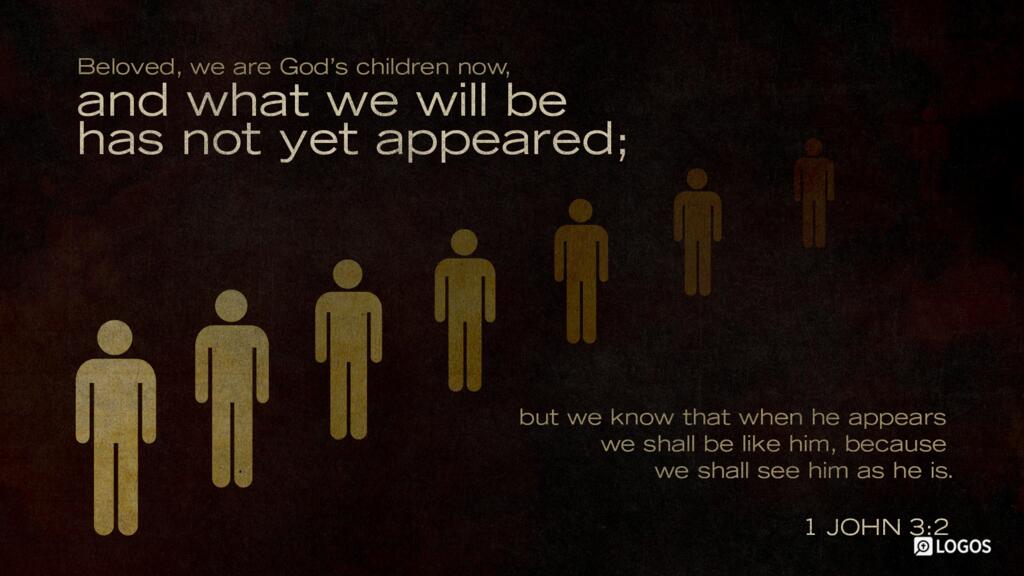
Beloved, we are God’s children now, and what we will be has not yet appeared; but we know that when he appears we shall be like him, because we shall see him as he is.
Copyright 2001 Crossway Bibles
NIVNew International Version (2011)
Dear friends, now we are children of God, and what we will be has not yet been made known. But we know that when Christ appears, we shall be like him, for we shall see him as he is.
Copyright 1973, 1978, 1984, 2011 Biblica, Inc.
CSBChristian Standard Bible
Dear friends, we are God’s children now, and what we will be has not yet been revealed. We know that when he appears, we will be like him because we will see him as he is.
Copyright 2017 Holman Bible Publishers
NLTNew Living Translation
Dear friends, we are already God’s children, but he has not yet shown us what we will be like when Christ appears. But we do know that we will be like him, for we will see him as he really is.
Holy Bible, New Living Translation, copyright © 1996, 2004, 2015 by Tyndale House Foundation. Used by permission of Tyndale House Publishers. All rights reserved.
LEBThe Lexham English Bible
Dear friends, now we are children of God, and what we will be has not yet been revealed. We know that whenever he is revealed we will be like him, because we will see him just as he is.
Copyright 2012 Lexham Press
KJV 1900King James Version
Beloved, now are we the sons of God, and it doth not yet appear what we shall be: but we know that, when he shall appear, we shall be like him; for we shall see him as he is.
Public Domain