1 John 3:1
The NET BibleOther versions
English
- NET The NET Bible
- DARBY 1890 Darby Bible
- ASV American Standard Version
- AV 1873 The Cambridge Paragraph Bible of the Authorized English Version
- CSB Christian Standard Bible
- D-R Douay-Rheims Bible
- ESV English Standard Version
- GW GOD’S WORD Translation
- GNB Good News Translation
- HCSB The Holman Christian Standard Bible
- KJV 1900 King James Version
- LSB Legacy Standard Bible
- LEB The Lexham English Bible
- MSG The Message: The Bible in Contemporary Language
- NASB95 New American Standard Bible (1995)
- NCV New Century Version
- NIrV New International Reader’s Version (1998)
- NIV New International Version (2011)
- NKJV The New King James Version
- NLT New Living Translation
- NRSVue New Revised Standard Version: Updated Edition
- RSV The Revised Standard Version
- RSVCE The Revised Standard Version, Catholic Edition
- TNIV Today’s New International Version
- YLT Young’s Literal Translation
Arabic
Czech
French
German
Greek
Hungarian
Italian
Korean
Latin
Portuguese
Russian
Simplified Chinese
Spanish
Traditional Chinese
3:1(See what sort of love the Father has given to us: that1 we should be called God’s children—and indeed2 we are!3 For this reason4 the world does not know us: because it did not know him.5
Footnotes
- 1 The ἵνα (hina) clause is best understood (1) as epexegetical (or explanatory), clarifying the love (ἀγάπην, agapēn) that the Father has given to believers. Although it is possible (2) to regard the ἵνα as indicating result, the use of ποταπήν (potapēn, “what sort of”) to modify ἀγάπην suggests that the idea of “love” will be qualified further in the following context, and this qualification is provided by the epexegetical ἵνα clause.
- 2 “Indeed” is not in the Greek text but is supplied to indicate emphasis.
- 3 The phrase καὶ ἐσμεν (kai esmen, “and we are”) is omitted in 049 69 𝔐. There seems to be no theological reason to omit the words. This has all the earmarks of a classic case of homoioteleuton, for the preceding word (κληθῶμεν, klēthōmen, “we should be called”) ends in -μεν (-men). The indicative mood indicates that the verb ἐσμέν (esmen) at the end of 3:1a is not governed by the ἵνα (hina) and does not belong with the ἵνα clause, since this would have required a subjunctive. If the verb ἐσμέν were subjunctive, the force of the clause would be “that we should be called children of God, and be (children of God).” With ἐσμέν as indicative, the clause reads “that we should be called children of God, and indeed we are (children of God).”
- 4 Lexically it is clear that this phrase indicates reason, but what is not clear is whether (1) τοῦτο (touto) refers to what follows, (2) to what precedes, or (3) to both (as with the ἐν τοῦτο [en touto] phrases throughout 1 John). Διὰ τοῦτο (dia touto) occurs 15 times in the Gospel of John, and a pattern emerges which is so consistent that it appears to be the key to the usage here. Six times in the Gospel of John (5:16, 18; 8:47; 10:17; 12:18, 39) the phrase refers to what follows, and in each of these instances an epexegetical ὅτι (hoti) clause follows. Nine times in John (1:31, 6:65, 7:21–22, 9:23, 12:27, 13:11, 15:19, 16:15, 19:11) the phrase refers to what precedes, and in none of these instances is it followed by a ὅτι clause. The phrase διὰ τοῦτο is used three times in the Johannine Epistles. In two of these (1 John 4:5, 3 John 10) there is no ὅτι clause following, and so the διὰ τοῦτο should refer to preceding material. Here in 3:1 there is an epexegetical ὅτι clause following, so the διὰ τοῦτο should (unless it is the only exception in the Gospel of John and the Johannine Epistles) refer to what follows, that is, to the ὅτι clause itself. This is indicated by the colon in the translation.
- 5 The pronoun him is a clear reference to Jesus Christ (compare John 1:10).
The NET Bible First Edition, Copyright 1996-2005 by Biblical Studies Press
In other versions
ESVEnglish Standard Version
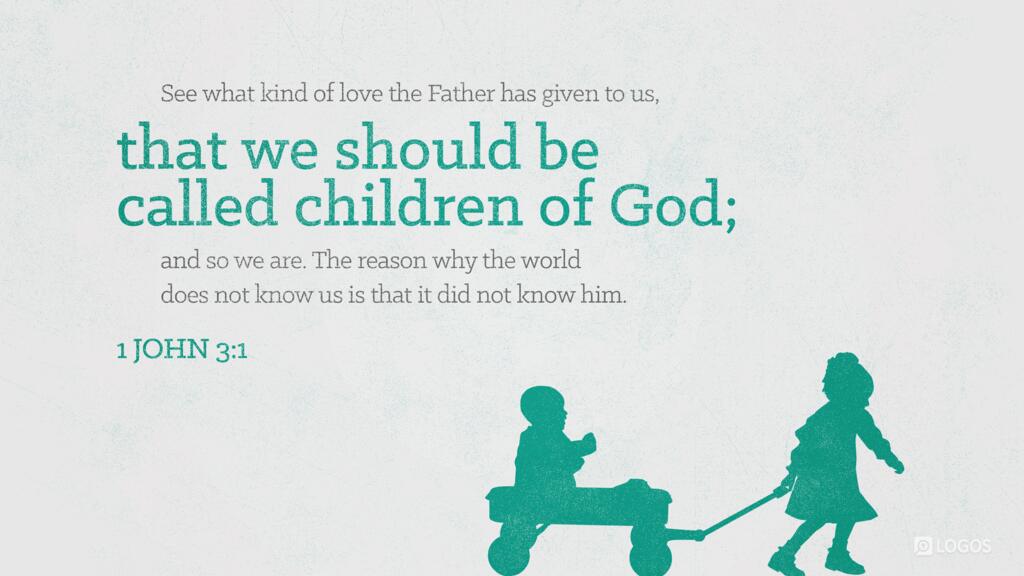
See what kind of love the Father has given to us, that we should be called children of God; and so we are. The reason why the world does not know us is that it did not know him.
Copyright 2001 Crossway Bibles
NIVNew International Version (2011)
See what great love the Father has lavished on us, that we should be called children of God! And that is what we are! The reason the world does not know us is that it did not know him.
Copyright 1973, 1978, 1984, 2011 Biblica, Inc.
CSBChristian Standard Bible
See what great love the Father has given us that we should be called God’s children—and we are! The reason the world does not know us is that it didn’t know him.
Copyright 2017 Holman Bible Publishers
NLTNew Living Translation
See how very much our Father loves us, for he calls us his children, and that is what we are! But the people who belong to this world don’t recognize that we are God’s children because they don’t know him.
Holy Bible, New Living Translation, copyright © 1996, 2004, 2015 by Tyndale House Foundation. Used by permission of Tyndale House Publishers. All rights reserved.
LEBThe Lexham English Bible
See what sort of love the Father has given to us: that we should be called children of God, and we are! Because of this the world does not know us: because it did not know him.
Copyright 2012 Lexham Press
KJV 1900King James Version
Behold, what manner of love the Father hath bestowed upon us, that we should be called the sons of God: therefore the world knoweth us not, because it knew him not.
Public Domain