1 Corinthians 13:8–12
The NET BibleOther versions
English
- NET The NET Bible
- DARBY 1890 Darby Bible
- ASV American Standard Version
- AV 1873 The Cambridge Paragraph Bible of the Authorized English Version
- CSB Christian Standard Bible
- D-R Douay-Rheims Bible
- ESV English Standard Version
- GW GOD’S WORD Translation
- GNB Good News Translation
- HCSB The Holman Christian Standard Bible
- KJV 1900 King James Version
- LSB Legacy Standard Bible
- LEB The Lexham English Bible
- MSG The Message: The Bible in Contemporary Language
- NASB95 New American Standard Bible (1995)
- NCV New Century Version
- NIrV New International Reader’s Version (1998)
- NIV New International Version (2011)
- NKJV The New King James Version
- NLT New Living Translation
- NRSVue New Revised Standard Version: Updated Edition
- RSV The Revised Standard Version
- RSVCE The Revised Standard Version, Catholic Edition
- TNIV Today’s New International Version
- YLT Young’s Literal Translation
Arabic
Czech
French
German
Greek
Hungarian
Italian
Korean
Latin
Portuguese
Russian
Simplified Chinese
Spanish
Traditional Chinese
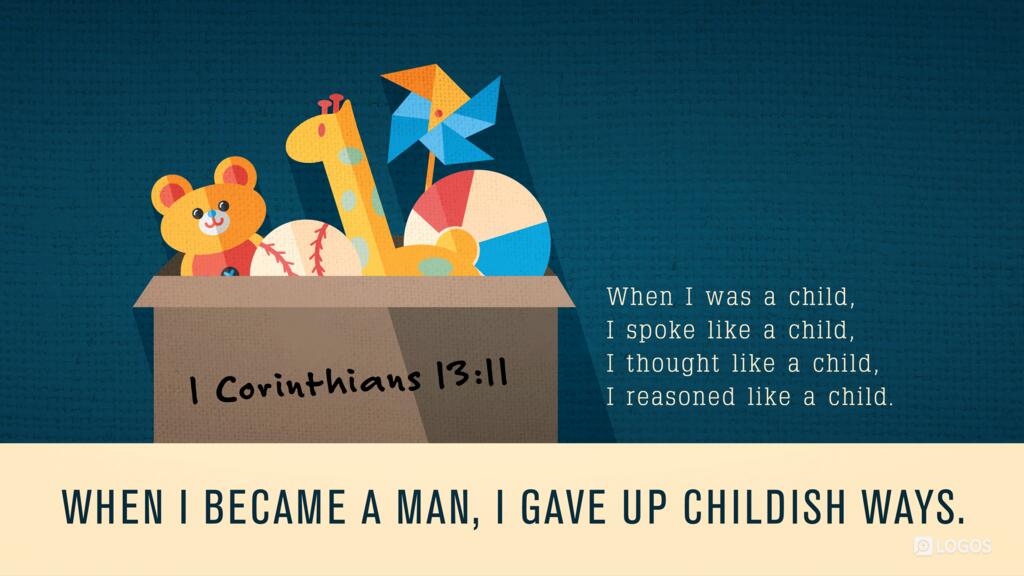
13:8Love never ends. But if there are prophecies, they will be set aside; if there are tongues, they will cease; if there is knowledge, it will be set aside. 13:9For we know in part, and we prophesy in part, 13:10but when what is perfect2 comes, the partial will be set aside. 13:11When I was a child, I talked like a child, I thought like a child, I reasoned like a child. But when I became an adult,3 I set aside childish ways. 13:12For now we see in a mirror indirectly,4 but then we will see face to face. Now I know in part, but then I will know fully, just as I have been fully known.
Footnotes
- 2 Or “when completion.”
- 3 The Greek term translated “adult” here is ἀνήρ (anēr), a term which ordinarily refers to males, husbands, etc. In this context Paul contrasts the states of childhood and adulthood, so the term has been translated “adult”; cf. 1.b.
- 4 Grk “we are seeing through [= using] a mirror by means of a dark image.” Corinth was well known in the ancient world for producing some of the finest bronze mirrors available. Paul’s point in this analogy, then, is not that our current understanding and relationship with God is distorted (as if the mirror reflected poorly), but rather that it is “indirect,” (i.e., the nature of looking in a mirror) compared to the relationship we will enjoy with him in the future when we see him “face to face” (cf. G. D. Fee, First Corinthians [], ). The word “indirectly” translates the Greek phrase ἐν αἰνίγματι (ejn ainigmati, “in an obscure image”) which itself may reflect an allusion to Num 12:8 ( οὐ διʼ αἰνιγμάτων), where God says that he speaks to Moses “mouth to mouth [= face to face] … and not in dark figures [of speech].” Though this allusion to the OT is not explicitly developed here, it probably did not go unnoticed by the Corinthians who were apparently familiar with OT traditions about Moses (cf. 1 Cor 10:2). Indeed, in 2 Cor 3:13–18 Paul had recourse with the Corinthians to contrast Moses’ ministry under the old covenant with the hope afforded through apostolic ministry and the new covenant. Further, it is in this context, specifically in 2 Cor 3:18, that the apostle invokes the use of the mirror analogy again in order to unfold the nature of the Christian’s progressive transformation by the Spirit.
The NET Bible First Edition, Copyright 1996-2005 by Biblical Studies Press
In other versions
ESVEnglish Standard Version
Love never ends. As for prophecies, they will pass away; as for tongues, they will cease; as for knowledge, it will pass away. For we know in part and we prophesy in part, but when the perfect comes, the partial will pass away. When I was a child, I spoke like a child, I thought like a child, I reasoned like a child. When I became a man, I gave up childish ways. For now we see in a mirror dimly, but then face to face. Now I know in part; then I shall know fully, even as I have been fully known.
Copyright 2001 Crossway Bibles
NIVNew International Version (2011)
Love never fails. But where there are prophecies, they will cease; where there are tongues, they will be stilled; where there is knowledge, it will pass away. For we know in part and we prophesy in part, but when completeness comes, what is in part disappears. When I was a child, I talked like a child, I thought like a child, I reasoned like a child. When I became a man, I put the ways of childhood behind me. For now we see only a reflection as in a mirror; then we shall see face to face. Now I know in part; then I shall know fully, even as I am fully known.
Copyright 1973, 1978, 1984, 2011 Biblica, Inc.
CSBChristian Standard Bible
Love never ends. But as for prophecies, they will come to an end; as for tongues, they will cease; as for knowledge, it will come to an end. For we know in part, and we prophesy in part, but when the perfect comes, the partial will come to an end. When I was a child, I spoke like a child, I thought like a child, I reasoned like a child. When I became a man, I put aside childish things. For now we see only a reflection as in a mirror, but then face to face. Now I know in part, but then I will know fully, as I am fully known.
Copyright 2017 Holman Bible Publishers
NLTNew Living Translation
Prophecy and speaking in unknown languages and special knowledge will become useless. But love will last forever! Now our knowledge is partial and incomplete, and even the gift of prophecy reveals only part of the whole picture! But when the time of perfection comes, these partial things will become useless.
When I was a child, I spoke and thought and reasoned as a child. But when I grew up, I put away childish things. Now we see things imperfectly, like puzzling reflections in a mirror, but then we will see everything with perfect clarity. All that I know now is partial and incomplete, but then I will know everything completely, just as God now knows me completely.
Holy Bible, New Living Translation, copyright © 1996, 2004, 2015 by Tyndale House Foundation. Used by permission of Tyndale House Publishers. All rights reserved.
LEBThe Lexham English Bible
Love never ends. But if there are prophecies, they will pass away. If there are tongues, they will cease. If there is knowledge, it will pass away. For we know in part and we prophesy in part, but whenever the perfect comes, the partial will pass away. When I was a child, I spoke like a child, I thought like a child, I reasoned like a child. When I became a man, I set aside the things of a child. For now we see through a mirror indirectly, but then face to face. Now I know in part, but then I will know completely, just as I have also been completely known.
Copyright 2012 Lexham Press
KJV 1900King James Version
Charity never faileth: but whether there be prophecies, they shall fail; whether there be tongues, they shall cease; whether there be knowledge, it shall vanish away. For we know in part, and we prophesy in part. But when that which is perfect is come, then that which is in part shall be done away. When I was a child, I spake as a child, I understood as a child, I thought as a child: but when I became a man, I put away childish things. For now we see through a glass, darkly; but then face to face: now I know in part; but then shall I know even as also I am known.
Public Domain