1 Corinthians 12:12–27
The NET BibleOther versions
English
- NET The NET Bible
- DARBY 1890 Darby Bible
- ASV American Standard Version
- AV 1873 The Cambridge Paragraph Bible of the Authorized English Version
- CSB Christian Standard Bible
- D-R Douay-Rheims Bible
- ESV English Standard Version
- GW GOD’S WORD Translation
- GNB Good News Translation
- HCSB The Holman Christian Standard Bible
- KJV 1900 King James Version
- LSB Legacy Standard Bible
- LEB The Lexham English Bible
- MSG The Message: The Bible in Contemporary Language
- NASB95 New American Standard Bible (1995)
- NCV New Century Version
- NIrV New International Reader’s Version (1998)
- NIV New International Version (2011)
- NKJV The New King James Version
- NLT New Living Translation
- NRSVue New Revised Standard Version: Updated Edition
- RSV The Revised Standard Version
- RSVCE The Revised Standard Version, Catholic Edition
- YLT Young’s Literal Translation
Arabic
Czech
French
German
Greek
Hungarian
Italian
Korean
Latin
Portuguese
Russian
Simplified Chinese
Spanish
Traditional Chinese
Different Members in One Body
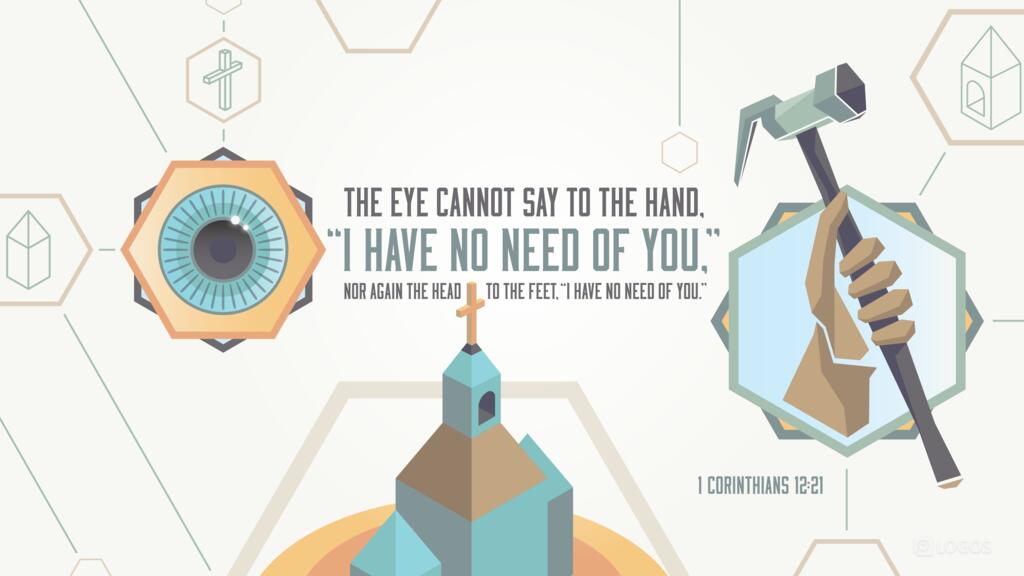
12:12For just as the body is one and yet has many members, and all the members of the body—though many—are one body, so too is Christ. 12:13For in one Spirit we were all baptized into one body. Whether Jews or Greeks or slaves4 or free, we were all made to drink of the one Spirit. 12:14For in fact the body is not a single member, but many. 12:15If the foot says, “Since I am not a hand, I am not part of the body,” it does not lose its membership in the body because of that. 12:16And if the ear says, “Since I am not an eye, I am not part of the body,” it does not lose its membership in the body because of that. 12:17If the whole body were an eye, what part would do the hearing? If the whole were an ear, what part would exercise the sense of smell? 12:18But as a matter of fact, God has placed each of the members in the body just as he decided. 12:19If they were all the same member, where would the body be? 12:20So now there are many members, but one body. 12:21The eye cannot say to the hand, “I do not need you,” nor in turn can the head say to the foot, “I do not need you.” 12:22On the contrary, those members that seem to be weaker are essential, 12:23and those members we consider less honorable we clothe with greater honor, and our unpresentable members are clothed with dignity,512:24but our presentable members do not need this. Instead, God has blended together the body, giving greater honor to the lesser member, 12:25so that there may be no division in the body, but the members may have mutual concern for one another. 12:26If one member suffers, everyone suffers with it. If a6 member is honored, all rejoice with it.
12:27Now you are Christ’s body, and each of you is a member of it.
Footnotes
- 4 See the note on the word “slave” in .
- 5 Grk “have greater propriety (or decorum, presentability).”
- 6 Before μέλος (melos, “member”) the great majority of witnesses read ἕν (hen, “one”; א2 C D F G Ψ 0285 33 1881 𝔐 latt sy), while the most important of the Alexandrian omit it (𝔓46 א* A B 1739). The addition of ἕν appears to be motivated by its presence earlier in the verse with μέλος and the parallel structure of the two conditional clauses in this verse, while little reason can be given for its absence (although accidental oversight is of course possible, it is not likely that all these witnesses should have overlooked it). has the word in brackets, indicating doubt as to its authenticity.
The NET Bible First Edition, Copyright 1996-2005 by Biblical Studies Press