John 7:25–44
The Message: The Bible in Contemporary LanguageOther versions
English
- MSG The Message: The Bible in Contemporary Language
- DARBY 1890 Darby Bible
- ASV American Standard Version
- AV 1873 The Cambridge Paragraph Bible of the Authorized English Version
- CSB Christian Standard Bible
- D-R Douay-Rheims Bible
- ESV English Standard Version
- GW GOD’S WORD Translation
- GNB Good News Translation
- HCSB The Holman Christian Standard Bible
- KJV 1900 King James Version
- LSB Legacy Standard Bible
- LEB The Lexham English Bible
- NET The NET Bible
- NASB95 New American Standard Bible (1995)
- NCV New Century Version
- NIrV New International Reader’s Version (1998)
- NIV New International Version (2011)
- NKJV The New King James Version
- NLT New Living Translation
- NRSVue New Revised Standard Version: Updated Edition
- RSV The Revised Standard Version
- RSVCE The Revised Standard Version, Catholic Edition
- YLT Young’s Literal Translation
Arabic
Czech
French
German
Greek
Hungarian
Italian
Korean
Latin
Portuguese
Russian
Simplified Chinese
Spanish
Traditional Chinese
25–27That’s when some of the people of Jerusalem said, “Isn’t this the one they were out to kill? And here he is out in the open, saying whatever he pleases, and no one is stopping him. Could it be that the rulers know that he is, in fact, the Messiah? And yet we know where this man came from. The Messiah is going to come out of nowhere. Nobody is going to know where he comes from.”
28–29That provoked Jesus, who was teaching in the Temple, to cry out, “Yes, you think you know me and where I’m from, but that’s not where I’m from. I didn’t set myself up in business. My true origin is in the One who sent me, and you don’t know him at all. I come from him—that’s how I know him. He sent me here.”
30–31They were looking for a way to arrest him, but not a hand was laid on him because it wasn’t yet God’s time. Many from the crowd committed themselves in faith to him, saying, “Will the Messiah, when he comes, provide better or more convincing evidence than this?”
32–34The Pharisees, alarmed at this seditious undertow going through the crowd, teamed up with the high priests and sent their police to arrest him. Jesus rebuffed them: “I am with you only a short time. Then I go on to the One who sent me. You will look for me, but you won’t find me. Where I am, you can’t come.”
35–36The Jews put their heads together. “Where do you think he is going that we won’t be able to find him? Do you think he is about to travel to the Greek world to teach the Jews? What is he talking about, anyway: ‘You will look for me, but you won’t find me,’ and ‘Where I am, you can’t come’?”
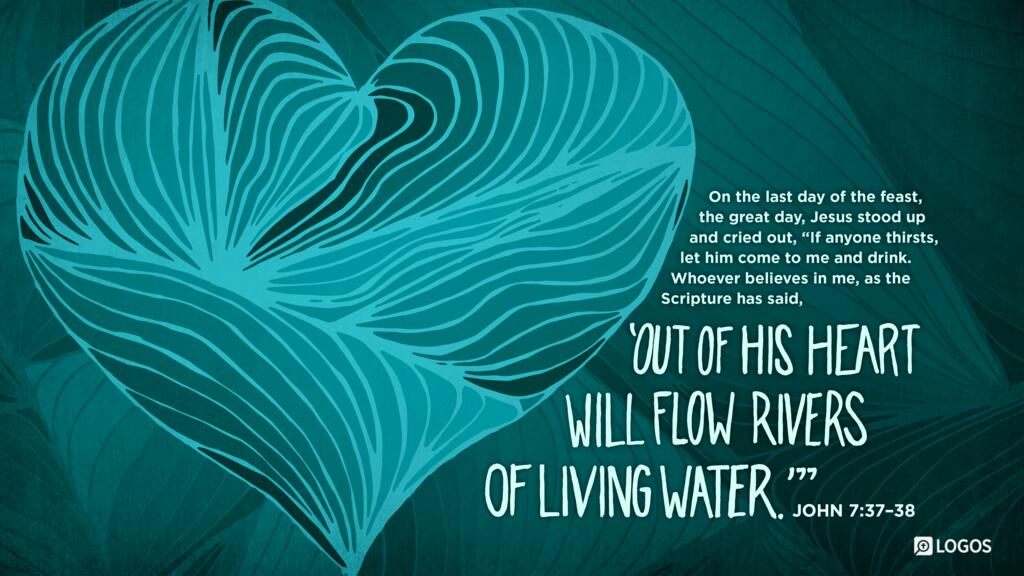
37–39On the final and climactic day of the Feast, Jesus took his stand. He cried out, “If anyone thirsts, let him come to me and drink. Rivers of living water will brim and spill out of the depths of anyone who believes in me this way, just as the Scripture says.” (He said this in regard to the Spirit, whom those who believed in him were about to receive. The Spirit had not yet been given because Jesus had not yet been glorified.)
40–44Those in the crowd who heard these words were saying, “This has to be the Prophet.” Others said, “He is the Messiah!” But others were saying, “The Messiah doesn’t come from Galilee, does he? Don’t the Scriptures tell us that the Messiah comes from David’s line and from Bethlehem, David’s village?” So there was a split in the crowd over him. Some went so far as wanting to arrest him, but no one laid a hand on him.
Copyright 2005 Eugene H. Peterson.