Matthew 14:22–33
The Lexham English BibleOther versions
English
- LEB The Lexham English Bible
- DARBY 1890 Darby Bible
- ASV American Standard Version
- AV 1873 The Cambridge Paragraph Bible of the Authorized English Version
- CSB Christian Standard Bible
- D-R Douay-Rheims Bible
- ESV English Standard Version
- GW GOD’S WORD Translation
- GNB Good News Translation
- HCSB The Holman Christian Standard Bible
- KJV 1900 King James Version
- LSB Legacy Standard Bible
- MSG The Message: The Bible in Contemporary Language
- NET The NET Bible
- NASB95 New American Standard Bible (1995)
- NCV New Century Version
- NIrV New International Reader’s Version (1998)
- NIV New International Version (2011)
- NKJV The New King James Version
- NLT New Living Translation
- NRSVue New Revised Standard Version: Updated Edition
- RSV The Revised Standard Version
- RSVCE The Revised Standard Version, Catholic Edition
- TNIV Today’s New International Version
- YLT Young’s Literal Translation
Arabic
Czech
French
German
Greek
Hungarian
Italian
Korean
Latin
Portuguese
Russian
Simplified Chinese
Spanish
Traditional Chinese
Jesus Walks on the Water
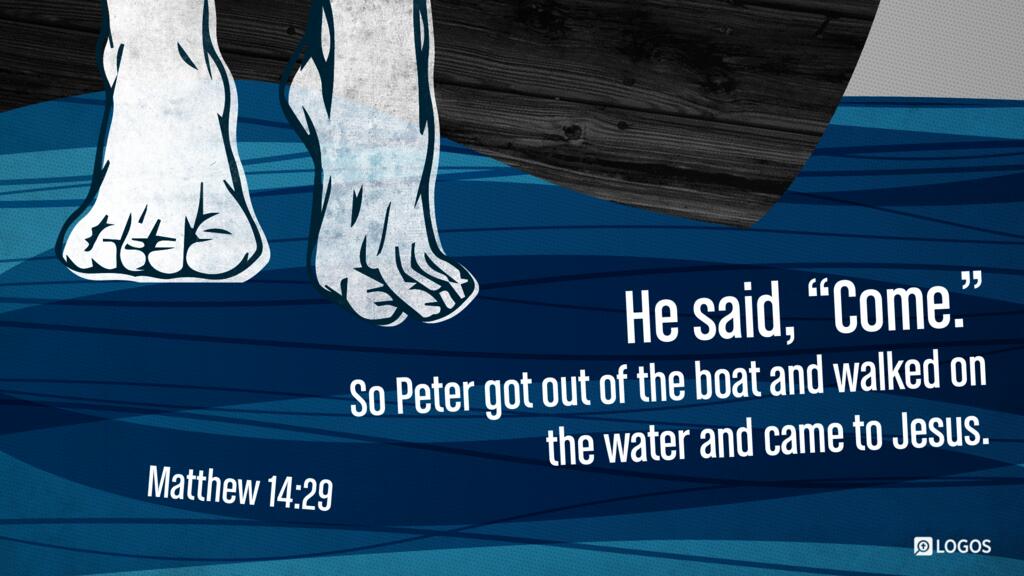
22And immediately he made the disciples get into the boat and go ahead of him to the other side, while he sent away the crowds. 23And after he* sent away the crowds, he went up on the mountain by himself to pray. So when* evening came, he was there alone. 24But the boat was already many stadia distant from the land, being beaten by the waves, because the wind was against it. 25And in the fourth watch of the night he came to them, walking on the sea. 26But the disciples, when they* saw him walking on the sea, were terrified, saying, “It is a ghost!” and they cried out in fear. 27But immediately Jesus spoke to them, saying, “Have courage, I am he! Do not be afraid!” 28And Peter answered him and* said, “Lord, if it is you,d command me to come to you on the water!” 29So he said, “Come!” And getting out of the boat, Peter walked on the water and came toward Jesus. 30But when he* saw the strong wind, he was afraid. And beginning to sink, he cried out, saying, “Lord, save me!” 31And immediately Jesus extended hise hand and* caught him and said to him, “You of little faith! Why did you doubt?” 32And when* they got into the boat, the wind abated. 33So those in the boat worshiped him, saying, “Truly you are the Son of God!”
Footnotes
- *Here “after” is supplied as a component of the participle (“sent away”) which is understood as temporal
- *Here “when” is supplied as a component of the temporal genitive absolute participle (“came”)
- *Here “when” is supplied as a component of the participle (“saw”) which is understood as temporal
- *Here “and” is supplied because the previous participle (“answered”) has been translated as a finite verb
- dLiterally “you are” he
- *Here “when” is supplied as a component of the participle (“saw”) which is understood as temporal
- eLiterally “the”; the Greek article is used here as a possessive pronoun
- *Here “and” is supplied because the previous participle (“extended”) has been translated as a finite verb
- *Here “when” is supplied as a component of the temporal genitive absolute participle (“got”)
Copyright 2012 Lexham Press