John 21:17–23
The Lexham English BibleOther versions
English
- LEB The Lexham English Bible
- DARBY 1890 Darby Bible
- ASV American Standard Version
- AV 1873 The Cambridge Paragraph Bible of the Authorized English Version
- CSB Christian Standard Bible
- D-R Douay-Rheims Bible
- ESV English Standard Version
- GW GOD’S WORD Translation
- GNB Good News Translation
- HCSB The Holman Christian Standard Bible
- KJV 1900 King James Version
- LSB Legacy Standard Bible
- MSG The Message: The Bible in Contemporary Language
- NET The NET Bible
- NASB95 New American Standard Bible (1995)
- NCV New Century Version
- NIrV New International Reader’s Version (1998)
- NIV New International Version (2011)
- NKJV The New King James Version
- NLT New Living Translation
- NRSVue New Revised Standard Version: Updated Edition
- RSV The Revised Standard Version
- RSVCE The Revised Standard Version, Catholic Edition
- YLT Young’s Literal Translation
Arabic
Czech
French
German
Greek
Hungarian
Italian
Korean
Latin
Portuguese
Russian
Simplified Chinese
Spanish
Traditional Chinese
17He said to him a third time, “Simon son of John, do you love me?” Peter was distressed because he said to him a third time, “Do you love me?” and he said to him, “Lord, you know everything! You know that I love you!” Jesus said to him, “Feed my sheep! 18Truly, truly I say to you, when you were young, you tied your clothes* around yourself and walked wherever you wanted. But when you grow old, you will stretch out your hands, and someone else will tie you up and carry you where you do not want to go.* 19(Now he said this to indicate by what kind of death he would glorify God.) And after he* had said this, he said to him, “Follow me!”
Peter and the Other Disciple Jesus Loved
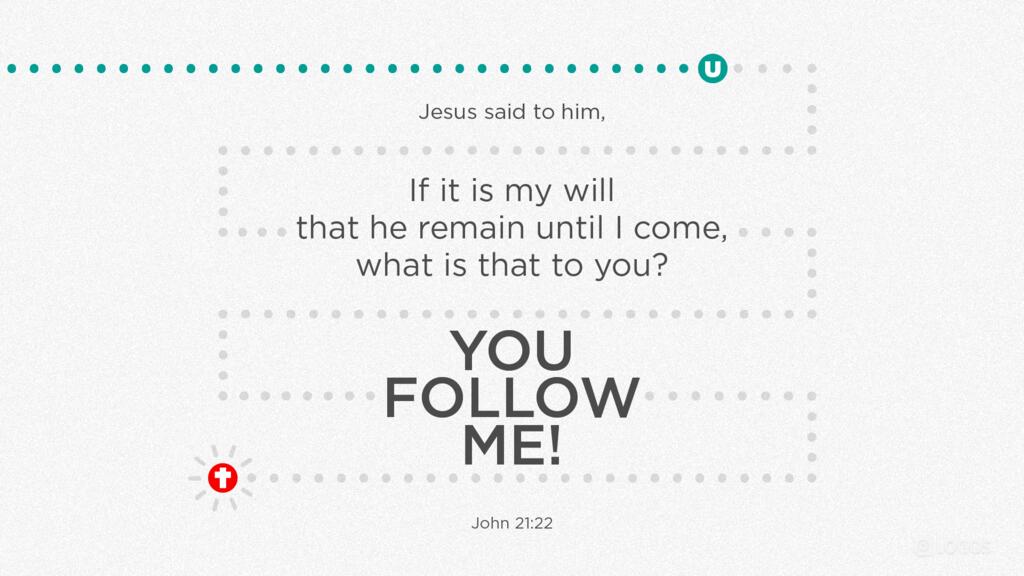
20Peter turned and* saw the disciple whom Jesus loved following them* (who also leaned back on his chest at the dinner and said, “Lord, who is the one betraying you?”) 21So when he* saw this one, Peter said to Jesus, “Lord, but what about this one?” 22Jesus said to him, “If I want him to remain until I come, what is that* to you? You follow me!” 23So this saying went out to the brothers that that disciple would not die. But Jesus did not say to him that he would not die, but “If I want him to remain until I come, what is that* to you?”
Footnotes
- *The words “your clothes” are not in the Greek text but are implied
- *The words “to go” are not in the Greek text but are implied
- *Here “after” is supplied as a component of the participle (“had said”) which is understood as temporal
- *Here “and” is supplied because the previous participle (“turned”) has been translated as a finite verb
- *Here the direct object is supplied from context in the English translation
- *Here “when” is supplied as a component of the participle (“saw”) which is understood as temporal
- *The words “is that” are not in the Greek text but are supplied in keeping with English style
- *The words “is that” are not in the Greek text but are supplied in keeping with English style
Copyright 2012 Lexham Press