John 11:23–35
The Lexham English BibleOther versions
English
- LEB The Lexham English Bible
- DARBY 1890 Darby Bible
- ASV American Standard Version
- AV 1873 The Cambridge Paragraph Bible of the Authorized English Version
- CSB Christian Standard Bible
- D-R Douay-Rheims Bible
- ESV English Standard Version
- GW GOD’S WORD Translation
- GNB Good News Translation
- HCSB The Holman Christian Standard Bible
- KJV 1900 King James Version
- LSB Legacy Standard Bible
- MSG The Message: The Bible in Contemporary Language
- NET The NET Bible
- NASB95 New American Standard Bible (1995)
- NCV New Century Version
- NIrV New International Reader’s Version (1998)
- NIV New International Version (2011)
- NKJV The New King James Version
- NLT New Living Translation
- NRSVue New Revised Standard Version: Updated Edition
- RSV The Revised Standard Version
- RSVCE The Revised Standard Version, Catholic Edition
- YLT Young’s Literal Translation
Arabic
Czech
French
German
Greek
Hungarian
Italian
Korean
Latin
Portuguese
Russian
Simplified Chinese
Spanish
Traditional Chinese
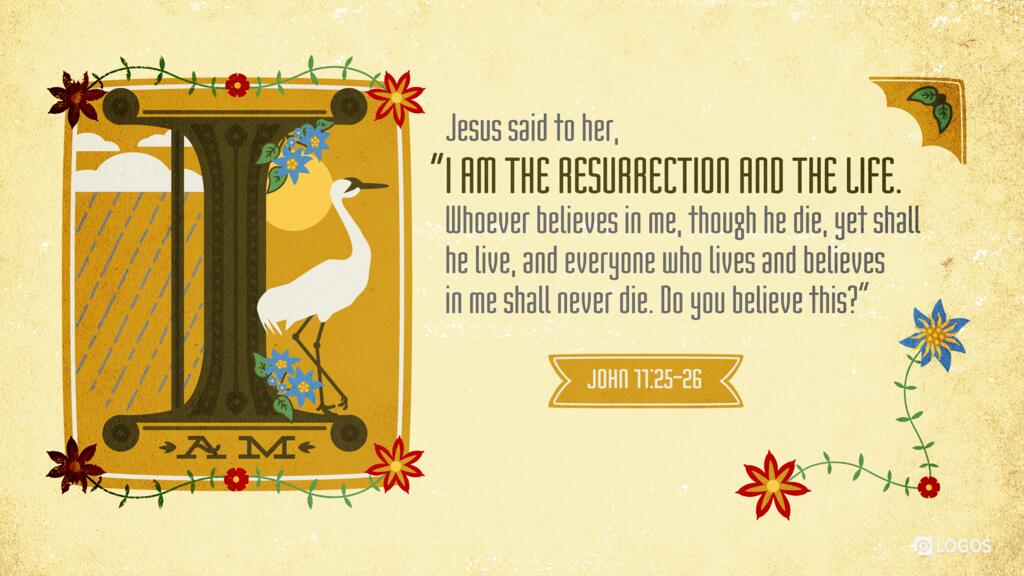
23Jesus said to her, “Your brother will rise again.” 24Martha said to him, “I know that he will rise again in the resurrection at the last day.” 25Jesus said to her, “I am the resurrection and the life. The one who believes in me, even if he dies, will live, 26and everyone who lives and believes in me will never die forever.g Do you believe this?” 27She said to him, “Yes, Lord, I have believed that you are the Christ, the Son of God, who comes into the world.”
Jesus Weeps
28And when she* had said this, she went and called her sister Mary privately, saying, “The Teacher is here and is calling for you.” 29So that one, when she heard it,* got up quickly and went to him. 30(Now Jesus has not yet come into the village, but was still in the place where Martha went to meet him.) 31So the Jews who were with her in the house and were consoling her, when they* saw Mary—that she stood up quickly and went out—followed her, because they* thought that she was going to the tomb in order to weep there.
32Then Mary, when she came where Jesus was and* saw him, fell at his feet, saying to him, “Lord, if you had been here, my brother would not have died.” 33Then Jesus, when he saw her weeping and the Jews who came with her weeping, was deeply moved in spirit and was troubled within himself. 34And he said, “Where have you laid him?” They said to him, “Lord, come and see.” 35Jesus wept.
Footnotes
- gLiterally “for the age”
- *Here “when” is supplied as a component of the participle (“had said”) which is understood as temporal
- *Here the direct object is supplied from context in the English translation
- *Here “when” is supplied as a component of the participle (“saw”) which is understood as temporal
- *Here “because” is supplied as a component of the participle (“thought”) which is understood as causal
- *Here “and” is supplied because the participle (“saw”) has been translated as a finite verb in keeping with English style
Copyright 2012 Lexham Press