John 11:1–25
The Lexham English BibleOther versions
English
- LEB The Lexham English Bible
- DARBY 1890 Darby Bible
- ASV American Standard Version
- AV 1873 The Cambridge Paragraph Bible of the Authorized English Version
- CSB Christian Standard Bible
- D-R Douay-Rheims Bible
- ESV English Standard Version
- GW GOD’S WORD Translation
- GNB Good News Translation
- HCSB The Holman Christian Standard Bible
- KJV 1900 King James Version
- LSB Legacy Standard Bible
- MSG The Message: The Bible in Contemporary Language
- NET The NET Bible
- NASB95 New American Standard Bible (1995)
- NCV New Century Version
- NIrV New International Reader’s Version (1998)
- NIV New International Version (2011)
- NKJV The New King James Version
- NLT New Living Translation
- NRSVue New Revised Standard Version: Updated Edition
- RSV The Revised Standard Version
- RSVCE The Revised Standard Version, Catholic Edition
- YLT Young’s Literal Translation
Arabic
Czech
French
German
Greek
Hungarian
Italian
Korean
Latin
Portuguese
Russian
Simplified Chinese
Spanish
Traditional Chinese
Lazarus Dies
11Now a certain man was sick, Lazarus from Bethany, the village of Mary and her sister Martha. 2(Now it was Mary who anointed the Lord with perfumed oil and wiped his feet with her hair, whose brother Lazarus was sick.) 3So the sisters sent word* to him, saying, “Lord, behold, the one whom you love is sick.” 4And when he* heard it,* Jesus said, “This sickness is not to death, but for the glory of God, in order that the Son of God may be glorified through it.” 5(Now Jesus loved Martha and her sister and Lazarus.) 6So when he heard that he was sick, then he remained in the place wherea he was two days.
7Then after this he said to the disciples, “Let us go to Judea again.” 8The disciples said to him, “Rabbi, the Jews were seeking just now to stone you, and are you going there again?” 9Jesus replied, Are there not twelve hours in the day? If anyone walks around in the daylight, he does not stumble, because he sees the light of this world. 10But if anyone walks around in the night, he stumbles, because the light is not in him. 11He said these things, and after this he said to them, “Our friend Lazarus has fallen asleep, but I am going so that I can awaken him.” 12So the disciples said to him, “Lord, if he has fallen asleep, he will get well.” 13(Now Jesus had been speaking about his death, but they thought that he was speaking about real sleep.b) 14So Jesus then said to them plainly, “Lazarus has died, 15and I am glad for your sakec that I was not there, so that you may believe. But let us go to him.” 16Then Thomas (the one who is called Didymus)d said to his fellow disciples, “Let us go also, so that we may die with him.”
Jesus the Resurrection and the Life
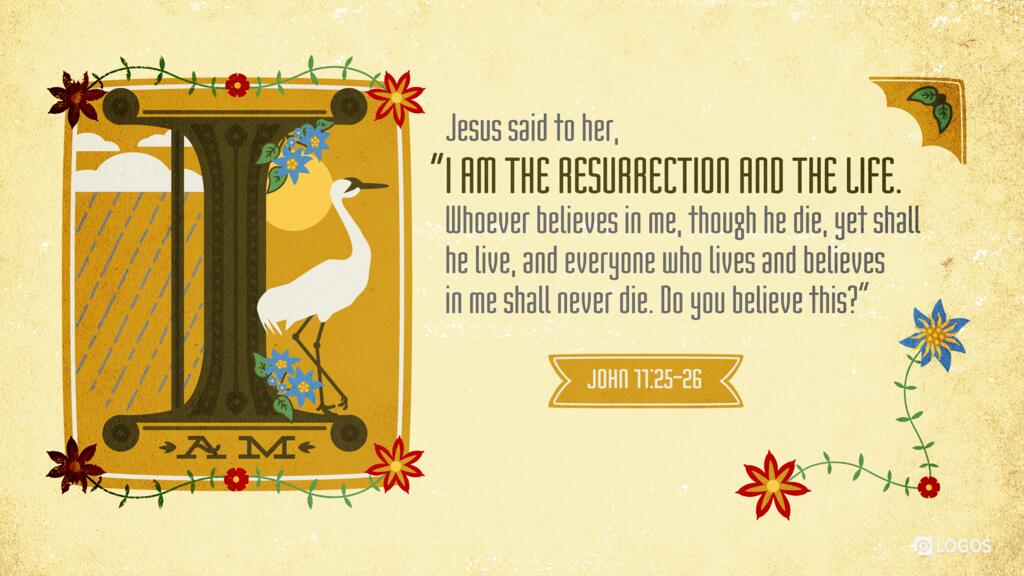
17So when he* arrived, Jesus found he had already been four days in the tomb. 18(Now Bethany was near Jerusalem, about fifteen stadia.e 19So many of the Jews came to Martha and Mary in order to console them concerning their* brother.) 20Now Martha, when she heard that Jesus was coming, went to meet him, but Mary was sitting in the house. 21So Martha said to Jesus, “Lord, if you had been here, my brother would not have died. 22Evenf now I know that whatever you ask God, God will grant you.” 23Jesus said to her, “Your brother will rise again.” 24Martha said to him, “I know that he will rise again in the resurrection at the last day.” 25Jesus said to her, “I am the resurrection and the life. The one who believes in me, even if he dies, will live,
Footnotes
- *Here the direct object is supplied from context in the English translation
- *Here “when” is supplied as a component of the participle (“heard”) which is understood as temporal
- *Here the direct object is supplied from context in the English translation
- aLiterally “in which”
- bLiterally “the sleep of slumber”
- cLiterally “for the sake of you”
- d“Didymus” means “the twin” in Greek
- *Here “when” is supplied as a component of the participle (“arrived”) which is understood as temporal
- eA “stade” or “stadium” (plur. “stadia”) is about 607 ft (187 m), so this was just under two miles (3 km)
- *Literally “the”; the Greek article is used here as a possessive pronoun
- fSome manuscripts have “But even”
Copyright 2012 Lexham Press