Acts 15:1–11
The Lexham English BibleOther versions
English
- LEB The Lexham English Bible
- DARBY 1890 Darby Bible
- ASV American Standard Version
- AV 1873 The Cambridge Paragraph Bible of the Authorized English Version
- CSB Christian Standard Bible
- D-R Douay-Rheims Bible
- ESV English Standard Version
- GW GOD’S WORD Translation
- GNB Good News Translation
- HCSB The Holman Christian Standard Bible
- KJV 1900 King James Version
- LSB Legacy Standard Bible
- MSG The Message: The Bible in Contemporary Language
- NET The NET Bible
- NASB95 New American Standard Bible (1995)
- NCV New Century Version
- NIrV New International Reader’s Version (1998)
- NIV New International Version (2011)
- NKJV The New King James Version
- NLT New Living Translation
- NRSVue New Revised Standard Version: Updated Edition
- RSV The Revised Standard Version
- RSVCE The Revised Standard Version, Catholic Edition
- YLT Young’s Literal Translation
Arabic
Czech
French
German
Greek
Hungarian
Italian
Korean
Latin
Portuguese
Russian
Simplified Chinese
Spanish
Traditional Chinese
The Jerusalem Council
15And some men came down from Judea and* began teaching* the brothers, “Unless you are circumcised according to the custom prescribed by Moses, you cannot be saved.” 2And after* there was no little strife and debate by Paul and Barnabas against them, they appointed Paul and Barnabas and some others from among them to go up to the apostles and elders in Jerusalem concerning this issue. 3So they were sent on their way by the church, and* passed through both Phoenicia and Samaria, telling in detail the conversion of the Gentiles and bringing great joy to all the brothers. 4And when they* arrived in Jerusalem, they were received by the church and the apostles and the elders, and reported all that God had done with them. 5But some of those who had believed from the party of the Pharisees stood up, saying, “It is necessary to circumcise them and to command them* to observe the law of Moses!”
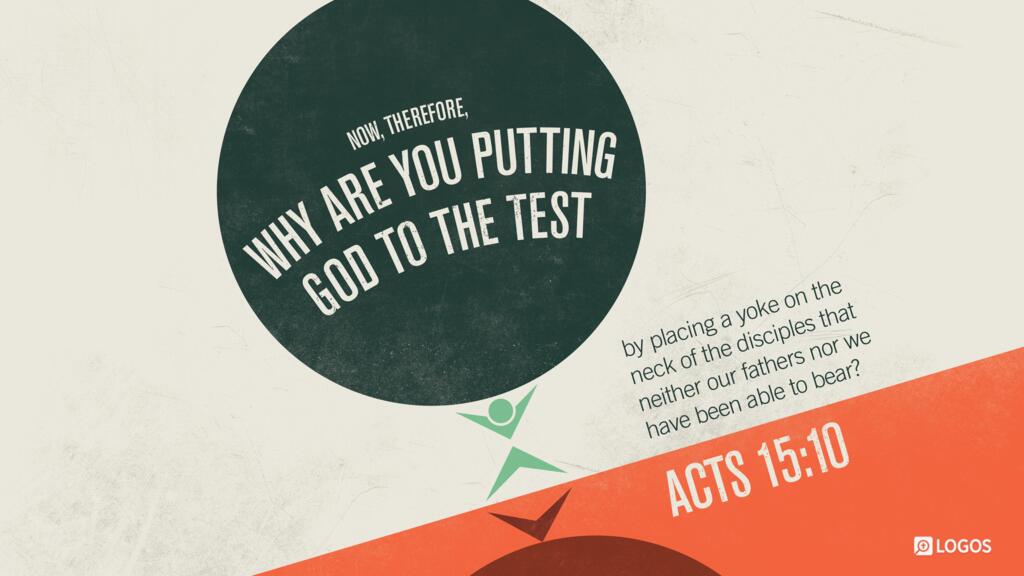
6Both the apostles and the elders assembled to deliberate concerning this matter. 7And after* there was much debate, Peter stood up and* said to them, “Men and brothers, you know that in the early daysa God chose among you through my mouth that the Gentiles should hear the message of the gospel and believe. 8And God, who knows the heart, testified to them by* giving them* the Holy Spirit, just as he also did to us. 9And he made no distinction between us and them, cleansing their hearts by faith. 10So now why are you putting God to the test by* placing on the neck of the disciples a yoke that neither our fathers nor we have been able to bear? 11But we believe we will be saved through the grace of the Lord Jesus in the sameb way those also are.”
Footnotes
- *Here “and” is supplied because the previous participle (“came down”) has been translated as a finite verb
- *The imperfect tense has been translated as ingressive here (“began teaching”)
- *Here “after” is supplied as a component of the temporal genitive absolute participle (“was”)
- *Here “and” is supplied because the previous participle (“were sent on their way”) has been translated as a finite verb
- *Here “when” is supplied as a component of the participle (“arrived”) which is understood as temporal
- *Here the direct object is supplied from context in the English translation
- *Here “after” is supplied as a component of the temporal genitive absolute participle (“was”)
- *Here “and” is supplied because the previous participle (“stood up”) has been translated as a finite verb
- aOr “from ancient days”
- *Here “by” is supplied as a component of the participle (“giving”) which is understood as means
- *Here the direct object is supplied from context in the English translation
- *Here “by” is supplied as a component of the infinitive (“placing”) which is understood as means
- bLiterally “which”
Copyright 2012 Lexham Press