Acts 10:24–48
The Lexham English BibleOther versions
English
- LEB The Lexham English Bible
- DARBY 1890 Darby Bible
- ASV American Standard Version
- AV 1873 The Cambridge Paragraph Bible of the Authorized English Version
- CSB Christian Standard Bible
- D-R Douay-Rheims Bible
- ESV English Standard Version
- GW GOD’S WORD Translation
- GNB Good News Translation
- HCSB The Holman Christian Standard Bible
- KJV 1900 King James Version
- LSB Legacy Standard Bible
- MSG The Message: The Bible in Contemporary Language
- NET The NET Bible
- NASB95 New American Standard Bible (1995)
- NCV New Century Version
- NIrV New International Reader’s Version (1998)
- NIV New International Version (2011)
- NKJV The New King James Version
- NLT New Living Translation
- NRSVue New Revised Standard Version: Updated Edition
- RSV The Revised Standard Version
- RSVCE The Revised Standard Version, Catholic Edition
- TNIV Today’s New International Version
- YLT Young’s Literal Translation
Arabic
Czech
French
German
Greek
Hungarian
Italian
Korean
Latin
Portuguese
Russian
Simplified Chinese
Spanish
Traditional Chinese
24And on the next day he entered into Caesarea.
Peter Visits Cornelius
Now Cornelius was waiting for them, and* had called together his relatives and close friends. 25So it happened that when Peter entered, Cornelius met him, fell at his* feet, and* worshiped him.* 26But Peter helped him up, saying, “Get up! I myself am also a man!” 27And as he* conversed with him, he went in and found many people gathered. 28And he said to them, “You know that it is forbidden for a Jewish man to associate with or to approach a foreigner. And to me God has shown that I should call no man common or unclean. 29Therefore—and without raising any objection—I came when I* was sent for. So I ask for what reason you sent for me.”
30And Cornelius said, “Four days ago at this hour,e the ninth, I was praying in my house. And behold, a man in shining clothing stood before me 31and said, ‘Cornelius, your prayer has been heard, and your charitable deeds have been remembered before God. 32Therefore send to Joppa and summon Simon who is also called Peter. This man is staying as a guest in the house of Simon, a tanner,f by the sea. 33Therefore I sent for you at once, and you were kind enough to come.g So now we all are present before God to hear all the things that have been commanded to you by the Lord.”
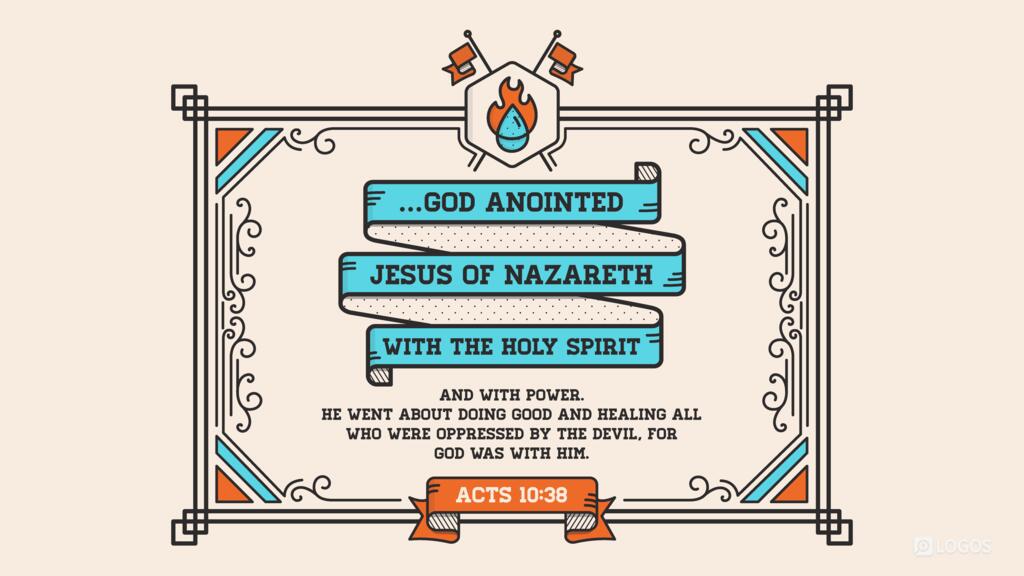
34So Peter opened his* mouth and* said, “In truth I understand that God is not one who shows partiality, 35but in every nation the one who fears him and who does what is right is acceptable to him. 36As for* the message that he sent to the sons of Israel, proclaiming the good news of peace through Jesus Christ—this one is Lord of all—37you know the thing that happened throughout all Judea, beginning from Galilee, after the baptism that John proclaimed: 38Jesus of Nazareth—how God anointed him with the Holy Spirit and with power, who went about doing good and healing all who were oppressed by the devil, because God was with him. 39And we are witnesses of all the things that he did both in the land of the Judeans and in Jerusalem, whom they also executed by* hanging him* on a tree. 40God raised this one up on the third day and granted that he should become visible, 41not to all the people but to us who had been chosen beforehand by God as witnesses, who ate and drank with him after he rose from the dead. 42And he commanded us to preach to the people and to testify solemnly that this one is the one appointedh by God as judge of the living and of the dead. 43To this one all the prophets testify, that through his name everyone who believes in him receives forgiveness of sins.”
The Holy Spirit Given to Gentiles
44While* Peter was still speaking these words, the Holy Spirit fell on all those who were listening to the message. 45And those believers from the circumcision who had accompanied Peter were astonished that the gift of the Holy Spirit had been poured out even on the Gentiles, 46for they heard them speaking in tongues and glorifying God. Then Peter said, 47“Surely no one can withhold the water for these people to be baptized, who have received the Holy Spirit as we also did!” 48So he ordered that they be baptized in the name of Jesus Christ. Then they asked him to stay for several days.
Footnotes
- *Here “and” is supplied because the previous participle (“waiting for”) has been translated as a finite verb
- *Literally “the”; the Greek article is used here as a possessive pronoun
- *Here “and” is supplied because the previous participle (“fell”) has been translated as a finite verb
- *Here the direct object is supplied from context in the English translation
- *Here “as” is supplied as a component of the participle (“conversed with”) which is understood as temporal
- *Here “when” is supplied as a component of the participle (“was sent for”) which is understood as temporal
- eLiterally “from the fourth day until this hour”
- fOr “of Simon Berseus”; most modern English versions treat the word as Simon’s profession (“Simon the tanner”), but the word may actually be a surname (“Simon Berseus” or “Simon Tanner”)
- gLiterally “have done rightly coming”
- *Literally “the”; the Greek article is used here as a possessive pronoun
- *Here “and” is supplied because the previous participle (“opened”) has been translated as a finite verb
- *The words “As for” are not in the Greek text, but are supplied in the translation in keeping with English style
- *Here “by” is supplied as a component of the participle (“hanging”) which is understood as means
- *Here the direct object is supplied from context in the English translation
- hOr “one who is designated”
- *Here “while” is supplied as a component of the temporal genitive absolute participle (“was … speaking”)
Copyright 2012 Lexham Press