Acts 1:8–16
The Lexham English BibleOther versions
English
- LEB The Lexham English Bible
- DARBY 1890 Darby Bible
- ASV American Standard Version
- AV 1873 The Cambridge Paragraph Bible of the Authorized English Version
- CSB Christian Standard Bible
- D-R Douay-Rheims Bible
- ESV English Standard Version
- GW GOD’S WORD Translation
- GNB Good News Translation
- HCSB The Holman Christian Standard Bible
- KJV 1900 King James Version
- LSB Legacy Standard Bible
- MSG The Message: The Bible in Contemporary Language
- NET The NET Bible
- NASB95 New American Standard Bible (1995)
- NCV New Century Version
- NIrV New International Reader’s Version (1998)
- NIV New International Version (2011)
- NKJV The New King James Version
- NLT New Living Translation
- NRSVue New Revised Standard Version: Updated Edition
- RSV The Revised Standard Version
- RSVCE The Revised Standard Version, Catholic Edition
- YLT Young’s Literal Translation
Arabic
Czech
French
German
Greek
Hungarian
Italian
Korean
Latin
Portuguese
Russian
Simplified Chinese
Spanish
Traditional Chinese
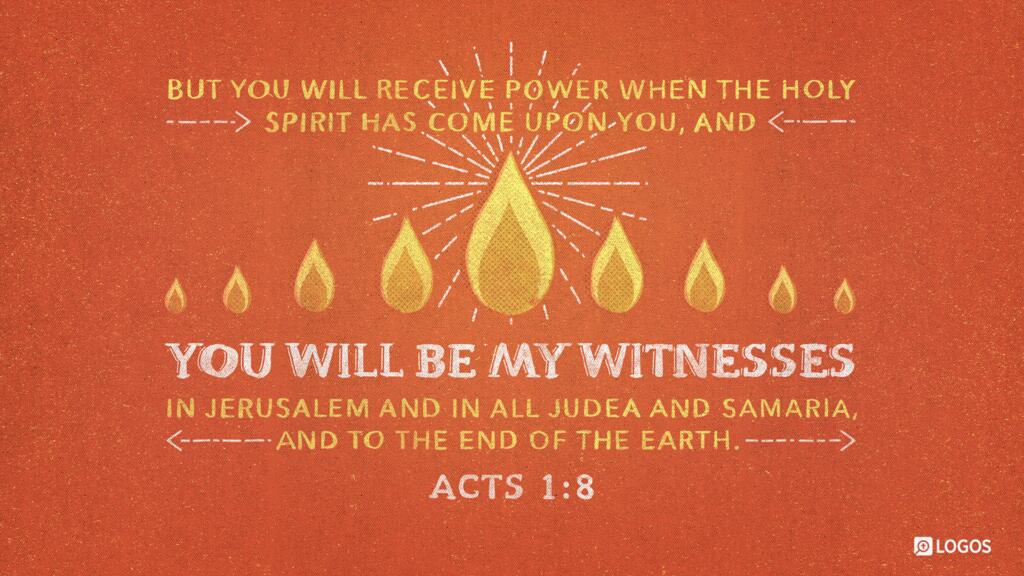
8But you will receive power when* the Holy Spirit has come upon you, and you will be my witnesses in Jerusalem, and in all Judea and Samaria, and to the farthest part of the earth.” 9And after he* had said these things, while* they were watching, he was taken up, and a cloud received him from their sight. 10And as they were staring into the sky while* he was departing, behold, two men in white clothing stood by them 11who also said, “Men of Galilee,d why do you stand there lookinge into the sky? This Jesus who was taken up from you into heaven like this will come back in the same way you saw him departing into heaven!”
Matthias Chosen to Replace Judas
12Then they returned to Jerusalem from the mountain that is called Olive Grovef which is near Jerusalem, a Sabbath day’s journey away.g 13And when they had entered, they went up to the upstairs room where they were staying—Peter and John and James and Andrew, Philip and Thomas, Bartholomew and Matthew, James son of Alphaeus and Simon the Zealot and Judas son of James. 14All these were busily engaged with one mind in prayer, together with the women and Mary the mother of Jesus and withh his brothers.
15And in those days Peter stood up in the midst of the brothers (and it was a crowd of persons of about one hundred twenty at the same place) and* said, 16“Men and brothers, it was necessary that the scripture be fulfilled, which the Holy Spirit proclaimed beforehand through the mouth of David concerning Judas, who became a guide to those who arrested Jesus,
Footnotes
- *Here “when” is supplied as a component of the temporal genitive absolute participle (“has come”)
- *Here “after” is supplied as a component of the participle (“had said”) which is understood as temporal
- *Here “while” is supplied as a component of the temporal genitive absolute participle (“were watching”)
- *Here “while” is supplied as a component of the temporal genitive absolute participle (“was departing”)
- dLiterally “Galileans”
- eSome manuscripts have “gazing”
- fThis is a variation of the name “Mount of Olives”
- gLiterally “having a journey of a Sabbath”
- hSome manuscripts omit “with”
- *Here “and” is supplied because the previous participle (“stood up”) has been translated as a finite verb
Copyright 2012 Lexham Press