Acts 1:8–16
The NET BibleOther versions
English
- NET The NET Bible
- DARBY 1890 Darby Bible
- ASV American Standard Version
- AV 1873 The Cambridge Paragraph Bible of the Authorized English Version
- CSB Christian Standard Bible
- D-R Douay-Rheims Bible
- ESV English Standard Version
- GW GOD’S WORD Translation
- GNB Good News Translation
- HCSB The Holman Christian Standard Bible
- KJV 1900 King James Version
- LSB Legacy Standard Bible
- LEB The Lexham English Bible
- MSG The Message: The Bible in Contemporary Language
- NASB95 New American Standard Bible (1995)
- NCV New Century Version
- NIrV New International Reader’s Version (1998)
- NIV New International Version (2011)
- NKJV The New King James Version
- NLT New Living Translation
- NRSVue New Revised Standard Version: Updated Edition
- RSV The Revised Standard Version
- RSVCE The Revised Standard Version, Catholic Edition
- YLT Young’s Literal Translation
Arabic
Czech
French
German
Greek
Hungarian
Italian
Korean
Latin
Portuguese
Russian
Simplified Chinese
Spanish
Traditional Chinese
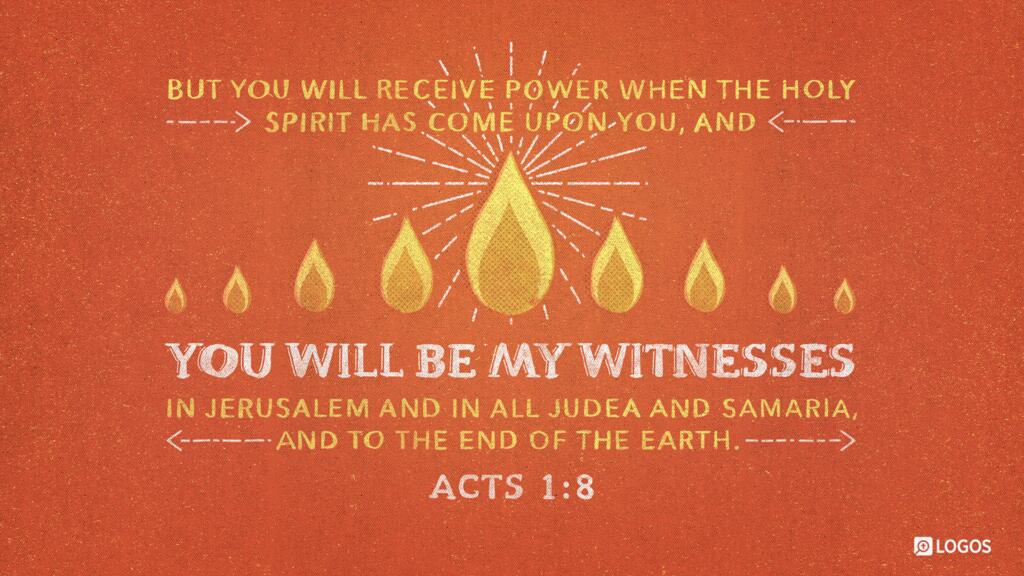
1:8But you will receive power when the Holy Spirit has come upon you, and you will be my witnesses in Jerusalem, and in all Judea and Samaria, and to the farthest parts22 of the earth.” 1:9After23 he had said this, while they were watching, he was lifted up and a cloud hid him from their sight. 1:10As24 they were still staring into the sky while he was going, suddenly25 two men in white clothing stood near them 1:11and said, “Men of Galilee, why do you stand here26 looking up into the sky? This same Jesus who has been taken up from you into heaven27 will come back in the same way you saw him go into heaven.”
A Replacement for Judas is Chosen
1:12Then they returned to Jerusalem28 from the mountain29 called the Mount of Olives30 (which is near Jerusalem, a Sabbath day’s journey31 away). 1:13When32 they had entered Jerusalem,33 they went to the upstairs room where they were staying. Peter34 and John, and James, and Andrew, Philip and Thomas, Bartholomew and Matthew, James son of Alphaeus and Simon the Zealot, and Judas son of James were there.351:14All these continued together in prayer with one mind, together with the women, along with Mary the mother of Jesus, and his brothers.361:15In those days37 Peter stood up among the believers38 (a gathering of about one hundred and twenty people) and said, 1:16“Brothers,39 the scripture had to be fulfilled that the Holy Spirit foretold through40 David concerning Judas—who became the guide for those who arrested Jesus—
Footnotes
- 22 Or “to the ends.”
- 23 Grk “And after.” Because of the difference between Greek style, which often begins sentences or clauses with “and,” and English style, which generally does not, καί (kai) has not been translated here.
- 24 Grk “And as.” Because of the difference between Greek style, which often begins sentences or clauses with “and,” and English style, which generally does not, καί (kai) has not been translated here.
- 25 Grk “behold.”
- 26 The word “here” is not in the Greek text, but is implied. Direct objects were frequently omitted in Greek when clear from the context, but must be supplied for the modern English reader.
- 27 Codex Bezae (D) and several other witnesses lack the words εἰς τὸν οὐρανόν (eis ton ouranon, “into heaven”) here, most likely by way of accidental deletion. In any event, it is hardly correct to suppose that the Western text has intentionally suppressed references to the ascension of Christ here, for the phrase is solidly attested in the final clause of the verse. Or “into the sky.” The Greek word οὐρανός (ouranos) may be translated “sky” (vv. 10, 11a) or “heaven” (twice in v. 11b) depending on the context.
- 28 For location see ; ; ; ; ; ; ; ; .
- 29 Or “from the hill.” The Greek term ὄρος (oros) refers to a relatively high elevation of land in contrast with βουνός (bounos, “hill”).
- 30 The Mount of Olives is the traditional name for this mountain, also called Olivet. The Mount of Olives is really a ridge running north to south about 1.8 mi (3 km) long, east of Jerusalem across the Kidron Valley. Its central elevation is about 100 ft (30 m) higher than Jerusalem. It was named for the large number of olive trees which grew on it.
- 31 The phrase a Sabbath day’s journey refers to the distance the rabbis permitted a person to travel on the Sabbath without breaking the Sabbath, specified in tractate Sotah 5:3 of the as 2,000 cubits (a cubit was about 18 inches). In this case the distance was about half a mile (1 km).
- 32 Grk “And when.” Because of the difference between Greek style, which often begins sentences or clauses with “and,” and English style, which generally does not, καί (kai) has not been translated here.
- 33 The word “Jerusalem” is not in the Greek text but is implied (direct objects were often omitted when clear from the context).
- 34 In the various lists of the twelve, Peter (also called Simon) is always mentioned first (see also Matt 10:1–4; Mark 3:16–19; Luke 6:13–16) and the first four are always the same, though not in the same order after Peter.
- 35 The words “were there” are not in the Greek text, but are implied.
- 36 Jesus’ brothers are mentioned in Matt 13:55 and John 7:3.
- 37 Grk “And in those days.” Because of the difference between Greek style, which often begins sentences or clauses with “and,” and English style, which generally does not, καί (kai) has not been translated here.
- 38 Or “brethren” (but the term includes both male and female believers present in this gathering, as indicated by those named in vv. 13–14).
- 39 Grk “Men brothers.” In light of the compound phrase ἄνδρες ἀδελφοί (andres adelphoi, “Men brothers”) Peter’s words are best understood as directly addressed to the males present, possibly referring specifically to the twelve (really ten at this point—eleven minus the speaker, Peter) mentioned by name in v. 13.
- 40 Grk “foretold by the mouth of.”
The NET Bible First Edition, Copyright 1996-2005 by Biblical Studies Press