Romans 7:14–25
The NET BibleOther versions
English
- NET The NET Bible
- DARBY 1890 Darby Bible
- ASV American Standard Version
- AV 1873 The Cambridge Paragraph Bible of the Authorized English Version
- CSB Christian Standard Bible
- D-R Douay-Rheims Bible
- ESV English Standard Version
- GW GOD’S WORD Translation
- GNB Good News Translation
- HCSB The Holman Christian Standard Bible
- KJV 1900 King James Version
- LSB Legacy Standard Bible
- LEB The Lexham English Bible
- MSG The Message: The Bible in Contemporary Language
- NASB95 New American Standard Bible (1995)
- NCV New Century Version
- NIrV New International Reader’s Version (1998)
- NIV New International Version (2011)
- NKJV The New King James Version
- NLT New Living Translation
- NRSVue New Revised Standard Version: Updated Edition
- RSV The Revised Standard Version
- RSVCE The Revised Standard Version, Catholic Edition
- YLT Young’s Literal Translation
Arabic
Czech
French
German
Greek
Hungarian
Italian
Korean
Latin
Portuguese
Russian
Simplified Chinese
Spanish
Traditional Chinese
7:14For we know that the law is spiritual—but I am unspiritual, sold into slavery to sin.217:15For I don’t understand what I am doing. For I do not do what I want—instead, I do what I hate.227:16But if I do what I don’t want, I agree that the law is good.237:17But now it is no longer me doing it, but sin that lives in me. 7:18For I know that nothing good lives in me, that is, in my flesh. For I want to do the good, but I cannot do it.247:19For I do not do the good I want, but I do the very evil I do not want! 7:20Now if I do what I do not want, it is no longer me doing it but sin that lives in me.
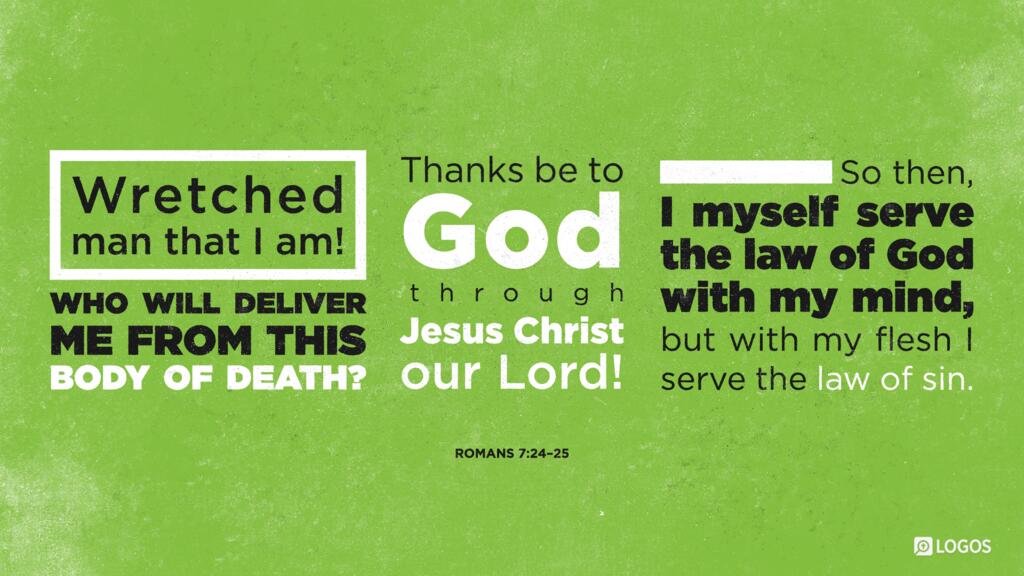
7:21So, I find the law that when I want to do good, evil is present with me. 7:22For I delight in the law of God in my inner being. 7:23But I see a different law in my members waging war against the law of my mind and making me captive to the law of sin that is in my members. 7:24Wretched man that I am! Who will rescue me from this body of death? 7:25Thanks be25 to God through Jesus Christ our Lord! So then,26 I myself serve the law of God with my mind, but27 with my flesh I serve28 the law of sin.
Footnotes
- 21 Grk “under sin.”
- 22 Grk “but what I hate, this I do.”
- 23 Grk “I agree with the law that it is good.”
- 24 Grk “For to wish is present in/with me, but not to do it.”
- 25 Most (א* A 1739 1881 𝔐 sy) read “I give thanks to God” rather than “Now thanks be to God” (א1 [B] Ψ 33 81 104 365 1506 ), the reading of . The reading with the verb (εὐχαριστῶ τῷ θεῷ, eucharistō tō theō) possibly arose from a transcriptional error in which several letters were doubled ( ). The conjunction δέ (de, “now”) is included in some as well (א1 Ψ 33 81 104 365 1506 ), but it should probably not be considered original. The support for the omission of δέ is both excellent and widespread (א* A B D 1739 1881 𝔐 lat sy), and its addition can be explained as an insertion to smooth out the transition between v. 24 and 25.
- 26 There is a double connective here that cannot be easily preserved in English: “consequently therefore,” emphasizing the conclusion of what he has been arguing.
- 27 Greek emphasizes the contrast between these two clauses more than can be easily expressed in English.
- 28 The words “I serve” have been repeated here for clarity.
The NET Bible First Edition, Copyright 1996-2005 by Biblical Studies Press