Psalm 139:13–14
The NET BibleOther versions
English
- NET The NET Bible
- DARBY 1890 Darby Bible
- ASV American Standard Version
- AV 1873 The Cambridge Paragraph Bible of the Authorized English Version
- CSB Christian Standard Bible
- D-R Douay-Rheims Bible
- ESV English Standard Version
- GW GOD’S WORD Translation
- GNB Good News Translation
- HCSB The Holman Christian Standard Bible
- KJV 1900 King James Version
- LSB Legacy Standard Bible
- LEB The Lexham English Bible
- MSG The Message: The Bible in Contemporary Language
- NASB95 New American Standard Bible (1995)
- NCV New Century Version
- NIrV New International Reader’s Version (1998)
- NIV New International Version (2011)
- NKJV The New King James Version
- NLT New Living Translation
- NRSVue New Revised Standard Version: Updated Edition
- RSV The Revised Standard Version
- RSVCE The Revised Standard Version, Catholic Edition
- YLT Young’s Literal Translation
Arabic
Czech
French
German
Hebrew
Hungarian
Italian
Korean
Latin
Portuguese
Russian
Simplified Chinese
Spanish
Traditional Chinese
139:13Certainly18 you made my mind and heart;19
you wove me together20 in my mother’s womb.
139:14I will give you thanks because your deeds are awesome and amazing.21
You knew me thoroughly;22
Footnotes
- 18 Or “for.”
- 19 Heb “my kidneys.” The kidneys were sometimes viewed as the seat of one’s emotions and moral character (cf. Pss 7:9; 26:2). A number of translations, recognizing that “kidneys” does not communicate this idea to the modern reader, have generalized the concept: “inmost being” (, ); “inward parts” (, ); “the delicate, inner parts of my body” (). In the last instance, the focus is almost entirely on the physical body rather than the emotions or moral character. The present translation, by using a hendiadys (one concept expressed through two terms), links the concepts of emotion (heart) and moral character (mind).
- 20 The Hebrew verb סָכַךְ (sakhakh, “to weave together”) is an alternate form of שָׂכַךְ (sakhakh, “to weave”) used in Job 10:11.
- 21 Heb “because awesome things, I am distinct, amazing [are] your works.” The text as it stands is syntactically problematic and makes little, if any, sense. The Niphal of פָּלָה (pala’) occurs elsewhere only in Exod 33:16. Many take the form from פָלָא (pala’; see §75.qq), which in the Niphal perfect means “to be amazing” (see 2 Sam 1:26; Ps 118:23; Prov 30:18). Some, following the and some other ancient witnesses, also prefer to emend the verb from first to second person, “you are amazing” (see L. C. Allen, Psalms 101–150 [], , ). The present translation assumes the text conflates two variants: נפלאים, the otherwise unattested masculine plural participle of פָלָא, and נִפְלָאוֹת (nifla’ot), the usual (feminine) plural form of the Niphal participle. The latter has been changed to a verb by later scribes in an attempt to accommodate it syntactically. The original text likely read, נוראות נפלאותים מעשׂיך (“your works [are] awesome [and] amazing”).
- 22 Heb “and my being knows very much.” Better parallelism is achieved (see v. 15a) if one emends יֹדַעַת (yoda’at), a Qal active participle, feminine singular form, to יָדַעְתָּ (yada’ta), a Qal perfect second masculine singular perfect. See L. C. Allen, Psalms 101–150 (), .
The NET Bible First Edition, Copyright 1996-2005 by Biblical Studies Press
In other versions
ESVEnglish Standard Version
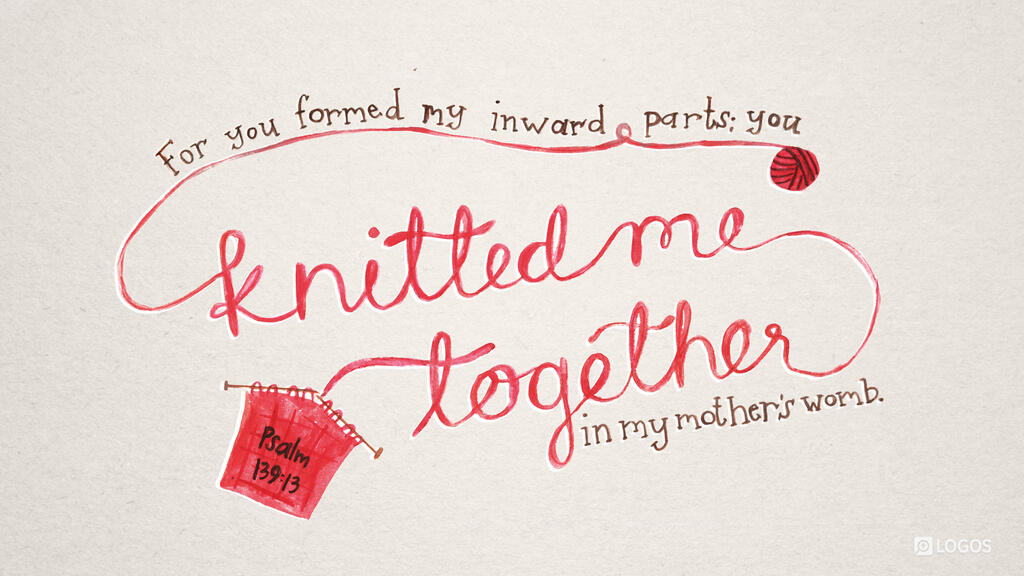
For you formed my inward parts;
you knitted me together in my mother’s womb.
I praise you, for I am fearfully and wonderfully made.
Wonderful are your works;
my soul knows it very well.
Copyright 2001 Crossway Bibles
NIVNew International Version (2011)
For you created my inmost being;
you knit me together in my mother’s womb.
I praise you because I am fearfully and wonderfully made;
your works are wonderful,
I know that full well.
Copyright 1973, 1978, 1984, 2011 Biblica, Inc.
CSBChristian Standard Bible
For it was you who created my inward parts;
you knit me together in my mother’s womb.
I will praise you
because I have been remarkably and wondrously made.
Your works are wondrous,
and I know this very well.
Copyright 2017 Holman Bible Publishers
NLTNew Living Translation
You made all the delicate, inner parts of my body
and knit me together in my mother’s womb.
Thank you for making me so wonderfully complex!
Your workmanship is marvelous—how well I know it.
Holy Bible, New Living Translation, copyright © 1996, 2004, 2015 by Tyndale House Foundation. Used by permission of Tyndale House Publishers. All rights reserved.
LEBThe Lexham English Bible
Indeed you created my inward parts;
you wove me in my mother’s womb.
I praise you, because I am fearfully
and wonderfully made.
Wonderful are your works,
and my soul knows it well.
Copyright 2012 Lexham Press
KJV 1900King James Version
For thou hast possessed my reins:
Thou hast covered me in my mother’s womb.
I will praise thee; for I am fearfully and wonderfully made:
Marvellous are thy works;
And that my soul knoweth right well.
Public Domain