Matthew 21:1–27
The NET BibleOther versions
English
- NET The NET Bible
- DARBY 1890 Darby Bible
- ASV American Standard Version
- AV 1873 The Cambridge Paragraph Bible of the Authorized English Version
- CSB Christian Standard Bible
- D-R Douay-Rheims Bible
- ESV English Standard Version
- GW GOD’S WORD Translation
- GNB Good News Translation
- HCSB The Holman Christian Standard Bible
- KJV 1900 King James Version
- LSB Legacy Standard Bible
- LEB The Lexham English Bible
- MSG The Message: The Bible in Contemporary Language
- NASB95 New American Standard Bible (1995)
- NCV New Century Version
- NIrV New International Reader’s Version (1998)
- NIV New International Version (2011)
- NKJV The New King James Version
- NLT New Living Translation
- NRSVue New Revised Standard Version: Updated Edition
- RSV The Revised Standard Version
- RSVCE The Revised Standard Version, Catholic Edition
- YLT Young’s Literal Translation
Arabic
Czech
French
German
Greek
Hungarian
Italian
Korean
Latin
Portuguese
Russian
Simplified Chinese
Spanish
Traditional Chinese
The Triumphal Entry
21:1Now1 when they approached Jerusalem2 and came to Bethphage,3 at the Mount of Olives,4 Jesus sent two disciples, 21:2telling them, “Go to the village ahead of you.5 Right away you will find a donkey tied there, and a colt with her. Untie them and bring them to me. 21:3If anyone says anything to you, you are to say, ‘The Lord needs them,’6 and he will send them at once.” 21:4This7 took place to fulfill what was spoken by the prophet:8
21:5“Tell the people of Zion,9
‘Look, your king is coming to you,
unassuming and seated on a donkey,
and on a colt, the foal of a donkey.’ ”10
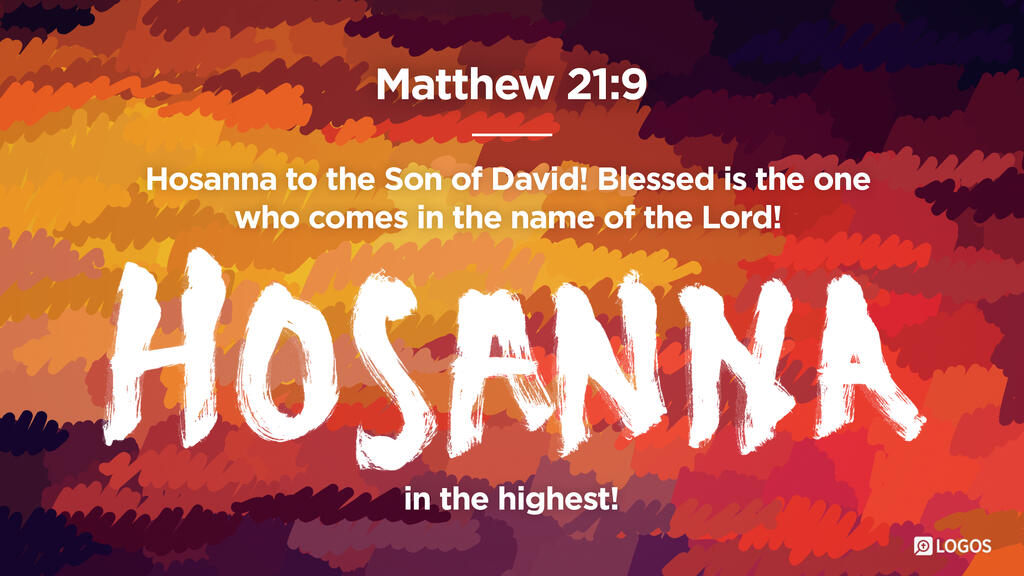
21:6So11 the disciples went and did as Jesus had instructed them. 21:7They brought the donkey and the colt and placed their cloaks12 on them, and he sat on them. 21:8A13 very large crowd spread their cloaks on the road. Others cut branches from the trees and spread them on the road. 21:9The crowds that went ahead of him and those following kept shouting,14 “Hosanna15 to the Son of David! Blessed is the one who comes in the name of the Lord!16 Hosanna in the highest!” 21:10As he entered Jerusalem the whole city was thrown into an uproar,17 saying, “Who is this?” 21:11And the crowds were saying, “This is the prophet Jesus, from Nazareth18 in Galilee.”
Cleansing the Temple
21:12Then19 Jesus entered the temple area20 and drove out all those who were selling and buying in the temple courts,21 and turned over the tables of the money changers and the chairs of those selling doves. 21:13And he said to them, “It is written, ‘My house will be called a house of prayer,’22 but you are turning it into a den23 of robbers!”24
21:14The blind and lame came to him in the temple courts, and he healed them. 21:15But when the chief priests and the experts in the law25 saw the wonderful things he did and heard the children crying out in the temple courts,26 “Hosanna to the Son of David,” they became indignant 21:16and said to him, “Do you hear what they are saying?” Jesus said to them, “Yes. Have you never read, ‘Out of the mouths of children and nursing infants you have prepared praise for yourself’?”2721:17And leaving them, he went out of the city to Bethany and spent the night there.
The Withered Fig Tree
21:18Now early in the morning, as he returned to the city, he was hungry. 21:19After noticing a fig tree28 by the road he went to it, but found nothing on it except leaves. He said to it, “Never again will there be fruit from you!” And the fig tree withered at once. 21:20When the disciples saw it they were amazed, saying, “How did the fig tree wither so quickly?” 21:21Jesus29 answered them, “I tell you the truth,30 if you have faith and do not doubt, not only will you do what was done to the fig tree, but even if you say to this mountain, ‘Be lifted up and thrown into the sea,’ it will happen. 21:22And whatever you ask in prayer, if you believe,31 you will receive.”
The Authority of Jesus
21:23Now after Jesus32 entered the temple courts,33 the chief priests and elders of the people came up to him as he was teaching and said, “By what authority34 are you doing these things, and who gave you this authority?” 21:24Jesus35 answered them, “I will also ask you one question. If you answer me then I will also tell you by what authority I do these things. 21:25Where did John’s baptism come from? From heaven or from people?”36 They discussed this among themselves, saying, “If we say, ‘From heaven,’ he will say, ‘Then why did you not believe him?’ 21:26But if we say, ‘From people,’ we fear the crowd, for they all consider John to be a prophet.” 21:27So37 they answered Jesus,38 “We don’t know.”39 Then he said to them, “Neither will I tell you40 by what authority41 I am doing these things.
Footnotes
- 1 Here καί (kai) has been translated as “now” to indicate the transition to a new topic.
- 2 For location see ; ; ; ; ; ; ; ; .
- 3 The exact location of the village of Bethphage is not known. Most put it on the southeast side of the Mount of Olives and northwest of Bethany, about 1.5 miles (3 km) east of Jerusalem.
- 4 “Mountain” in English generally denotes a higher elevation than it often does in reference to places in Palestine. The Mount of Olives is really a ridge running north to south about 3 kilometers (1.8 miles) long, east of Jerusalem across the Kidron Valley. Its central elevation is about 30 meters (100 ft) higher than Jerusalem. It was named for the large number of olive trees which grew on it.
- 5 Grk “the village lying before you” ( κατέναντι 2.b).
- 6 The custom called angaria allowed the impressment of animals for service to a significant figure.
- 7 Here δέ (de) has not been translated.
- 8 Grk “what was spoken by the prophet, saying.” The present participle λέγοντος (legontos) is redundant and has not been translated.
- 9 Grk “Tell the daughter of Zion” (the phrase “daughter of Zion” is an idiom for the inhabitants of Jerusalem: “people of Zion”). The idiom “daughter of Zion” has been translated as “people of Zion” because the original idiom, while firmly embedded in the Christian tradition, is not understandable to most modern English readers.
- 10 Grk “the foal of an animal under the yoke,” i.e., a hard-working animal. This is a quotation from Zech 9:9.
- 11 Here δέ (de) has been translated as “so” to indicate the implied result of Jesus’ instructions in vv. 2–3.
- 12 Grk “garments”; but this refers in context to their outer cloaks. The action is like 2 Kgs 9:13.
- 13 Here δέ (de) has not been translated.
- 14 Grk “were shouting, saying.” The participle λέγοντας (legontas) is redundant here in contemporary English and has not been translated.
- 15 The expression Ὡσαννά (hōsanna, literally in Hebrew, “O Lord, save”) in the quotation from Ps 118:25–26 was probably by this time a familiar liturgical expression of praise, on the order of “Hail to the king,” although both the underlying Aramaic and Hebrew expressions meant “O Lord, save us.” In words familiar to every Jew, the author is indicating that at this point every messianic expectation is now at the point of realization. It is clear from the words of the psalm shouted by the crowd that Jesus is being proclaimed as messianic king. See E. Lohse, 9:682–84. Hosanna is an Aramaic expression that literally means, “help, I pray,” or “save, I pray.” By Jesus’ time it had become a strictly liturgical formula of praise, however, and was used as an exclamation of praise to God.
- 16 A quotation from Ps 118:25–26.
- 17 Grk “was shaken.” The translation “thrown into an uproar” is given by L&N 25.233.
- 18 For location see ; ; ; ; .
- 19 Here καί (kai) has been translated as “then” to indicate the implied sequence of events within the narrative.
- 20 Grk “the temple.” The merchants (those who were selling) would have been located in the Court of the Gentiles.
- 21 Grk “the temple.” Matthew (here, 21:12–27), Mark (11:15–19) and Luke (19:45–46) record this incident of the temple cleansing at the end of Jesus’ ministry. John (2:13–16) records a cleansing of the temple at the beginning of Jesus’ ministry. See the note on the word temple courts in for a discussion of the relationship of these accounts to one another.
- 22 A quotation from Isa 56:7.
- 23 Or “a hideout” (see L&N 1.57).
- 24 A quotation from Jer 7:11. The meaning of Jesus’ statement about making the temple courts a den of robbers probably operates here at two levels. Not only were the religious leaders robbing the people financially, but because of this they had also robbed them spiritually by stealing from them the opportunity to come to know God genuinely. It is possible that these merchants had recently been moved to this location for convenience.
- 25 Or “and the scribes.” See the note on the phrase “experts in the law” in .
- 26 Grk “crying out in the temple [courts] and saying.” The participle λέγοντας (legontas) is somewhat redundant here in contemporary English and has not been translated.
- 27 A quotation from Ps 8:2.
- 28 Grk “one fig tree.” The fig tree is a variation on the picture of a vine as representing the nation; see Isa 5:1–7.
- 29 Grk “And answering, Jesus said.” This is somewhat redundant and has been simplified in the translation.
- 30 Grk “Truly (ἀμήν, amēn), I say to you.”
- 31 Grk “believing”; the participle here is conditional.
- 32 Grk “he.”
- 33 Grk “the temple.”
- 34 On this phrase, see ποῖος 2.a.γ.1
- 35 Grk “answering, Jesus said to them.” This is somewhat redundant and has been simplified in the translation. Here δέ (de) has not been translated.
- 36 The plural Greek term ἀνθρώπων (anthrōpōn) is used here (and in v. 26) in a generic sense, referring to both men and women (cf. , , “of human origin”; , “from human beings”; , “merely human”). The question is whether John’s ministry was of divine or human origin.
- 37 Here δέ (de) has been translated as “So” to indicate that the clause is a result of the deliberations of the leaders.
- 38 Grk “answering Jesus, they said.” This construction is somewhat awkward in English and has been simplified in the translation.
- 39 Very few questions could have so completely revealed the wicked intentions of the religious leaders. Jesus’ question revealed the motivation of the religious leaders and exposed them for what they really were—hypocrites. They indicted themselves when they cited only two options and chose neither of them (“We do not know”). The point of Matt 21:23–27 is that no matter what Jesus said in response to their question, they were not going to believe it and would in the end use it against him.
- 40 Neither will I tell you. Though Jesus gave no answer, the analogy he used to their own question makes his view clear. His authority came from heaven.
- 41 On this phrase, see ποῖος 2.a.γ. This is exactly the same phrase as in v. 23.
The NET Bible First Edition, Copyright 1996-2005 by Biblical Studies Press