Luke 15:1–10
The NET BibleOther versions
English
- NET The NET Bible
- DARBY 1890 Darby Bible
- ASV American Standard Version
- AV 1873 The Cambridge Paragraph Bible of the Authorized English Version
- CSB Christian Standard Bible
- D-R Douay-Rheims Bible
- ESV English Standard Version
- GW GOD’S WORD Translation
- GNB Good News Translation
- HCSB The Holman Christian Standard Bible
- KJV 1900 King James Version
- LSB Legacy Standard Bible
- LEB The Lexham English Bible
- MSG The Message: The Bible in Contemporary Language
- NASB95 New American Standard Bible (1995)
- NCV New Century Version
- NIrV New International Reader’s Version (1998)
- NIV New International Version (2011)
- NKJV The New King James Version
- NLT New Living Translation
- NRSVue New Revised Standard Version: Updated Edition
- RSV The Revised Standard Version
- RSVCE The Revised Standard Version, Catholic Edition
- YLT Young’s Literal Translation
Arabic
Czech
French
German
Greek
Hungarian
Italian
Korean
Latin
Portuguese
Russian
Simplified Chinese
Spanish
Traditional Chinese
The Parable of the Lost Sheep and Coin
15:1Now all the tax collectors1 and sinners were coming2 to hear him. 15:2But3 the Pharisees4 and the experts in the law5 were complaining,6 “This man welcomes7 sinners and eats with them.”
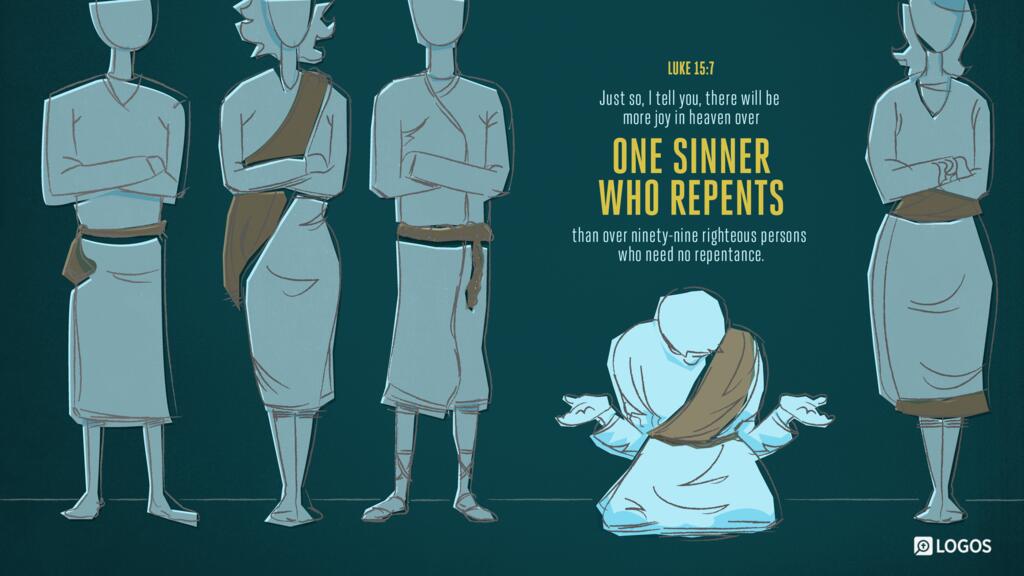
15:3So8 Jesus9 told them10 this parable:1115:4“Which one12 of you, if he has a hundred13 sheep and loses one of them, would not leave the ninety-nine in the open pasture14 and go look for15 the one that is lost until he finds it?1615:5Then17 when he has found it, he places it on his shoulders, rejoicing. 15:6Returning18 home, he calls together19 his20 friends and neighbors, telling them, ‘Rejoice with me, because I have found my sheep that was lost.’ 15:7I tell you, in the same way there will be more joy in heaven over one sinner21 who repents than over ninety-nine righteous people22 who have no need to repent.23
15:8“Or what woman, if she has ten silver coins24 and loses25 one of them,26 does not light a lamp, sweep27 the house, and search thoroughly until she finds it? 15:9Then28 when she has found it, she calls together her29 friends and neighbors, saying, ‘Rejoice30 with me, for I have found the coin31 that I had lost.’ 15:10In the same way, I tell you, there is joy in the presence of God’s angels32 over one sinner who repents.”
Footnotes
- 1 See the note on tax collectors in .
- 2 Grk “were drawing near.”
- 3 Here καί (kai) has been translated as “but” to indicate the contrast present in this context.
- 4 See the note on Pharisees in .
- 5 Or “and the scribes.” See the note on the phrase “experts in the law” in .
- 6 Or “grumbling”; Grk “were complaining, saying.” The participle λέγοντες (legontes) is redundant in contemporary English and has not been translated.
- 7 Or “accepts,” “receives.” This is not the first time this issue has been raised: Luke 5:27–32; 7:37–50.
- 8 Here δέ (de) has been translated as “so” to indicate that Jesus’ telling of the parable is in response to the complaints of the Pharisees and experts in the law.
- 9 Grk “he”; the referent (Jesus) has been specified in the translation for clarity.
- 10 Them means at the minimum the parable is for the leadership, but probably also for those people Jesus accepted, but the leaders regarded as outcasts.
- 11 Grk “parable, saying.” The participle λέγων (legōn) is redundant in contemporary English and has not been translated.
- 12 Grk “What man.” The Greek word ἄνθρωπος (anthrōpos) is used here in a somewhat generic sense.
- 13 This individual with a hundred sheep is a shepherd of modest means, as flocks often had up to two hundred head of sheep.
- 14 Or “desert,” but here such a translation might suggest neglect of the 99 sheep left behind.
- 15 Grk “go after,” but in contemporary English the idiom “to look for” is used to express this.
- 16 Until he finds it. The parable pictures God’s pursuit of the sinner. On the image of Jesus as the Good Shepherd, see John 10:1–18.
- 17 Here καί (kai) has been translated as “then” to indicate the implied sequence of events within the narrative.
- 18 Grk “And coming into his …” Here καί (kai) has not been translated because of differences between Greek and English style.
- 19 A touch of drama may be present, as the term calls together can mean a formal celebration (1 Kgs 1:9–10).
- 20 Grk “the”; in context the article is used as a possessive pronoun ( ). It occurs before “neighbors” as well (“his friends and his neighbors”) but has not been translated the second time because of English style.
- 21 There will be more joy in heaven over one sinner who repents. The pursuit of the sinner is a priority in spite of the presence of others who are doing well (see also Luke 5:32; 19:10). The theme of repentance, a major Lukan theme, is again emphasized.
- 22 Here δικαίοις (dikaiois) is an adjective functioning substantivally and has been translated “righteous people.”
- 23 Or “who do not need to repent”; Grk “who do not have need of repentance.”
- 24 This silver coin is a drachma, equal to a denarius, that is, a day’s pay for the average laborer.
- 25 Grk “What woman who has ten silver coins, if she loses.” The initial participle ἔχουσα (echousa) has been translated as a finite verb parallel to ἀπολέσῃ (apolesē) in the conditional clause to improve the English style.
- 26 Grk “one coin.”
- 27 Grk “and sweep,” but καί (kai) has not been translated since English normally uses a coordinating conjunction only between the last two elements in a series of three or more.
- 28 Here καί (kai) has been translated as “then” to indicate the implied sequence of events within the narrative.
- 29 Grk “the”; in context the article is used as a possessive pronoun ( ).
- 30 Rejoice. Besides the theme of pursuing the lost, the other theme of the parable is the joy of finding them.
- 31 Grk “drachma.”
- 32 The whole of heaven is said to rejoice. Joy in the presence of God’s angels is a way of referring to God’s joy as well without having to name him explicitly. Contemporary Judaism tended to refer to God indirectly where possible out of reverence or respect for the divine name.
The NET Bible First Edition, Copyright 1996-2005 by Biblical Studies Press