Luke 1:26–34
The NET BibleOther versions
English
- NET The NET Bible
- DARBY 1890 Darby Bible
- ASV American Standard Version
- AV 1873 The Cambridge Paragraph Bible of the Authorized English Version
- CSB Christian Standard Bible
- D-R Douay-Rheims Bible
- ESV English Standard Version
- GW GOD’S WORD Translation
- GNB Good News Translation
- HCSB The Holman Christian Standard Bible
- KJV 1900 King James Version
- LSB Legacy Standard Bible
- LEB The Lexham English Bible
- MSG The Message: The Bible in Contemporary Language
- NASB95 New American Standard Bible (1995)
- NCV New Century Version
- NIrV New International Reader’s Version (1998)
- NIV New International Version (2011)
- NKJV The New King James Version
- NLT New Living Translation
- NRSVue New Revised Standard Version: Updated Edition
- RSV The Revised Standard Version
- RSVCE The Revised Standard Version, Catholic Edition
- YLT Young’s Literal Translation
Arabic
Czech
French
German
Greek
Hungarian
Italian
Korean
Latin
Portuguese
Russian
Simplified Chinese
Spanish
Traditional Chinese
Birth Announcement of Jesus the Messiah
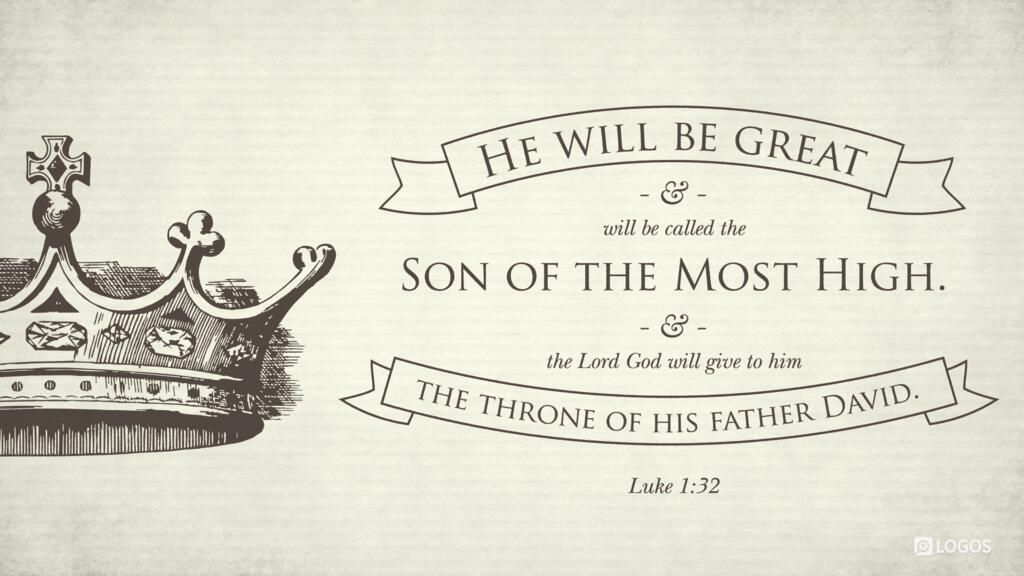
1:26In the sixth month of Elizabeth’s pregnancy,82 the angel Gabriel83 was sent by84 God to a town of Galilee called Nazareth,851:27to a virgin engaged86 to a man whose name was Joseph, a descendant of David,87 and the virgin’s name was Mary. 1:28The88 angel89 came90 to her and said, “Greetings, favored one,91 the Lord is with you!”921:29But93 she was greatly troubled94 by his words and began to wonder about the meaning of this greeting.951:30So96 the angel said to her, “Do not be afraid,97 Mary, for you have found favor98 with God! 1:31Listen:99 You will become pregnant100 and give birth to101 a son, and you will name him102 Jesus.1031:32He104 will be great,105 and will be called the Son of the Most High,106 and the Lord God will give him the throne of his father107 David. 1:33He108 will reign over the house of Jacob109 forever, and his kingdom will never end.” 1:34Mary110 said to the angel, “How will this be, since I have not had sexual relations with111 a man?”
Footnotes
- 82 Grk “in the sixth month.” The phrase “of Elizabeth’s pregnancy” was supplied in the translation to clarify the exact time meant by this reference. That Elizabeth’s pregnancy is meant is clear from vv. 24–25.
- 83 Gabriel is the same angel mentioned previously in v. 19. He is traditionally identified as an angel who brings revelation (see Dan 8:15–16; 9:21). Gabriel and Michael are the only two good angels named in the Bible.
- 84 Or “from.” The account suggests God’s planned direction in these events, so “by” is better than “from,” as six months into Elizabeth’s pregnancy, God acts again.
- 85 Nazareth was a town in the region of Galilee, located north of Samaria and Judea. Galilee extended from about 45 to 85 miles north of Jerusalem and was about 30 miles in width. Nazareth was a very small village and was located about 15 miles west of the southern edge of the Sea of Galilee. For location see ; ; ; ; .
- 86 Or “promised in marriage.”
- 87 Grk “Joseph, of the house of David.” The Greek word order here favors connecting Davidic descent to Joseph, not Mary, in this remark.
- 88 Grk “And coming to her.” Here καί (kai) has not been translated because of differences between Greek and English style.
- 89 Grk “And coming to her, he said”; the referent (the angel) has been specified in the translation for clarity.
- 90 Grk “coming to her, he said.” The participle εἰσελθών (eiselthōn) has been translated as a finite verb due to requirements of contemporary English style.
- 91 The address, “favored one” (a perfect participle, Grk “Oh one who is favored”) points to Mary as the recipient of God’s grace, not a bestower of it. She is a model saint in this passage, one who willingly receives God’s benefits. The rendering “full of grace” suggests something more of Mary as a bestower of grace, but does not make sense here contextually.
- 92 Most (A C D Θ f13 33 𝔐 latt sy) read here εὐλογημένη σὺ ἐν γυναιξίν (eulogēmenē su en gunaixin, “blessed are you among women”) which also appears in 1:42 (where it is textually certain). This has the earmarks of a scribal addition for balance; the shorter reading, attested by the most important witnesses and several others (א B L W Ψ f1 565 579 700 1241 co), is thus preferred.
- 93 Most (A C Θ 0130 f13 𝔐 lat sy) have ἰδοῦσα (idousa, “when [she] saw [the angel]”) here as well, making Mary’s concern the appearance of the angel. This construction is harder than the shorter reading since it adds a transitive verb without an explicit object. However, the shorter reading has significant support (א B D L W Ψ f1 565 579 1241 sa) and on balance should probably be considered authentic.
- 94 On the phrase greatly troubled see 1:12. Mary’s reaction was like Zechariah’s response.
- 95 Grk “to wonder what kind of greeting this might be.” Luke often uses the optative this way to reveal a figure’s thinking (3:15; 8:9; 18:36; 22:23).
- 96 Here καί (kai) has been translated as “so” to indicate that Gabriel’s statement is a response to Mary’s perplexity over the greeting.
- 97 Do not be afraid. See 1:13 for a similar statement to Zechariah.
- 98 Or “grace.” The expression found favor is a Semitism, common in the OT (Gen 6:8; 18:3; 43:14; 2 Sam 15:25). God has chosen to act on this person’s behalf.
- 99 Grk “And behold.”
- 100 Grk “you will conceive in your womb.”
- 101 Or “and bear.”
- 102 Grk “you will call his name.”
- 103 See v. 13 for a similar construction. You will name him Jesus. This verse reflects the birth announcement of a major figure; see 1:13; Gen 16:7; Judg 13:5; Isa 7:14. The Greek form of the name Iēsous, which was translated into Latin as Jesus, is the same as the Hebrew Yeshua (Joshua), which means “Yahweh saves” (Yahweh is typically rendered as “Lord” in the OT). It was a fairly common name among Jews in 1st century Palestine, as references to a number of people by this name in the and Josephus indicate.
- 104 Grk “this one.”
- 105 Compare the description of Jesus as great here with 1:15, “great before the Lord.” Jesus is greater than John, since he is Messiah compared to a prophet. Great is stated absolutely without qualification to make the point.
- 106 The expression Most High is a way to refer to God without naming him. Such avoiding of direct reference to God was common in 1st century Judaism out of reverence for the divine name.
- 107 Or “ancestor.”
- 108 Grk “And he.” Here καί (kai) has not been translated because of differences between Greek and English style. A new sentence is begun here in the translation because of the length of the sentence in Greek.
- 109 Or “over Israel.” The expression house of Jacob refers to Israel. This points to the Messiah’s relationship to the people of Israel.
- 110 Grk “And Mary.” Here καί (kai) has not been translated because of differences between Greek and English style.
- 111 Grk “have not known.” The expression in the Greek text is a euphemism for sexual relations. Mary seems to have sensed that the declaration had an element of immediacy to it that excluded Joseph. Many modern translations render this phrase “since I am a virgin,” but the Greek word for virgin is not used in the text, and the euphemistic expression is really more explicit, referring specifically to sexual relations.
The NET Bible First Edition, Copyright 1996-2005 by Biblical Studies Press
In other versions
ESVEnglish Standard Version
In the sixth month the angel Gabriel was sent from God to a city of Galilee named Nazareth, to a virgin betrothed to a man whose name was Joseph, of the house of David. And the virgin’s name was Mary. And he came to her and said, “Greetings, O favored one, the Lord is with you!” But she was greatly troubled at the saying, and tried to discern what sort of greeting this might be. And the angel said to her, “Do not be afraid, Mary, for you have found favor with God. And behold, you will conceive in your womb and bear a son, and you shall call his name Jesus. He will be great and will be called the Son of the Most High. And the Lord God will give to him the throne of his father David, and he will reign over the house of Jacob forever, and of his kingdom there will be no end.”
And Mary said to the angel, “How will this be, since I am a virgin?”
Copyright 2001 Crossway Bibles
NIVNew International Version (2011)
In the sixth month of Elizabeth’s pregnancy, God sent the angel Gabriel to Nazareth, a town in Galilee, to a virgin pledged to be married to a man named Joseph, a descendant of David. The virgin’s name was Mary. The angel went to her and said, “Greetings, you who are highly favored! The Lord is with you.”
Mary was greatly troubled at his words and wondered what kind of greeting this might be. But the angel said to her, “Do not be afraid, Mary; you have found favor with God. You will conceive and give birth to a son, and you are to call him Jesus. He will be great and will be called the Son of the Most High. The Lord God will give him the throne of his father David, and he will reign over Jacob’s descendants forever; his kingdom will never end.”
“How will this be,” Mary asked the angel, “since I am a virgin?”
Copyright 1973, 1978, 1984, 2011 Biblica, Inc.
CSBChristian Standard Bible
In the sixth month, the angel Gabriel was sent by God to a town in Galilee called Nazareth, to a virgin engaged to a man named Joseph, of the house of David. The virgin’s name was Mary. And the angel came to her and said, “Greetings, favored woman! The Lord is with you.” But she was deeply troubled by this statement, wondering what kind of greeting this could be. Then the angel told her, “Do not be afraid, Mary, for you have found favor with God. Now listen: You will conceive and give birth to a son, and you will name him Jesus. He will be great and will be called the Son of the Most High, and the Lord God will give him the throne of his father David. He will reign over the house of Jacob forever, and his kingdom will have no end.”
Mary asked the angel, “How can this be, since I have not had sexual relations with a man?”
Copyright 2017 Holman Bible Publishers
NLTNew Living Translation
In the sixth month of Elizabeth’s pregnancy, God sent the angel Gabriel to Nazareth, a village in Galilee, to a virgin named Mary. She was engaged to be married to a man named Joseph, a descendant of King David. Gabriel appeared to her and said, “Greetings, favored woman! The Lord is with you!”
Confused and disturbed, Mary tried to think what the angel could mean. “Don’t be afraid, Mary,” the angel told her, “for you have found favor with God! You will conceive and give birth to a son, and you will name him Jesus. He will be very great and will be called the Son of the Most High. The Lord God will give him the throne of his ancestor David. And he will reign over Israel forever; his Kingdom will never end!”
Mary asked the angel, “But how can this happen? I am a virgin.”
Holy Bible, New Living Translation, copyright © 1996, 2004, 2015 by Tyndale House Foundation. Used by permission of Tyndale House Publishers. All rights reserved.
LEBThe Lexham English Bible
Now in the sixth month, the angel Gabriel was sent from God to a town of Galilee named Nazareth, to a virgin legally promised in marriage to a man named Joseph of the house of David. And the name of the virgin was Mary. And he came to her and said, “Greetings, favored one! The Lord is with you.” But she was greatly perplexed at the statement, and was pondering what sort of greeting this might be. And the angel said to her,
“Do not be afraid, Mary, for you have found favor with God.
And behold, you will conceive in the womb and will give birth to a son,
and you will call his name Jesus.
This one will be great, and he will be called the Son of the Most High,
and the Lord God will give him the throne of his father David.
And he will reign over the house of Jacob forever,
and of his kingdom there will be no end.
And Mary said to the angel, “How will this be, since I have not had sexual relations with a man?”
Copyright 2012 Lexham Press
KJV 1900King James Version
And in the sixth month the angel Gabriel was sent from God unto a city of Galilee, named Nazareth, To a virgin espoused to a man whose name was Joseph, of the house of David; and the virgin’s name was Mary. And the angel came in unto her, and said, Hail, thou that art highly favoured, the Lord is with thee: blessed art thou among women. And when she saw him, she was troubled at his saying, and cast in her mind what manner of salutation this should be. And the angel said unto her, Fear not, Mary: for thou hast found favour with God. And, behold, thou shalt conceive in thy womb, and bring forth a son, and shalt call his name JESUS. He shall be great, and shall be called the Son of the Highest: and the Lord God shall give unto him the throne of his father David: And he shall reign over the house of Jacob for ever; and of his kingdom there shall be no end. Then said Mary unto the angel, How shall this be, seeing I know not a man?
Public Domain