Joshua 6:1–12:24
The NET BibleOther versions
English
- NET The NET Bible
- DARBY 1890 Darby Bible
- ASV American Standard Version
- AV 1873 The Cambridge Paragraph Bible of the Authorized English Version
- CSB Christian Standard Bible
- D-R Douay-Rheims Bible
- ESV English Standard Version
- GW GOD’S WORD Translation
- GNB Good News Translation
- HCSB The Holman Christian Standard Bible
- KJV 1900 King James Version
- LSB Legacy Standard Bible
- LEB The Lexham English Bible
- MSG The Message: The Bible in Contemporary Language
- NASB95 New American Standard Bible (1995)
- NCV New Century Version
- NIrV New International Reader’s Version (1998)
- NIV New International Version (2011)
- NKJV The New King James Version
- NLT New Living Translation
- NRSVue New Revised Standard Version: Updated Edition
- RSV The Revised Standard Version
- RSVCE The Revised Standard Version, Catholic Edition
- YLT Young’s Literal Translation
Arabic
Czech
French
German
Hebrew
Hungarian
Italian
Korean
Latin
Portuguese
Russian
Simplified Chinese
Spanish
Traditional Chinese
6:1Now Jericho1 was shut tightly2 because of the Israelites. No one was allowed to leave or enter.3 6:2The Lord told Joshua, “See, I am about to defeat Jericho for you,4 along with its king and its warriors. 6:3Have all the warriors march around the city one time;5 do this for six days. 6:4Have seven priests carry seven rams’ horns6 in front of the ark. On the seventh day march around the city seven times, while the priests blow the horns. 6:5When you hear the signal from the ram’s horn,7 have the whole army give a loud battle cry.8 Then the city wall will collapse9 and the warriors should charge straight ahead.”10
6:6So Joshua son of Nun summoned the priests and instructed them, “Pick up the ark of the covenant, and seven priests must carry seven rams’ horns in front of the ark of the Lord.” 6:7And he told11 the army,12 “Move ahead13 and march around the city, with armed troops going ahead of the ark of the Lord.”
6:8When Joshua gave the army its orders,14 the seven priests carrying the seven rams’ horns before the Lord moved ahead and blew the horns as the ark of the covenant of the Lord followed behind. 6:9Armed troops marched ahead of the priests blowing the horns, while the rear guard followed along behind the ark blowing rams’ horns. 6:10Now Joshua had instructed the army,15 “Do not give a battle cry16 or raise your voices; say nothing17 until the day I tell you, ‘Give the battle cry.’18 Then give the battle cry!”19 6:11So Joshua made sure they marched the ark of the Lord around the city one time.20 Then they went back to the camp and spent the night there.21
6:12Bright and early the next morning Joshua had the priests pick up the ark of the Lord.22 6:13The seven priests carrying the seven rams’ horns before the ark of the Lord marched along blowing their horns. Armed troops marched ahead of them, while the rear guard followed along behind the ark of the Lord blowing rams’ horns. 6:14They marched around the city one time on the second day, then returned to the camp. They did this six days in all.
6:15On the seventh day they were up at the crack of dawn23 and marched around the city as before—only this time they marched around it seven times.24 6:16The seventh time around, the priests blew the rams’ horns and Joshua told the army,25 “Give the battle cry,26 for the Lord is handing the city over to you!27 6:17The city and all that is in it must be set apart for the Lord,28 except for Rahab the prostitute and all who are with her in her house, because she hid the spies29 we sent. 6:18But be careful when you are setting apart the riches for the Lord. If you take any of it, you will make the Israelite camp subject to annihilation and cause a disaster.30 6:19All the silver and gold, as well as bronze and iron items, belong to the Lord.31 They must go into the Lord’s treasury.”
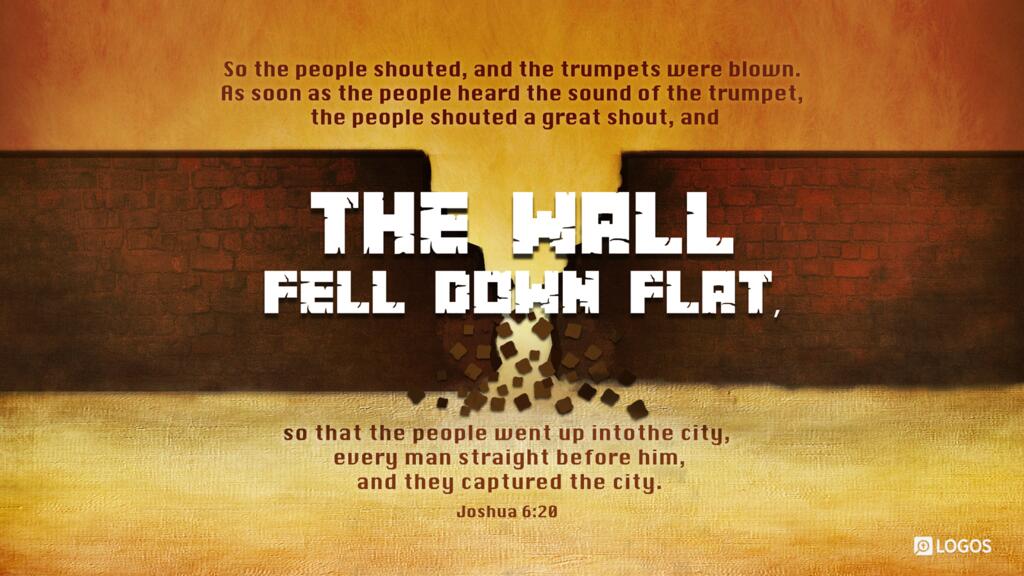
6:20The rams’ horns sounded32 and when the army33 heard the signal,34 they gave a loud battle cry.35 The wall collapsed36 and the warriors charged straight ahead into the city and captured it.37 6:21They annihilated with the sword everything that breathed in the city,38 including men and women, young and old, as well as cattle, sheep, and donkeys. 6:22Joshua told the two men who had spied on the land, “Enter the prostitute’s house39 and bring out the woman and all who belong to her as you promised her.”40 6:23So the young spies went and brought out Rahab, her father, mother, brothers, and all who belonged to her. They brought out her whole family and took them to a place outside41 the Israelite camp. 6:24But they burned42 the city and all that was in it, except for the silver, gold, and bronze and iron items they put in the treasury of the Lord’s house.43 6:25Yet Joshua spared44 Rahab the prostitute, her father’s family,45 and all who belonged to her. She lives in Israel46 to this very day because she hid the messengers Joshua sent to spy on Jericho.47 6:26At that time Joshua made this solemn declaration:48 “The man who attempts to rebuild49 this city of Jericho50 will stand condemned before the Lord.51 He will lose his firstborn son when he lays its foundations and his youngest son when he erects its gates!”52 6:27The Lord was with Joshua and he became famous throughout the land.53
Achan Sins and is Punished
7:1But the Israelites disobeyed the command about the city’s riches.1 Achan son of Carmi, son of Zabdi,2 son of Zerah, from the tribe of Judah, stole some of the riches.3 The Lord was furious with the Israelites.4
7:2Joshua sent men from Jericho5 to Ai (which is located near Beth Aven, east of Bethel6) and instructed them, “Go up and spy on the land.” So the men went up and spied on Ai. 7:3They returned and reported to Joshua,7 “Don’t send the whole army.8 About two or three thousand men are adequate to defeat Ai.9 Don’t tire out the whole army, for Ai is small.”10
7:4So about three thousand men went up, but they fled from the men of Ai. 7:5The men of Ai killed about thirty-six of them and chased them from in front of the city gate all the way to the fissures11 and defeated them on the steep slope.12 The people’s13 courage melted away like water.14
7:6Joshua tore his clothes;15 he and the leaders16 of Israel lay face down on the ground before the ark of the Lord until evening17 and threw dirt on their heads.187:7Joshua prayed,19 “O, Master, Lord! Why did you bring these people across the Jordan to hand us over to the Amorites so they could destroy us? 7:8If only we had been satisfied to live on the other side of the Jordan! O Lord, what can I say now that Israel has retreated20 before its enemies? 7:9When the Canaanites and all who live in the land hear about this, they will turn against us and destroy the very memory of us21 from the earth. What will you do to protect your great reputation?”22
7:10The Lord responded23 to Joshua, “Get up! Why are you lying there face down?24 7:11Israel has sinned; they have violated my covenantal commandment!25 They have taken some of the riches;26 they have stolen them and deceitfully put them among their own possessions.27 7:12The Israelites are unable to stand before their enemies; they retreat because they have become subject to annihilation.28 I will no longer be with you,29 unless you destroy what has contaminated you.30 7:13Get up! Ritually consecrate the people and tell them this: ‘Ritually consecrate yourselves for tomorrow, because the Lord God of Israel says, “You are contaminated,31 O Israel! You will not be able to stand before your enemies until you remove what is contaminating you.”32 7:14In the morning you must approach in tribal order.33 The tribe the Lord selects34 must approach by clans. The clan the Lord selects must approach by families.35 The family the Lord selects must approach man by man.36 7:15The one caught with the riches37 must be burned up38 along with all who belong to him, because he violated the Lord’s covenant and did such a disgraceful thing in Israel.’ ”
7:16Bright and early the next morning Joshua made Israel approach in tribal order39 and the tribe of Judah was selected. 7:17He then made the clans of Judah approach and the clan of the Zerahites was selected. He made the clan of the Zerahites approach and Zabdi40 was selected.417:18He then made Zabdi’s42 family approach man by man43 and Achan son of Carmi, son of Zabdi, son of Zerah, from the tribe of Judah, was selected. 7:19So Joshua said to Achan, “My son, honor44 the Lord God of Israel and give him praise! Tell me what you did; don’t hide anything from me!” 7:20Achan told Joshua, “It is true. I have sinned against the Lord God of Israel in this way:45 7:21I saw among the goods we seized a nice robe from Babylon,46 two hundred silver pieces,47 and a bar of gold weighing fifty shekels. I wanted them, so I took them. They are hidden in the ground right in the middle of my tent with the silver underneath.”
7:22Joshua sent messengers who ran to the tent. The things were hidden right in his tent, with the silver underneath.48 7:23They took it all from the middle of the tent, brought it to Joshua and all the Israelites, and placed49 it before the Lord. 7:24Then Joshua and all Israel took Achan, son of Zerah, along with the silver, the robe, the bar of gold, his sons, daughters, ox, donkey, sheep, tent, and all that belonged to him and brought them up to the Valley of Disaster.507:25Joshua said, “Why have you brought disaster51 on us? The Lord will bring disaster on you today!” All Israel stoned him to death. (They also stoned and burned the others.)52 7:26Then they erected over him a large pile of stones (it remains to this very day53) and the Lord’s anger subsided. So that place is called the Valley of Disaster to this very day.
Israel Conquers Ai
8:1The Lord told Joshua, “Don’t be afraid and don’t panic!1 Take the whole army with you and march against Ai!2 See, I am handing over to you3 the king of Ai, along with his people, city, and land. 8:2Do to Ai and its king what you did to Jericho4 and its king, except you may plunder its goods and cattle. Set an ambush behind the city!”
8:3Joshua and the whole army marched against Ai.5 Joshua selected thirty thousand brave warriors and sent them out at night. 8:4He told6 them, “Look, set an ambush behind the city. Don’t go very far from the city; all of you be ready! 8:5I and all the troops7 who are with me will approach the city. When they come out to fight us like before, we will retreat from them. 8:6They will attack8 us until we have lured them from the city, for they will say, ‘They are retreating from us like before.’ We will retreat from them. 8:7Then you rise up from your hiding place9 and seize10 the city. The Lord your God will hand it over to you. 8:8When you capture the city, set it11 on fire. Do as the Lord says! See, I have given you orders.”128:9Joshua sent them away and they went to their hiding place13 west of Ai, between Bethel14 and Ai.15 Joshua spent that night with the army.16
8:10Bright and…
This passage has been shortened. Keep reading Joshua 6:1–12:24 in Logos
Footnotes
- 1 For location see ; ; ; ; ; .
- 2 Heb “was shutting and shut up.” 2: paraphrases, “blocking [any way of access] and blocked [against any who would leave].”
- 3 Heb “there was no one going out and there was no one coming in.”
- 4 Heb “I have given into your hand Jericho.” The Hebrew verb נָתַתִּי (natatti, “I have given”) is probably best understood as a perfect of certitude, indicating the certainty of the action. The Hebrew pronominal suffix “your” is singular, being addressed to Joshua as the leader and representative of the nation. To convey to the modern reader what is about to happen and who is doing it, the translation “I am about to defeat Jericho for you” has been used.
- 5 Heb “and go around the city, all [you] men of war, encircling the city one time.” The Hebrew verb וְסַבֹּתֶם (vésabbotem, “and go around”) is plural, being addressed to the whole army.
- 6 Heb “rams’ horns, trumpets.”
- 7 Heb “and it will be at the sounding of the horn, the ram’s horn, when you hear the sound of the ram’s horn.” The text of Josh 6:5 seems to be unduly repetitive, so for the sake of English style and readability, it is best to streamline the text here. The reading in the Hebrew looks like a conflation of variant readings, with the second (“when you hear the sound of the ram’s horn”) being an interpolation that assimilates the text to verse 20 (“when the army heard the sound of the horn”). Note that the words “when you hear the sound of the ram’s horn” do not appear in the of verse 5.
- 8 Heb “all the people will shout with a loud shout.”
- 9 Heb “fall in its place.”
- 10 Heb “and the people will go up, each man straight ahead.”
- 11 An alternative reading is “and they said.” In this case the subject is indefinite and the verb should be translated as passive, “[the army] was told.”
- 12 Heb “the people.”
- 13 Heb “pass by.”
- 14 Heb “when Joshua spoke to the people.”
- 15 Heb “the people.”
- 16 Or “the shout.”
- 17 Heb “do not let a word come out of your mouths.”
- 18 Or “the shout.”
- 19 Or “the shout.”
- 20 Heb “and he made the ark of the Lord go around the city, encircling one time.”
- 21 Heb “and they entered the camp and spent the night in the camp.”
- 22 Heb “Joshua rose early in the morning and the priests picked up the ark of the Lord.”
- 23 Heb “On the seventh day they rose early, when the dawn ascended.”
- 24 Heb “and they went around the city according to this manner seven times, only on that day they went around the city seven times.”
- 25 Heb “the people.”
- 26 Or “the shout.”
- 27 Heb “for the Lord has given to you the city.” The verbal form is a perfect, probably indicating certitude here.
- 28 Or “dedicated to the Lord.” To make the city set apart for the Lord would involve annihilating all the people and animals and placing its riches in the Lord’s treasury (vv. 19, 21, 24).
- 29 Heb “messengers.”
- 30 Heb “Only you keep [away] from what is set apart [to the Lord] so that you might not, as you are setting [it] apart, take some of what is set apart [to the Lord] and make the camp of Israel set apart [to destruction by the Lord] and bring trouble on it.”
- 31 Heb “it is holy to the Lord.”
- 32 Heb “and the people shouted and they blew the rams’ horns.” The initial statement (“and the people shouted”) seems premature, since the verse goes on to explain that the battle cry followed the blowing of the horns. The statement has probably been accidentally duplicated from what follows. It is omitted in the .
- 33 Heb “the people.”
- 34 Heb “the sound of the horn.”
- 35 Heb “they shouted with a loud shout.”
- 36 Heb “fell in its place.”
- 37 Heb “and the people went up into the city, each one straight ahead, and they captured the city.”
- 38 Heb “all which was in the city.”
- 39 Heb “the house of the woman, the prostitute.”
- 40 Heb “and bring out from there the woman and all who belong to her as you swore on oath to her.”
- 41 Or “placed them outside.”
- 42 The Hebrew text adds “with fire.”
- 43 Heb “the treasury of the house of the Lord.” Technically the Lord did not have a “house” yet, so perhaps this refers to the tabernacle using later terminology.
- 44 Heb “kept alive.”
- 45 Heb the house of her father.”
- 46 Or “among the Israelites”; Heb “in the midst of Israel.”
- 47 For location see ; ; ; ; ; .
- 48 Normally the Hiphil of שָׁבַע (shava’) has a causative sense (“make [someone] take an oath”; see Josh 2:17, 20), but here (see also Josh 23:7) no object is stated or implied. If Joshua is calling divine judgment down upon the one who attempts to rebuild Jericho, then “make a solemn appeal [to God as judge]” or “pronounce a curse” would be an appropriate translation. However, the tone seems stronger. Joshua appears to be announcing the certain punishment of the violator. 1 Kgs 16:34, which records the fulfillment of Joshua’s prediction, supports this. Casting Joshua in a prophetic role, it refers to Joshua’s statement as the “word of the Lord” spoken through Joshua.
- 49 Heb “rises up and builds.”
- 50 The omits “Jericho.” It is probably a scribal addition.
- 51 The Hebrew phrase אָרוּר לִפְנֵי יְהוָה (’arur lifney yéhvah, “cursed [i.e., condemned] before the Lord”) also occurs in 1 Sam 26:19.
- 52 Heb “With his firstborn he will lay its foundations and with his youngest he will erect its gates.” The Hebrew verb יַצִּיב (yatsiv, “he will erect”) is imperfect, not jussive, suggesting Joshua’s statement is a prediction, not an imprecation.
- 53 Heb “and the report about him was in all the land.” The Hebrew term אֶרֶץ (’erets, “land”) may also be translated “earth.”
- 1 Heb “But the sons of Israel were unfaithful with unfaithfulness concerning what was set apart [to the Lord].”
- 2 1 Chr 2:6 lists a “Zimri” (but no Zabdi) as one of the five sons of Zerah (cf. also 1 Chr 7:17, 18).
- 3 Heb “took from what was set apart [to the Lord].”
- 4 Heb “the anger of the Lord burned against the sons of Israel.” This incident illustrates well the principle of corporate solidarity and corporate guilt. The sin of one man brought the Lord’s anger down upon the entire nation.
- 5 For location see ; ; ; ; ; .
- 6 For the location of Bethel see ; ; ; ; .
- 7 Heb “and they returned to Joshua and said to him.”
- 8 Heb “Don’t let all the people go up.”
- 9 Heb “Let about two thousand men or about three thousand men go up to defeat Ai.”
- 10 Heb “all the people for they are small.”
- 11 The meaning and correct translation of the Hebrew word שְׁבָרִים (shévarim) is uncertain. The translation “fissures” is based on usage of the plural form of the noun in Ps 60:4 (60:2 ), where it appears to refer to cracks in the earth caused by an earthquake. Perhaps deep ravines or gorges are in view, or the word is a proper noun (“all the way to Shebarim”).
- 12 The precise geographical location of the Israelite defeat at this “steep slope” is uncertain.
- 13 Or “army’s.”
- 14 Heb “and the heart of the people melted and became water.”
- 15 Tearing one’s clothes was an outward expression of extreme sorrow (see Gen 37:34; 44:13).
- 16 Or “elders.”
- 17 Heb “and fell on his face to the ground before the ark of the Lord until evening, he and the elders of Israel.”
- 18 Throwing dirt on one’s head was an outward expression of extreme sorrow (see Lam 2:10; Ezek 27:30).
- 19 Heb “said.”
- 20 Heb “turned [the] back.”
- 21 Heb “and cut off our name.”
- 22 Heb “What will you do for your great name?”
- 23 Heb “said.”
- 24 Heb “Why are you falling on your face?”
- 25 Heb “They have violated my covenant which I commanded them.”
- 26 Heb “what was set apart [to the Lord].”
- 27 Heb “and also they have stolen, and also they have lied, and also they have placed [them] among their items.”
- 28 Heb “they turn [the] back before their enemies because they are set apart [to destruction by the Lord].”
- 29 The second person pronoun is plural in Hebrew, indicating these words are addressed to the entire nation.
- 30 Heb “what is set apart [to destruction by the Lord] from your midst.”
- 31 Heb “what is set apart [to destruction by the Lord] [is] in your midst.”
- 32 Heb “remove what is set apart [i.e., to destruction by the Lord] from your midst.”
- 33 Heb “by your tribes.”
- 34 Heb “takes forcefully, seizes.”
- 35 Heb “houses.”
- 36 Heb “by men.”
- 37 Heb “with what was set apart [to the Lord].”
- 38 Heb “burned with fire.”
- 39 Heb “by tribes.”
- 40 See the note on “Zabdi” in .
- 41 Heb “and he selected Zabdi.” The Lord is the apparent subject. The supports reading a passive (Niphal) form here, as does the immediate context.
- 42 Heb “his”; the referent (Zabdi) has been specified in the translation for clarity.
- 43 Heb “by men.”
- 44 Heb “give glory to.”
- 45 Heb “like this and like this I did.”
- 46 Heb “Shinar,” a reference to Babylon (cf. Gen 10:10; 11:2; 14:1). Many modern translations retain the Hebrew name “Shinar” (cf. , ) but some use the more familiar “Babylon” (cf. , ).
- 47 Heb “shekels.”
- 48 Heb “Look, [it was] hidden in his tent, and the silver was beneath it.”
- 49 Heb “poured out,” probably referring to the way the silver pieces poured out of their container.
- 50 Or “Trouble” The name is “Achor” in Hebrew, which means “disaster” or “trouble” (also in v. 26).
- 51 Or “trouble.” The word is “achor” in Hebrew (also in the following clause).
- 52 Heb “and they burned them with fire and they stoned them with stones.” These words are somewhat parenthetical in nature and are omitted in the ; they may represent a later scribal addition.
- 53 Heb “to this day.” The phrase “to this day” is omitted in the and may represent a later scribal addition.
- 1 Or perhaps “and don’t get discouraged!”
- 2 Heb “Take with you all the people of war and arise, go up against Ai!”
- 3 Heb “I have given into our hand.” The verbal form, a perfect, is probably best understood as a perfect of certitude, indicating the certainty of the action.
- 4 For location see ; ; ; ; ; .
- 5 “And Joshua and all the people of war arose to go up [against] Ai.”
- 6 Or “commanded, ordered.”
- 7 Heb “the people.”
- 8 Heb “come out after.”
- 9 Heb “from the ambush.”
- 10 Heb “take possession of.”
- 11 Heb “the city.”
- 12 Heb “I have commanded you.”
- 13 Or “the place of ambush.”
- 14 For location see ; ; ; ; .
- 15 Heb “and they stayed between Bethel and Ai, west of Ai.”
- 16 Heb “in the midst of the people.”
The NET Bible First Edition, Copyright 1996-2005 by Biblical Studies Press