Isaiah 8:22–9:4
The NET BibleOther versions
English
- NET The NET Bible
- DARBY 1890 Darby Bible
- ASV American Standard Version
- AV 1873 The Cambridge Paragraph Bible of the Authorized English Version
- CSB Christian Standard Bible
- D-R Douay-Rheims Bible
- ESV English Standard Version
- GW GOD’S WORD Translation
- GNB Good News Translation
- HCSB The Holman Christian Standard Bible
- KJV 1900 King James Version
- LSB Legacy Standard Bible
- LEB The Lexham English Bible
- MSG The Message: The Bible in Contemporary Language
- NASB95 New American Standard Bible (1995)
- NCV New Century Version
- NIrV New International Reader’s Version (1998)
- NIV New International Version (2011)
- NKJV The New King James Version
- NLT New Living Translation
- NRSVue New Revised Standard Version: Updated Edition
- RSV The Revised Standard Version
- RSVCE The Revised Standard Version, Catholic Edition
- YLT Young’s Literal Translation
Arabic
Czech
French
German
Hebrew
Hungarian
Italian
Korean
Latin
Portuguese
Russian
Simplified Chinese
Spanish
Traditional Chinese
8:22When one looks out over the land, he sees43 distress and darkness, gloom44 and anxiety, darkness and people forced from the land.459:11The gloom will be dispelled for those who were anxious.2
In earlier times he3 humiliated
the land of Zebulun,
and the land of Naphtali;4
but now he brings honor5
to the way of the sea,
the region beyond the Jordan,
and Galilee of the nations.6
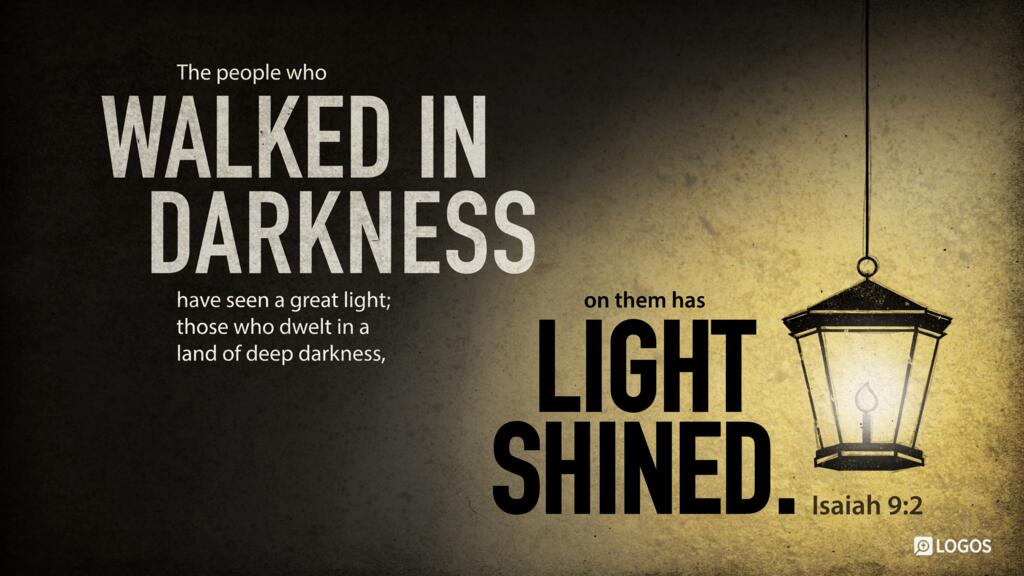
9:2The people walking in darkness
see a bright light;7
light shines
on those who live in a land of deep darkness.8
9:3You9 have enlarged the nation;
you give them great joy.10
They rejoice in your presence
as harvesters rejoice;
as warriors celebrate11 when they divide up the plunder.
9:4For their oppressive yoke
and the club that strikes their shoulders,
the cudgel the oppressor uses on them,12
you have shattered, as in the day of Midian’s defeat.13
Footnotes
- 43 Heb “and behold” (so , , ).
- 44 The precise meaning of מְעוּף (mé’uf) is uncertain; the word occurs only here. See 734 מָעוּף.
- 45 Heb “and darkness, pushed.” The word מְנֻדָּח (ménudakh) appears to be a Pual participle from נדח (“push”), but the Piel is unattested for this verb and the Pual occurs only here.
- 1 In the Hebrew text () the chapter division comes one verse later than in the English Bible; 9:1 (8:23 ). Thus 9:2–21 in the English Bible = 9:1–20 in the Hebrew text. Beginning with 10:1 the verse numbers in the English Bible and the Hebrew Bible are again the same.
- 2 The Hebrew text reads, “Indeed there is no gloom for the one to whom there was anxiety for her.” The feminine singular pronominal suffix “her” must refer to the land (cf. vv. 22a, 23b). So one could translate, “Indeed there will be no gloom for the land which was anxious.” In this case the statement introduces the positive message to follow. Some assume an emendation of לֹא (lo’, “no”) to לוֹ (lo, “to him”) and of לָהּ (lah, “to her”) to לוֹ (lo, “to him”), yielding this literal reading: “indeed there is gloom for him, for the one to whom there was anxiety for him.” In this case the statement concludes the preceding description of judgment.
- 3 The Lord must be understood as the subject of the two verbs in this verse.
- 4 The statement probably alludes to the Assyrian conquest of Israel in 734–733 b.c., when Tiglath-pileser III annexed much of Israel’s territory and reduced Samaria to a puppet state.
- 5 Heb Just as in earlier times he humiliated …, [in] the latter times he has brought honor.” The main verbs in vv. 1b–4 are Hebrew perfects. The prophet takes his rhetorical stance in the future age of restoration and describes future events as if they have already occurred. To capture the dramatic effect of the original text, the translation uses the English present or present perfect.
- 6 These three geographical designations may refer to provinces established by the Assyrians in 734–733 b.c. The “way of the sea” is the province of Dor, along the Mediterranean coast, the “region beyond the Jordan” is the province of Gilead in Transjordan, and “Galilee of the nations” (a title that alludes to how the territory had been overrun by foreigners) is the province of Megiddo located west of the Sea of Galilee. See Y. Aharoni, Land of the Bible, 374.
- 7 The darkness symbolizes judgment and its effects (see 8:22); the light represents deliverance and its effects, brought about by the emergence of a conquering Davidic king (see vv. 3–6).
- 8 Traditionally צַלְמָוֶת (tsalmavet) has been interpreted as a compound noun, meaning “shadow of death” (so , , ), but usage indicates that the word, though it sometimes refers to death, means “darkness.” The term should probably be repointed as an abstract noun צַלְמוּת (tsalmut). See the note at .
- 9 The Lord is addressed directly in vv. 3–4.
- 10 The Hebrew consonantal text reads “You multiply the nation, you do not make great the joy.” The particle לֹא (lo’, “not”) is obviously incorrect; the marginal reading has לוֹ (lo, “to him”). In this case, one should translate, “You multiply the nation, you increase his (i.e., their) joy.” However, the parallelism is tighter if one emends הַגּוֹי לוֹ (hagoy lo, “the nation, to him”) to הַגִּילָה (haggilah, “the joy,” a noun attested in Isa 65:18), which corresponds to הַשִּׂמְחָה (hasimkhah, “the joy”) later in the verse (H. Wildberger, Isaiah, 1:). As attractive as this reading is, it has not textual evidence supporting it. The reading (accepting the marginal reading “to him” for the negative particle “not”) affirms that Yahweh caused the nation to grow in population and increased their joy.
- 11 Heb “as they are happy.” The word “warriors” is supplied in the translation to clarify the word picture. This last simile comes close to reality, for vv. 4–5 indicate that the people have won a great military victory over their oppressors.
- 12 Heb “for the yoke of his burden, and the staff of his shoulder, the scepter of the oppressor against him.” The singular pronouns are collective, referring to the people. The oppressed nation is compared to an ox weighed down by a heavy yoke and an animal that is prodded and beaten.
- 13 This alludes to Gideon’s victory over Midian (Judg 7–8), when the Lord delivered Israel from an oppressive foreign invader.
The NET Bible First Edition, Copyright 1996-2005 by Biblical Studies Press