Genesis 9:1–17
The NET BibleOther versions
English
- NET The NET Bible
- DARBY 1890 Darby Bible
- ASV American Standard Version
- AV 1873 The Cambridge Paragraph Bible of the Authorized English Version
- CSB Christian Standard Bible
- D-R Douay-Rheims Bible
- ESV English Standard Version
- GW GOD’S WORD Translation
- GNB Good News Translation
- HCSB The Holman Christian Standard Bible
- KJV 1900 King James Version
- LSB Legacy Standard Bible
- LEB The Lexham English Bible
- MSG The Message: The Bible in Contemporary Language
- NASB95 New American Standard Bible (1995)
- NCV New Century Version
- NIrV New International Reader’s Version (1998)
- NIV New International Version (2011)
- NKJV The New King James Version
- NLT New Living Translation
- NRSVue New Revised Standard Version: Updated Edition
- RSV The Revised Standard Version
- RSVCE The Revised Standard Version, Catholic Edition
- YLT Young’s Literal Translation
Arabic
Czech
French
German
Hebrew
Hungarian
Italian
Korean
Latin
Portuguese
Russian
Simplified Chinese
Spanish
Traditional Chinese
God’s Covenant with Humankind through Noah
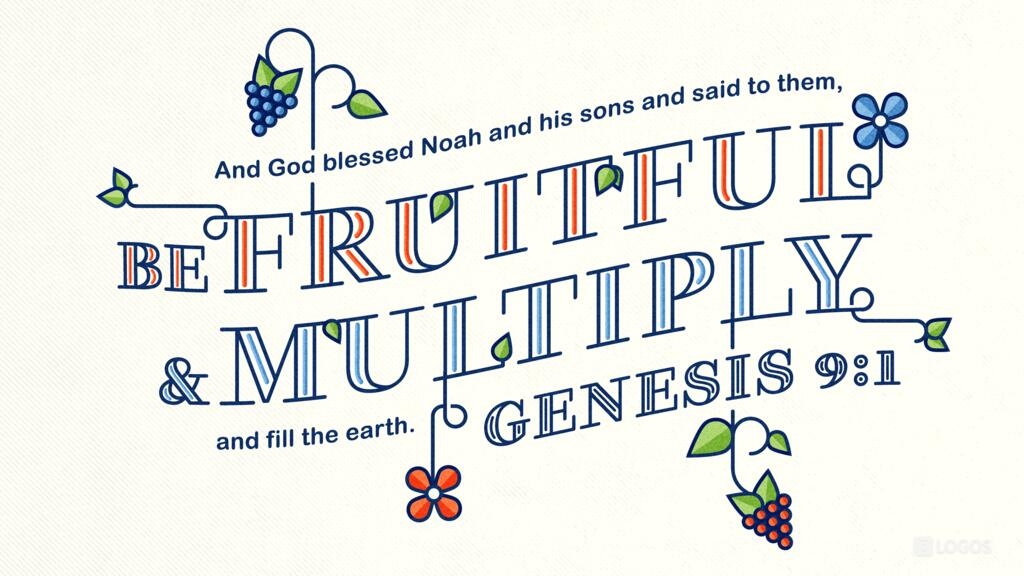
9:1Then God blessed Noah and his sons and said to them, “Be fruitful and multiply and fill the earth. 9:2Every living creature of the earth and every bird of the sky will be terrified of you.1 Everything that creeps on the ground and all the fish of the sea are under your authority.29:3You may eat any moving thing that lives.3 As I gave you4 the green plants, I now give5 you everything.
9:4But6 you must not eat meat7 with its life (that is,8 its blood) in it.99:5For your lifeblood10 I will surely exact punishment,11 from12 every living creature I will exact punishment. From each person13 I will exact punishment for the life of the individual14 since the man was his relative.15
9:6“Whoever sheds human blood,16
by other humans17
must his blood be shed;
for in God’s image18
God19 has made humankind.”
9:7But as for you,20 be fruitful and multiply; increase abundantly on the earth and multiply on it.”
9:8God said to Noah and his sons,219:9“Look! I now confirm22 my covenant with you and your descendants after you239:10and with every living creature that is with you, including the birds, the domestic animals, and every living creature of the earth with you, all those that came out of the ark with you—every living creature of the earth.249:11I confirm25 my covenant with you: Never again will all living things26 be wiped out27 by the waters of a flood;28 never again will a flood destroy the earth.”
9:12And God said, “This is the guarantee29 of the covenant I am making30 with you31 and every living creature with you, a covenant32 for all subsequent33 generations: 9:13I will place34 my rainbow35 in the clouds, and it will become36 a guarantee of the covenant between me and the earth. 9:14Whenever37 I bring clouds over the earth and the rainbow appears in the clouds, 9:15then I will remember my covenant with you38 and with all living creatures of all kinds.39 Never again will the waters become a flood and destroy40 all living things.419:16When the rainbow is in the clouds, I will notice it and remember42 the perpetual covenant between God and all living creatures of all kinds that are on the earth.”
9:17So God said to Noah, “This is the guarantee of the covenant that I am confirming between me and all living things43 that are on the earth.”
Footnotes
- 1 Heb “and fear of you and dread of you will be upon every living creature of the earth and upon every bird of the sky.” The suffixes on the nouns “fear” and “dread” are objective genitives. The animals will fear humans from this time forward.
- 2 Heb “into your hand are given.” The “hand” signifies power. To say the animals have been given into the hands of humans means humans have been given authority over them.
- 3 Heb “every moving thing that lives for you will be for food.”
- 4 The words “I gave you” are not in the Hebrew text, but are supplied in the translation for stylistic reasons.
- 5 The perfect verb form describes the action that accompanies the declaration.
- 6 Heb “only.”
- 7 Or “flesh.”
- 8 Heb “its life, its blood.” The second word is in apposition to the first, explaining what is meant by “its life.” Since the blood is equated with life, meat that had the blood in it was not to be eaten.
- 9 The words “in it” are supplied in the translation for stylistic reasons. You must not eat meat with its life … in it. Because of the carnage produced by the flood, people might conclude that life is cheap and therefore treat it lightly. But God will not permit them to kill or even to eat anything with the lifeblood still in it, serving as a reminder of the sanctity of life.
- 10 Again the text uses apposition to clarify what kind of blood is being discussed: “your blood, [that is] for your life.” See C. L. Dewar, “The Biblical Use of the Term ‘Blood,’ ” 4 (1953): 204–8.
- 11 The word “punishment” is not in the Hebrew text, but is supplied in the translation for clarification. The verb דָּרָשׁ (darash) means “to require, to seek, to ask for, to exact.” Here it means that God will exact punishment for the taking of a life. See R. Mawdsley, “Capital Punishment in Gen. 9:6,” 18 (1975): 20–25.
- 12 Heb “from the hand of,” which means “out of the hand of” or “out of the power of” and is nearly identical in sense to the preposition מִן (min) alone.
- 13 Heb “and from the hand of the man.” The article has a generic function, indicating the class, i.e., humankind.
- 14 Heb “of the man.”
- 15 Heb “from the hand of a man, his brother.” The point is that God will require the blood of someone who kills, since the person killed is a relative (“brother”) of the killer. The language reflects Noah’s situation (after the flood everyone would be part of Noah’s extended family), but also supports the concept of the brotherhood of humankind. According to the Genesis account the entire human race descended from Noah.
- 16 Heb “the blood of man.”
- 17 Heb “by man,” a generic term here for other human beings.
- 18 See the notes on the words “humankind” and “likeness” in , as well as J. Barr, “The Image of God in the Book of Genesis—A Study of Terminology,” 51 (1968/69): 11–26.
- 19 Heb “he”; the referent (God) has been specified in the translation for clarity.
- 20 The disjunctive clause (conjunction + pronominal subject + verb) here indicates a strong contrast to what has preceded. Against the backdrop of the warnings about taking life, God now instructs the people to produce life, using terms reminiscent of the mandate given to Adam (Gen 1:28).
- 21 Heb “to Noah and to his sons with him, saying.”
- 22 Heb “I, look, I confirm.” The particle הִנְנִי (hinni) used with the participle מֵקִים (meqim) gives the sense of immediacy or imminence, as if to say, “Look! I am now confirming.”
- 23 The three pronominal suffixes (translated “you,” “your,” and “you”) are masculine plural. As v. 8 indicates, Noah and his sons are addressed.
- 24 The verbal repetition is apparently for emphasis.
- 25 The verb וַהֲקִמֹתִי (vahaqimoti) is a perfect with the vav (ו) consecutive and should be translated with the English present tense, just as the participle at the beginning of the speech was (v. 9). Another option is to translate both forms with the English future tense (“I will confirm”).
- 26 Heb “all flesh.”
- 27 Heb “cut off.”
- 28 Heb “and all flesh will not be cut off again by the waters of the flood.”
- 29 Heb “sign.”
- 30 On the making of covenants in Genesis, see W. F. Albright, “The Hebrew Expression for ‘Making a Covenant’ in Pre-Israelite Documents,” 121 (1951): 21–22.
- 31 Heb “between me and between you.”
- 32 The words “a covenant” are supplied in the translation for clarification.
- 33 The Hebrew term עוֹלָם (’olam) means “ever, forever, lasting, perpetual.” The covenant would extend to subsequent generations.
- 34 The translation assumes that the perfect verbal form is used rhetorically, emphasizing the certainty of the action. Other translation options include “I have placed” (present perfect; cf. , ) and “I place” (instantaneous perfect; cf. ).
- 35 The Hebrew word קֶשֶׁת (qeshet) normally refers to a warrior’s bow. Some understand this to mean that God the warrior hangs up his battle bow at the end of the flood, indicating he is now at peace with humankind, but others question the legitimacy of this proposal. See C. Westermann, Genesis, 1:, and G. J. Wenham, Genesis (), 1:.
- 36 The perfect verbal form with vav (ו) consecutive here has the same aspectual function as the preceding perfect of certitude.
- 37 The temporal indicator (וְהָיָה, véhayah, conjunction + the perfect verb form), often translated “it will be,” anticipates a future development.
- 38 Heb “which [is] between me and between you.”
- 39 Heb “all flesh.”
- 40 Heb “to destroy.”
- 41 Heb “all flesh.”
- 42 The translation assumes that the infinitive לִזְכֹּר (lizkor, “to remember”) here expresses the result of seeing the rainbow. Another option is to understand it as indicating purpose, in which case it could be translated, “I will look at it so that I may remember.”
- 43 Heb “all flesh.”
The NET Bible First Edition, Copyright 1996-2005 by Biblical Studies Press