Ephesians 4:13–24
The NET BibleOther versions
English
- NET The NET Bible
- DARBY 1890 Darby Bible
- ASV American Standard Version
- AV 1873 The Cambridge Paragraph Bible of the Authorized English Version
- CSB Christian Standard Bible
- D-R Douay-Rheims Bible
- ESV English Standard Version
- GW GOD’S WORD Translation
- GNB Good News Translation
- HCSB The Holman Christian Standard Bible
- KJV 1900 King James Version
- LSB Legacy Standard Bible
- LEB The Lexham English Bible
- MSG The Message: The Bible in Contemporary Language
- NASB95 New American Standard Bible (1995)
- NCV New Century Version
- NIrV New International Reader’s Version (1998)
- NIV New International Version (2011)
- NKJV The New King James Version
- NLT New Living Translation
- NRSVue New Revised Standard Version: Updated Edition
- RSV The Revised Standard Version
- RSVCE The Revised Standard Version, Catholic Edition
- YLT Young’s Literal Translation
Arabic
Czech
French
German
Greek
Hungarian
Italian
Korean
Latin
Portuguese
Russian
Simplified Chinese
Spanish
Traditional Chinese
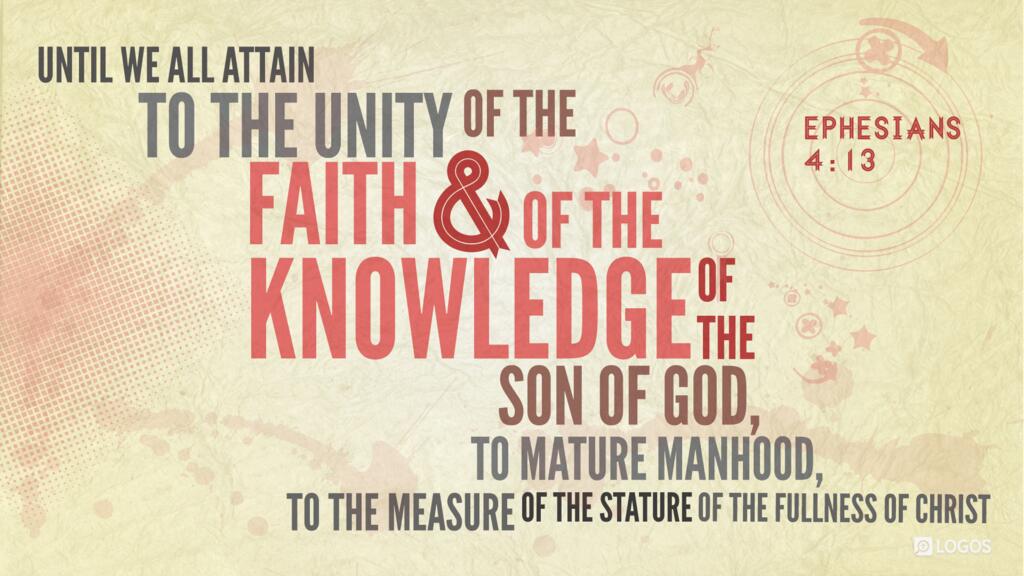
4:13until we all attain to the unity of the faith and of the knowledge of the Son of God—a mature person, attaining to16 the measure of Christ’s full stature.174:14So18 we are no longer to be children, tossed back and forth by waves and carried about by every wind of teaching by the trickery of people who craftily carry out their deceitful schemes.194:15But practicing the truth in love,20 we will in all things grow up into Christ, who is the head. 4:16From him the whole body grows, fitted and held together21 through every supporting ligament.22 As each one does its part, the body grows in love.
Live in Holiness
4:17So I say this, and insist23 in the Lord, that you no longer live as the Gentiles do, in the futility24 of their thinking.254:18They are darkened in their understanding,26 being alienated from the life of God because of the ignorance that is in them due to the hardness of their hearts. 4:19Because they are callous, they have given themselves over to indecency for the practice of every kind of impurity with greediness.274:20But you did not learn about Christ like this, 4:21if indeed you heard about him and were taught in him, just as the truth is in Jesus. 4:22You were taught with reference to your former way of life to lay aside28 the old man who is being corrupted in accordance with deceitful desires, 4:23to be renewed in the spirit of your mind, 4:24and to put on the new man who has been created in God’s image29—in righteousness and holiness that comes from truth.30
Footnotes
- 16 The words “attaining to” were supplied in the translation to pick up the καταντήσωμεν (katantēsōmen) mentioned earlier in the sentence and the εἰς (eis) which heads up this clause.
- 17 Grk “the measure of the stature of the fullness of Christ.” On this translation of ἡλικία (hēlikia, “stature”) see 3.
- 18 Because of the length and complexity of the Greek sentence, a new sentence was started here in the translation.
- 19 While the sense of the passage is clear enough, translation in English is somewhat difficult. The Greek says: “by the trickery of men, by craftiness with the scheme of deceit.” The point is that the author is concerned about Christians growing into maturity. He is fearful that certain kinds of very cunning people, who are skilled at deceitful scheming, should come in and teach false doctrines which would in turn stunt the growth of the believers.
- 20 The meaning of the participle ἀληθεύοντες (alētheuontes; from the verb ἀληθεύω [alētheuō]) is debated. In classical times the verb could mean “to speak the truth,” or “to be true, to prove true.” In the it appears five times (Gen 20:16; 42:16; Prov 21:3; Isa 44:26; Sir 34:4) and translates four different Hebrew words; there it is an ethical term used of proving or being true, not with the idea of speaking the truth. In the NT the only other place the verb appears is in Gal 4:16 where it means “to speak the truth.” However, in Ephesians the concept of “being truthful” is the best sense of the word. In contrast to the preceding verse, where there are three prepositional phrases to denote falsehood and deceit, the present word speaks of being real or truthful in both conduct and speech. Their deceit was not only in their words but also in their conduct. In other words, the believers’ conduct should be transparent, revealing the real state of affairs, as opposed to hiding or suppressing the truth through cunning and deceit. See H. W. Hoehner, Ephesians, 564–65, and R. Bultmann, 1:251.
- 21 The Greek participle συμβιβαζόμενον (sumbibazomenon) translated “held together” also has in different contexts, the idea of teaching implied in it.
- 22 Grk “joint of supply.”
- 23 On the translation of μαρτύρομαι (marturomai) as “insist” see 2.
- 24 On the translation of ματαιότης (mataiotēs) as “futility” see
- 25 Or “thoughts,” “mind.”
- 26 In the Greek text this clause is actually subordinate to περιπατεῖ (peripatei) in v. 17. It was broken up in the English translation so as to avoid an unnecessarily long and cumbersome statement.
- 27 Greediness refers to an increasing desire for more and more. The point is that sinful passions and desires are never satisfied.
- 28 An alternative rendering for the infinitives in vv. 22–24 (“to lay aside … to be renewed … to put on”) is “that you have laid aside … that you are being renewed … that you have put on.” The three infinitives of vv. 22 (ἀποθέσθαι, apothesthai), 23 (ἀνανεοῦσθαι, ananeousthai), and 24 (ἐνδύσασθαι, endusasthai), form part of an indirect discourse clause; they constitute the teaching given to the believers addressed in the letter. The problem in translation is that one cannot be absolutely certain whether they go back to indicatives in the original statement (i.e., “you have put off”) or imperatives (i.e., “put off!”). Every other occurrence of an aorist infinitive in indirect discourse in the NT goes back to an imperative, but in all of these examples the indirect discourse is introduced by a verb that implies a command. The verb διδάσκω (didaskō) in the corpus Paulinum may be used to relate the indicatives of the faith as well as the imperatives. This translation implies that the infinitives go back to imperatives, though the alternate view that they refer back to indicatives is also a plausible interpretation. For further discussion, see .
- 29 Or “in God’s likeness.” Grk “according to God.” The preposition κατά used here denotes a measure of similarity or equality ( B.5.b.α).
- 30 Or “in righteousness and holiness which is based on truth” or “originated from truth.”
The NET Bible First Edition, Copyright 1996-2005 by Biblical Studies Press