Ephesians 1:7–10
The NET BibleOther versions
English
- NET The NET Bible
- DARBY 1890 Darby Bible
- ASV American Standard Version
- AV 1873 The Cambridge Paragraph Bible of the Authorized English Version
- CSB Christian Standard Bible
- D-R Douay-Rheims Bible
- ESV English Standard Version
- GW GOD’S WORD Translation
- GNB Good News Translation
- HCSB The Holman Christian Standard Bible
- KJV 1900 King James Version
- LSB Legacy Standard Bible
- LEB The Lexham English Bible
- MSG The Message: The Bible in Contemporary Language
- NASB95 New American Standard Bible (1995)
- NCV New Century Version
- NIrV New International Reader’s Version (1998)
- NIV New International Version (2011)
- NKJV The New King James Version
- NLT New Living Translation
- NRSVue New Revised Standard Version: Updated Edition
- RSV The Revised Standard Version
- RSVCE The Revised Standard Version, Catholic Edition
- YLT Young’s Literal Translation
Arabic
Czech
French
German
Greek
Hungarian
Italian
Korean
Latin
Portuguese
Russian
Simplified Chinese
Spanish
Traditional Chinese
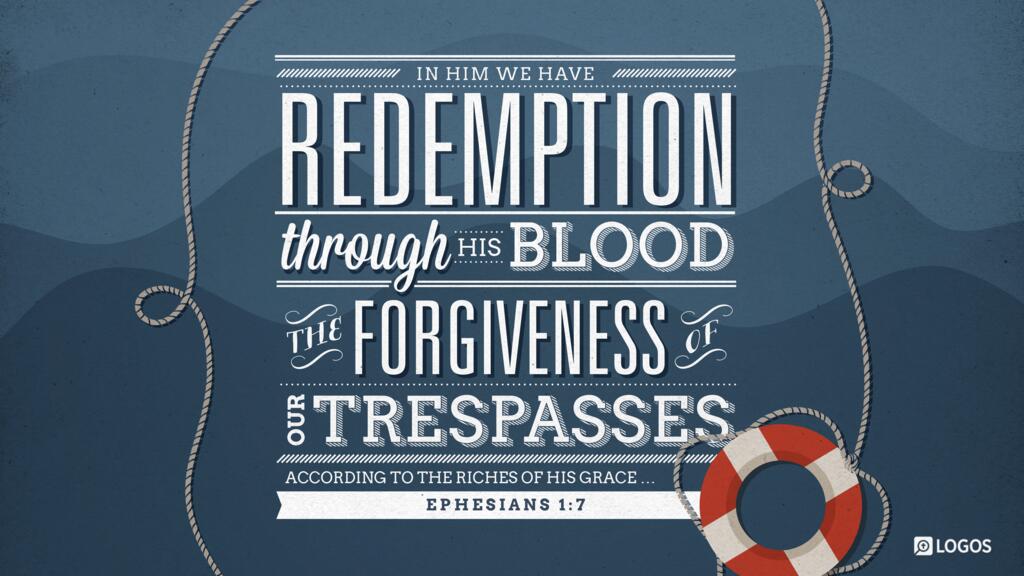
1:7In him19 we have redemption through his blood,20 the forgiveness of our trespasses, according to the riches of his grace 1:8that he lavished on us in all wisdom and insight. 1:9He did this when he revealed21 to us the secret22 of his will, according to his good pleasure that he set forth23 in Christ,241:10toward the administration of the fullness of the times, to head up25 all things in Christ—the things in heaven26 and the things on earth.27
Footnotes
- 19 Grk “in whom” (the relative clause of v. 7 is subordinate to v. 6). The “him” refers to Christ.
- 20 In this context his blood, the blood of Jesus Christ, refers to the price paid for believers’ redemption, which is the sacrificial death of Christ on the cross.
- 21 Or “He did this by revealing”; Grk “making known, revealing.” Verse 9 begins with a participle dependent on “lavished” in v. 8; the adverbial participle could be understood as temporal (“when he revealed”), which would be contemporaneous to the action of the finite verb “lavished,” or as means (“by revealing”). The participle has been translated here with the temporal nuance to allow for means to also be a possible interpretation. If the translation focused instead upon means, the temporal nuance would be lost as the time frame for the action of the participle would become indistinct.
- 22 Or “mystery.” In the NT μυστήριον (mustērion) refers to a divine secret previously undisclosed.
- 23 Or “purposed,” “publicly displayed.” Cf. Rom 3:25.
- 24 Grk “in him”; the referent (Christ) has been specified in the translation for the sake of clarity. In Christ. has “in himself” as though the antecedent were God the Father. Although possible, the notion of the verb set forth (Greek προτίθημι, protithēmi) implies a plan that is carried out in history (cf. Rom 1:13; 3:25) and thus more likely refers to Christ.
- 25 The precise meaning of the infinitive ἀνακεφαλαιώσασθαι (anakephalaiōsasthai) in v. 10 is difficult to determine since it was used relatively infrequently in Greek literature and only twice in the NT (here and Rom 13:9). While there have been several suggestions, three deserve mention: (1) “To sum up.” In Rom 13:9, using the same term, the author there says that the law may be “summarized in one command, to love your neighbor as yourself.” The idea then in Eph 1:10 would be that all things in heaven and on earth can be summed up and made sense out of in relation to Christ. (2) “To renew.” If this is the nuance of the verb then all things in heaven and earth, after their plunge into sin and ruin, are renewed by the coming of Christ and his redemption. (3) “To head up.” In this translation the idea is that Christ, in the fullness of the times, has been exalted so as to be appointed as the ruler (i.e., “head”) over all things in heaven and earth (including the church). That this is perhaps the best understanding of the verb is evidenced by the repeated theme of Christ’s exaltation and reign in Ephesians and by the connection to the κεφαλή- (kephalē-) language of 1:22 (cf. Schlier, 3:682; L&N 63.8; M. Barth, Ephesians [ 34], 1:; contra A. T. Lincoln, Ephesians [], ).
- 26 Grk “the heavens.”
- 27 And the things on earth. Verse 10 ends with “in him.” The redundancy keeps the focus on Christ at the expense of good Greek style. Verse 11 repeats the reference with a relative pronoun (“in whom”)—again, at the expense of good Greek style. Although the syntax is awkward, the theology is rich. This is not the first time that a NT writer was so overcome with awe for his Lord that he seems to have lost control of his pen. Indeed, it happened frequently enough that some have labeled their christologically motivated solecisms an “apostolic disease.”
The NET Bible First Edition, Copyright 1996-2005 by Biblical Studies Press
In other versions
ESVEnglish Standard Version
In him we have redemption through his blood, the forgiveness of our trespasses, according to the riches of his grace, which he lavished upon us, in all wisdom and insight making known to us the mystery of his will, according to his purpose, which he set forth in Christ as a plan for the fullness of time, to unite all things in Christ, things in heaven and things on earth in him.
Copyright 2001 Crossway Bibles
NIVNew International Version (2011)
In him we have redemption through his blood, the forgiveness of sins, in accordance with the riches of God’s grace that he lavished on us. With all wisdom and understanding, he made known to us the mystery of his will according to his good pleasure, which he purposed in Christ, to be put into effect when the times reach their fulfillment—to bring unity to all things in heaven and on earth under Christ.
Copyright 1973, 1978, 1984, 2011 Biblica, Inc.
CSBChristian Standard Bible
In him we have redemption through his blood, the forgiveness of our trespasses, according to the riches of his grace that he richly poured out on us with all wisdom and understanding. He made known to us the mystery of his will, according to his good pleasure that he purposed in Christ as a plan for the right time—to bring everything together in Christ, both things in heaven and things on earth in him.
Copyright 2017 Holman Bible Publishers
NLTNew Living Translation
He is so rich in kindness and grace that he purchased our freedom with the blood of his Son and forgave our sins. He has showered his kindness on us, along with all wisdom and understanding.
God has now revealed to us his mysterious will regarding Christ—which is to fulfill his own good plan. And this is the plan: At the right time he will bring everything together under the authority of Christ—everything in heaven and on earth.
Holy Bible, New Living Translation, copyright © 1996, 2004, 2015 by Tyndale House Foundation. Used by permission of Tyndale House Publishers. All rights reserved.
LEBThe Lexham English Bible
in whom we have redemption through his blood, the forgiveness of sins, according to the riches of his grace, that he caused to abound to us in all wisdom and insight, making known to us the mystery of his will, according to his good pleasure that he purposed in him, for the administration of the fullness of times, to bring together all things in Christ, the things in the heavens and the things on the earth, in him
Copyright 2012 Lexham Press
KJV 1900King James Version
In whom we have redemption through his blood, the forgiveness of sins, according to the riches of his grace; Wherein he hath abounded toward us in all wisdom and prudence; Having made known unto us the mystery of his will, according to his good pleasure which he hath purposed in himself: That in the dispensation of the fulness of times he might gather together in one all things in Christ, both which are in heaven, and which are on earth; even in him:
Public Domain