Ephesians 1:13–15
The NET BibleOther versions
English
- NET The NET Bible
- DARBY 1890 Darby Bible
- ASV American Standard Version
- AV 1873 The Cambridge Paragraph Bible of the Authorized English Version
- CSB Christian Standard Bible
- D-R Douay-Rheims Bible
- ESV English Standard Version
- GW GOD’S WORD Translation
- GNB Good News Translation
- HCSB The Holman Christian Standard Bible
- KJV 1900 King James Version
- LSB Legacy Standard Bible
- LEB The Lexham English Bible
- MSG The Message: The Bible in Contemporary Language
- NASB95 New American Standard Bible (1995)
- NCV New Century Version
- NIrV New International Reader’s Version (1998)
- NIV New International Version (2011)
- NKJV The New King James Version
- NLT New Living Translation
- NRSVue New Revised Standard Version: Updated Edition
- RSV The Revised Standard Version
- RSVCE The Revised Standard Version, Catholic Edition
- YLT Young’s Literal Translation
Arabic
Czech
French
German
Greek
Hungarian
Italian
Korean
Latin
Portuguese
Russian
Simplified Chinese
Spanish
Traditional Chinese
1:13And when32 you heard the word of truth (the gospel of your salvation)—when you believed in Christ33—you were marked with the seal34 of the promised Holy Spirit,351:14who is the down payment36 of our inheritance, until the redemption of God’s own possession,37 to the praise of his glory.
Prayer for Wisdom and Revelation
1:15For this reason,38 because I39 have heard40 of your faith in the Lord Jesus and your love41 for all the saints,
Footnotes
- 32 Grk “in whom you also, when …” (continuing the sentence from v. 12).
- 33 Grk “in whom also having believed.” The relative pronoun “whom” has been replaced in the translation with its antecedent (“Christ”) to improve the clarity.
- 34 Or “you were sealed.”
- 35 Grk “the Holy Spirit of promise.” Here ἐπαγγελίας (epangelias, “of promise”) has been translated as an attributive genitive.
- 36 Or “first installment,” “pledge,” “deposit.” Down payment. The Greek word ἀρραβών (arrabōn) denotes the first payment or first installment of money or goods which serves as a guarantee or pledge for the completion of the transaction. In the NT the term is used only figuratively of the Holy Spirit as the down payment of the blessings promised by God (it is used also in 2 Cor 1:22 and 5:5). In the “already—not yet” scheme of the NT the possession of the Spirit now by believers (“already”) can be viewed as a guarantee that God will give them the balance of the promised blessings in the future (“not yet”).
- 37 Grk “the possession.”
- 38 The conjunctive phrase For this reason points back to the preceding section, vv. 3–14, which is also summed up in this verse in the expression because I have heard of your faith. In other words, the author’s prayer can be made for his audience because he knows that they are true believers.
- 39 Grk “even I.”
- 40 Grk “having also heard.”
- 41 𝔓46 א* A B P 33 1739 1881 2464 Hier lack “your love” (τὴν ἀγάπην, tēn agapēn), while various other groups of have different arrangements of the phrase “your love toward all the saints” (τὴν ἀγάπην τὴν εἰς πάντας τοὺς ἁγίους, tēn agapēn tēn eis pantas tous hagious). Most witnesses, especially the later ones (א2 D1 Ψ 𝔐 latt sa), read τὴν ἀγάπην τὴν εἰς πάντας τοὺς ἁγίους. Externally, the shorter reading is superior. Internally, the omission of τὴν ἀγάπην is a significantly harder reading, for the saints become an object of faith on par with the Lord Jesus. If this reading is authentic, however, the force of πίστις (pistis) is probably closer to “faithfulness,” a meaning that could perhaps be suitable toward both the Lord and the saints. Nevertheless, if the shorter reading is authentic, later scribes would no doubt have been tempted to alter it. With the parallel in Col 1:4 at hand, τὴν ἀγάπην would have been the most obvious phrase to add. ( suggests that ἢν ἔχετε would have been added instead of the second τήν if the shorter reading were original, in conformity with Col 1:4, but this is not necessarily so: Scribes often altered the text as minimally as possible, and since the second τήν was already present, replacing it with ἢν ἔχετε, when the meaning was not significantly different from the second τήν, seems unlikely.) Further, ἀγάπην comes after “saints” (thus, τὴν εἰς πάντας τοὺς ἁγίους ἀγάπην) in some witnesses (81 104 326 365 1175), and the second τήν is lacking (thus, τὴν ἀγάπην εἰς πάντας τοὺς ἁγίους) in others (D* F G). Such a floating text normally indicates inauthenticity. On the other hand, τὴν ἀγάπην could easily have dropped out of the text by way of haplography, the Alexandrian scribes’ eyes skipping from τήν to τήν. The weak first declension feminine article-noun-article construction is common enough in the NT, occurring over 40 times, yet in four of these texts there is some evidence for an omission similar to Eph 1:15 (Rom 11:17; 2 Tim 3:10; Rev 11:2; 21:9). But in none of these places is the Alexandrian testimony united in the omission as it is here. Further, a wholesale Alexandrian omission of τὴν ἀγάπην presupposes a much stronger genealogical relation among the Alexandrian than many scholars would embrace. What seems to tip the scales in favor of the longer reading, however, is the intrinsic evidence: The question of whether πίστις could be used to mean faithfulness in the general sense toward both the Lord and the saints is quite problematic. All in all, a decision is difficult, but the longer reading is, with hesitation, preferred.
The NET Bible First Edition, Copyright 1996-2005 by Biblical Studies Press
In other versions
ESVEnglish Standard Version
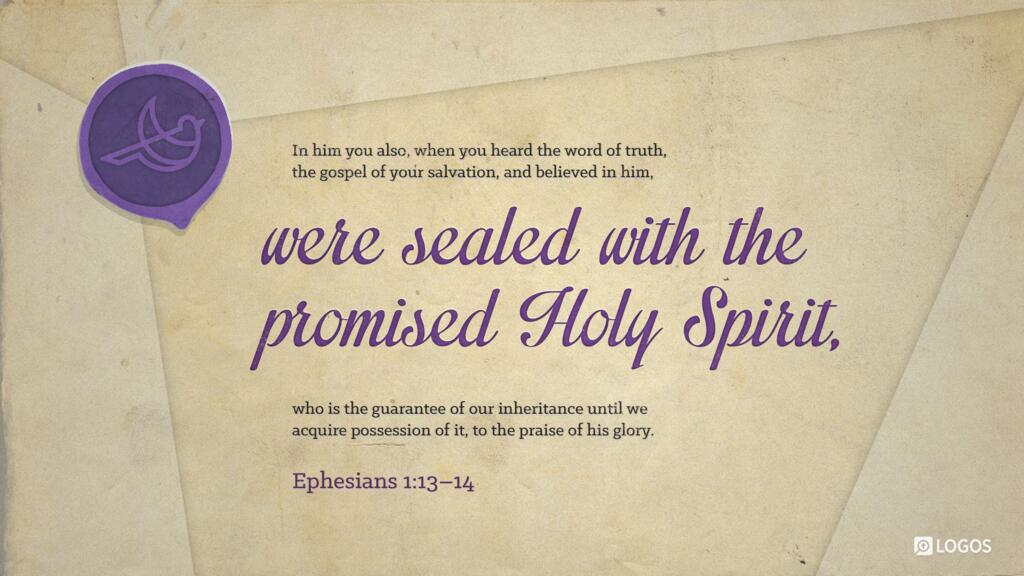
In him you also, when you heard the word of truth, the gospel of your salvation, and believed in him, were sealed with the promised Holy Spirit, who is the guarantee of our inheritance until we acquire possession of it, to the praise of his glory.
For this reason, because I have heard of your faith in the Lord Jesus and your love toward all the saints,
Copyright 2001 Crossway Bibles
NIVNew International Version (2011)
And you also were included in Christ when you heard the message of truth, the gospel of your salvation. When you believed, you were marked in him with a seal, the promised Holy Spirit, who is a deposit guaranteeing our inheritance until the redemption of those who are God’s possession—to the praise of his glory.
For this reason, ever since I heard about your faith in the Lord Jesus and your love for all God’s people,
Copyright 1973, 1978, 1984, 2011 Biblica, Inc.
CSBChristian Standard Bible
In him you also were sealed with the promised Holy Spirit when you heard the word of truth, the gospel of your salvation, and when you believed. The Holy Spirit is the down payment of our inheritance, until the redemption of the possession, to the praise of his glory.
This is why, since I heard about your faith in the Lord Jesus and your love for all the saints,
Copyright 2017 Holman Bible Publishers
NLTNew Living Translation
And now you Gentiles have also heard the truth, the Good News that God saves you. And when you believed in Christ, he identified you as his own by giving you the Holy Spirit, whom he promised long ago. The Spirit is God’s guarantee that he will give us the inheritance he promised and that he has purchased us to be his own people. He did this so we would praise and glorify him.
Ever since I first heard of your strong faith in the Lord Jesus and your love for God’s people everywhere,
Holy Bible, New Living Translation, copyright © 1996, 2004, 2015 by Tyndale House Foundation. Used by permission of Tyndale House Publishers. All rights reserved.
LEBThe Lexham English Bible
in whom also you, when you heard the word of truth, the gospel of your salvation, in whom also when you believed you were sealed with the promised Holy Spirit, who is the down payment of our inheritance, until the redemption of the possession, to the praise of his glory.
Because of this I also, hearing of your faith in the Lord Jesus and your love for all the saints,
Copyright 2012 Lexham Press
KJV 1900King James Version
In whom ye also trusted, after that ye heard the word of truth, the gospel of your salvation: in whom also after that ye believed, ye were sealed with that holy Spirit of promise, Which is the earnest of our inheritance until the redemption of the purchased possession, unto the praise of his glory.
Wherefore I also, after I heard of your faith in the Lord Jesus, and love unto all the saints,
Public Domain