Deuteronomy 8:1–10
The NET BibleOther versions
English
- NET The NET Bible
- DARBY 1890 Darby Bible
- ASV American Standard Version
- AV 1873 The Cambridge Paragraph Bible of the Authorized English Version
- CSB Christian Standard Bible
- D-R Douay-Rheims Bible
- ESV English Standard Version
- GW GOD’S WORD Translation
- GNB Good News Translation
- HCSB The Holman Christian Standard Bible
- KJV 1900 King James Version
- LSB Legacy Standard Bible
- LEB The Lexham English Bible
- MSG The Message: The Bible in Contemporary Language
- NASB95 New American Standard Bible (1995)
- NCV New Century Version
- NIrV New International Reader’s Version (1998)
- NIV New International Version (2011)
- NKJV The New King James Version
- NLT New Living Translation
- NRSVue New Revised Standard Version: Updated Edition
- RSV The Revised Standard Version
- RSVCE The Revised Standard Version, Catholic Edition
- YLT Young’s Literal Translation
Arabic
Czech
French
German
Hebrew
Hungarian
Italian
Korean
Latin
Portuguese
Russian
Simplified Chinese
Spanish
Traditional Chinese
The Lord’s Provision in the Desert
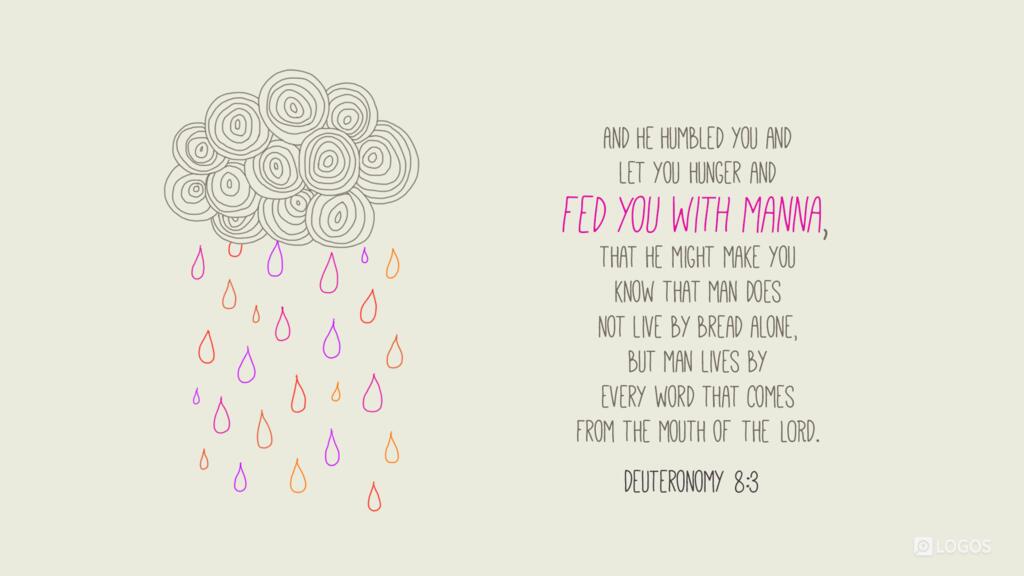
8:1You must keep carefully all these commandments1 I am giving2 you today so that you may live, increase in number,3 and go in and occupy the land that the Lord promised to your ancestors.48:2Remember the whole way by which he5 has brought you these forty years through the desert6 so that he might, by humbling you, test you to see if you have it within you to keep his commandments or not. 8:3So he humbled you by making you hungry and then feeding you with unfamiliar manna.7 He did this to teach you8 that humankind9 cannot live by bread10 alone, but also by everything that comes from the Lord’s mouth.118:4Your clothing did not wear out nor did your feet swell all these forty years. 8:5Be keenly aware that just as a parent disciplines his child,12 the Lord your God disciplines you. 8:6So you must keep his13 commandments, live according to his standards,14 and revere him. 8:7For the Lord your God is bringing you to a good land, a land of brooks,15 springs, and fountains flowing forth in valleys and hills, 8:8a land of wheat, barley, vines, fig trees, and pomegranates, of olive trees and honey, 8:9a land where you may eat food16 in plenty and find no lack of anything, a land whose stones are iron17 and from whose hills you can mine copper. 8:10You will eat your fill and then praise the Lord your God because of the good land he has given you.
Footnotes
- 1 The singular term (מִצְוָה, mitsvah) includes the whole corpus of covenant stipulations, certainly the book of Deuteronomy at least (cf. Deut 5:28; 6:1, 25; 7:11; 11:8, 22; 15:5; 17:20; 19:9; 27:1; 30:11; 31:5). The plural (מִצְוֹת, mitsot) refers to individual stipulations (as in vv. 2, 6).
- 2 Heb “commanding” (so ). For stylistic reasons, to avoid redundancy, “giving” has been used in the translation (likewise in v. 11).
- 3 Heb “multiply” (so , , ); , “increase.”
- 4 Heb “fathers” (also in vv. 16, 18).
- 5 Heb “the Lord your God.” The pronoun has been used in the translation for stylistic reasons.
- 6 Or “wilderness” (so , , ); likewise in v. 15.
- 7 Heb “manna which you and your ancestors did not know.” By popular etymology the word “manna” comes from the Hebrew phrase מָן הוּא (man hu’), i.e., “What is it?” (Exod 16:15). The question remains unanswered to this very day. Elsewhere the material is said to be “white like coriander seed” with “a taste like honey cakes” (Exod 16:31; cf. Num 11:7). Modern attempts to associate it with various desert plants are unsuccessful for the text says it was a new thing and, furthermore, one that appeared and disappeared miraculously (Exod 16:21–27).
- 8 Heb “in order to make known to you.” In the Hebrew text this statement is subordinated to what precedes, resulting in a very long sentence in English. The translation makes this statement a separate sentence for stylistic reasons.
- 9 Heb “the man,” but in a generic sense, referring to the whole human race (“mankind” or “humankind”).
- 10 The Hebrew term may refer to “food” in a more general sense (cf. ).
- 11 Jesus quoted this text to the devil in the midst of his forty-day fast to make the point that spiritual nourishment is incomparably more important than mere physical bread (Matt 4:4; cf. Luke 4:4).
- 12 Heb “just as a man disciplines his son.” The Hebrew text reflects the patriarchal idiom of the culture.
- 13 Heb “the commandments of the Lord your God.” The pronoun has been used in the translation for stylistic reasons to avoid redundancy.
- 14 Heb “by walking in his ways.” The “ways” of the Lord refer here to his moral standards as reflected in his commandments. The verb “walk” is used frequently in the Bible (both OT and NT) for one’s moral and ethical behavior.
- 15 Or “wadis.”
- 16 The Hebrew term may refer to “food” in a more general sense (cf. , , ) or “bread” in particular (cf. , , ).
- 17 A land whose stones are iron. Since iron deposits are few and far between in Palestine, the reference here is probably to iron ore found in mines as opposed to the meteorite iron more commonly known in that area.
The NET Bible First Edition, Copyright 1996-2005 by Biblical Studies Press