Deuteronomy 31:1–11
The NET BibleOther versions
English
- NET The NET Bible
- DARBY 1890 Darby Bible
- ASV American Standard Version
- AV 1873 The Cambridge Paragraph Bible of the Authorized English Version
- CSB Christian Standard Bible
- D-R Douay-Rheims Bible
- ESV English Standard Version
- GW GOD’S WORD Translation
- GNB Good News Translation
- HCSB The Holman Christian Standard Bible
- KJV 1900 King James Version
- LSB Legacy Standard Bible
- LEB The Lexham English Bible
- MSG The Message: The Bible in Contemporary Language
- NASB95 New American Standard Bible (1995)
- NCV New Century Version
- NIrV New International Reader’s Version (1998)
- NIV New International Version (2011)
- NKJV The New King James Version
- NLT New Living Translation
- NRSVue New Revised Standard Version: Updated Edition
- RSV The Revised Standard Version
- RSVCE The Revised Standard Version, Catholic Edition
- YLT Young’s Literal Translation
Arabic
Czech
French
German
Hebrew
Hungarian
Italian
Korean
Latin
Portuguese
Russian
Simplified Chinese
Spanish
Traditional Chinese
Succession of Moses by Joshua
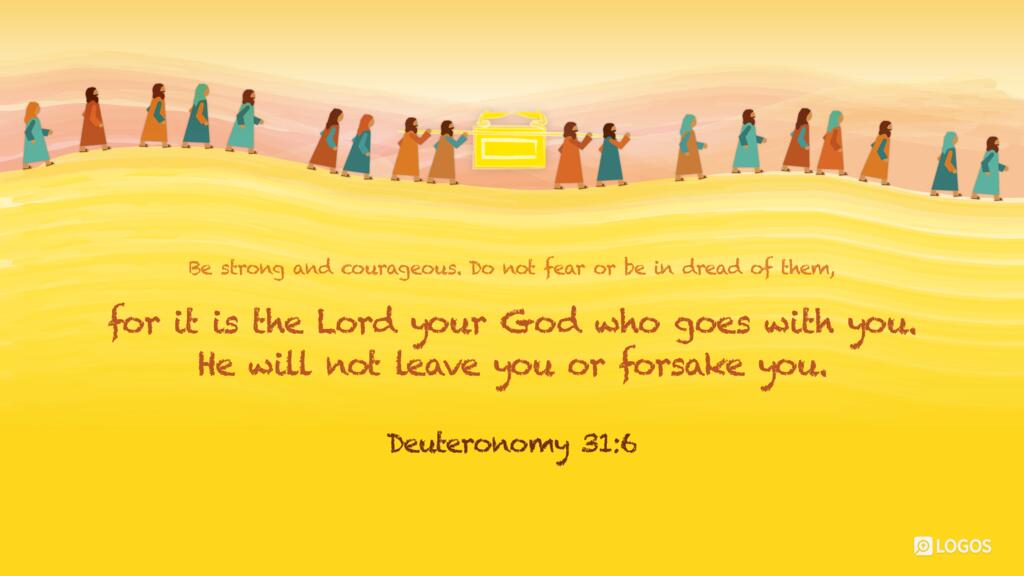
31:1Then Moses went1 and spoke these words2 to all Israel. 31:2He said to them, “Today I am a hundred and twenty years old. I am no longer able to get about,3 and the Lord has said to me, ‘You will not cross the Jordan.’ 31:3As for the Lord your God, he is about to cross over before you; he will destroy these nations before you and dispossess them. As for Joshua, he is about to cross before you just as the Lord has said. 31:4The Lord will do to them just what he did to Sihon and Og, the Amorite kings, and to their land, which he destroyed. 31:5The Lord will deliver them over to you and you will do to them according to the whole commandment I have given you. 31:6Be strong and courageous! Do not fear or tremble before them, for the Lord your God is the one who is going with you. He will not fail you or abandon you!” 31:7Then Moses called out to Joshua4 in the presence of all Israel, “Be strong and courageous, for you will accompany these people to the land that the Lord promised to give their ancestors,5 and you will enable them to inherit it. 31:8The Lord is indeed going before you—he will be with you; he will not fail you or abandon you. Do not be afraid or discouraged!”
The Deposit of the Covenant Text
31:9Then Moses wrote down this law and gave it to the Levitical priests, who carry the ark of the Lord’s covenant, and to all Israel’s elders. 31:10He6 commanded them: “At the end of seven years, at the appointed time of the cancellation of debts,7 at the Feast of Temporary Shelters,831:11when all Israel comes to appear before the Lord your God in the place he chooses, you must read this law before them9 within their hearing.
Footnotes
- 1 For the reading וַיֵּלֶךְ (vayyelekh, “he went”), the and Qumran have וַיְכַל (vaykhal, “he finished”): “So Moses finished speaking,” etc. The difficult reading of the favors its authenticity.
- 2 In the this refers to the words that follow (cf. , ).
- 3 Or “am no longer able to lead you” (, ); Heb “am no longer able to go out and come in.”
- 4 The Hebrew text includes “and said to him.” This has not been included in the translation for stylistic reasons.
- 5 Heb “fathers” (also in v. 20).
- 6 Heb “Moses.” The pronoun has been used in the translation for stylistic reasons.
- 7 The Hebrew term שְׁמִטָּה (shémittah), a derivative of the verb שָׁמַט (shamat, “to release; to relinquish”), refers to the procedure whereby debts of all fellow Israelites were to be canceled. Since the Feast of Tabernacles celebrated God’s own deliverance of and provision for his people, this was an appropriate time for Israelites to release one another. See note on this word at .
- 8 The Hebrew phrase [הַסֻּכּוֹת חַג] ([khag] hassukot, “[festival of] huts” [or “shelters”]) is traditionally known as the Feast of Tabernacles. See note on the name of the festival in . For the regulations on this annual festival see Deut 16:13–15.
- 9 Heb “before all Israel.”
The NET Bible First Edition, Copyright 1996-2005 by Biblical Studies Press